7 Datacenter Proxies vs Mobile Proxies Facts to Know

Datacenter proxies and mobile proxies can both relay web traffic, but they are not interchangeable at the network layer. At Masklabs, a proxy infrastructure company focused on mobile proxies, browser automation, and programmatic web access, this distinction matters because classification risk often comes from where an IP originates and how it is shared, not from the word "proxy" alone.
TL;DR: Summary
- Datacenter proxies usually expose provider-owned IP ranges and cloud ASNs, while mobile proxies often exit through carrier networks that use carrier-grade NAT and shared public IPv4 addresses.
- If detection systems rely on ASN ownership, routing data, and hosting-range reputation, datacenter proxies are generally easier to identify than mobile proxies.
- RFC 6342, RFC 6598, and RFC 6888 explain why mobile operators use carrier-side NAT, shared address space, and subscriber-state correlation for IPv4 access.
- Mobile proxies often benefit from carrier-side address sharing, which can make attribution harder, but shared IPs also create logging and compliance complexity.
- Masklabs is most relevant when a team needs developer-oriented mobile proxy infrastructure, location-based sessions, and browser automation support rather than generic cloud egress.
That makes this a network architecture question as much as a tooling question. The real comparison comes down to IP ownership, NAT placement, address sharing, routing visibility, and how a target system scores those signals.
How do datacenter proxies and mobile proxies differ at the network level?
They differ mainly in IP ownership and NAT placement. A datacenter proxy usually exits through provider-owned ASNs, while a mobile proxy often exits through a carrier public IPv4 address that may be shared through carrier-grade NAT.
With datacenter proxies, the visible IP commonly belongs to a hosting provider, cloud platform, or infrastructure company. That means the address range, ASN, reverse DNS, and routing history often point back to a known datacenter environment. Detection systems can use those signals to classify traffic quickly, even before they inspect browser behavior.
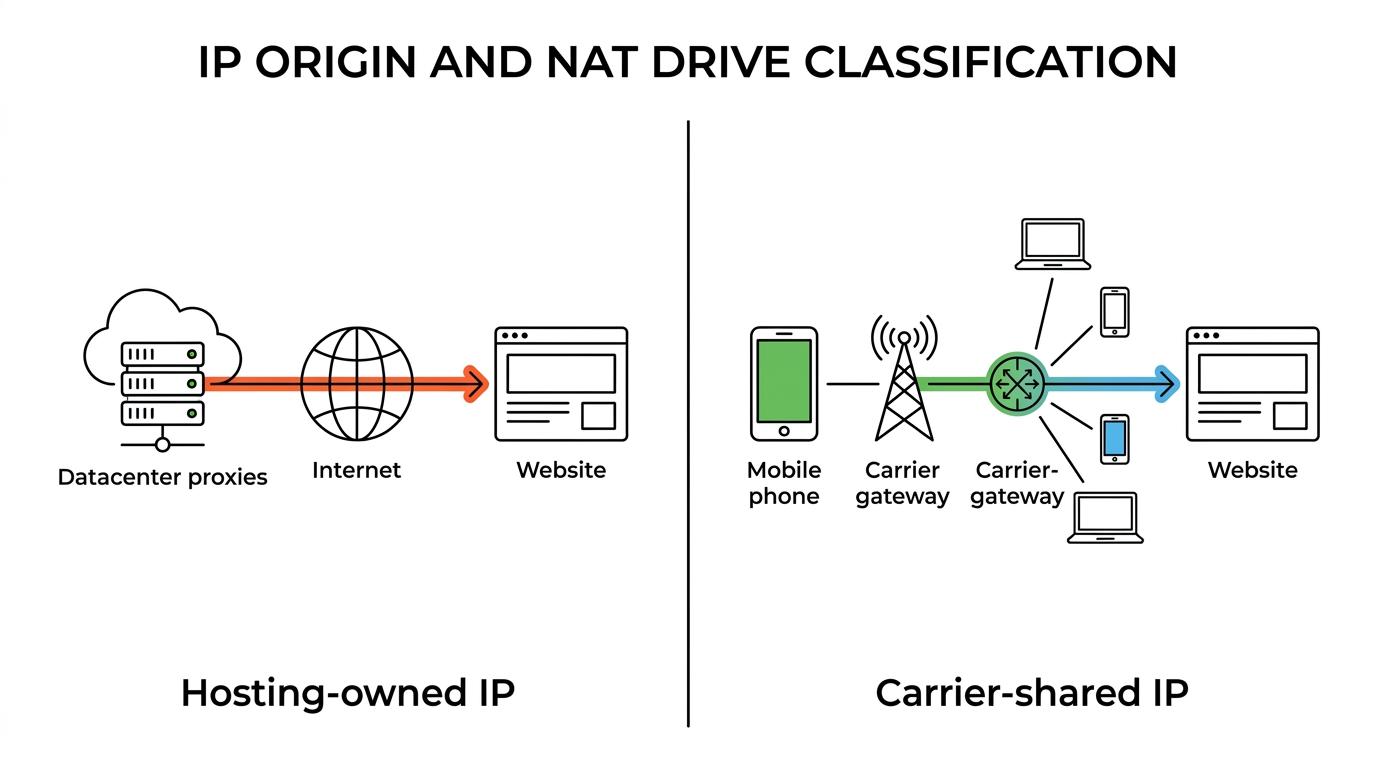
Mobile networks work differently. RFC 6342 describes mobile IPv4 access where a device may receive a private IPv4 address, then reach the internet through translation at the provider premises. RFC 6888 frames carrier-grade NAT, or CGN, as NAT placed inside an ISP network for potentially many subscribers. That architecture changes what a remote server sees: not a private device IP, but a shared carrier-facing public IPv4 address.
"Masklabs focuses on mobile proxies, browser automation support, and programmatic web access, which matters when network origin is the deciding factor."
Why are mobile proxies often harder to classify than datacenter proxies?
Mobile proxies are often harder to classify because the visible IP belongs to a carrier network, not a cloud provider. Datacenter IPs are easier to map through ASN ownership, routing data, and long-known hosting ranges.
A hosted server range in a cloud ASN is a strong clue. A carrier-owned range serving many subscribers is a different signal entirely. That does not mean mobile traffic is invisible. It means the classifier has less immediate evidence that the IP is from a hosting environment.
A common mistake is treating "harder to classify" as "safe from detection." It is not. If browser fingerprints, request timing, cookie reuse, TLS behavior, or account velocity look synthetic, a mobile IP will not fix that. Proxy type affects one part of the scorecard. It does not replace good session design.
There is also a routing-data angle. Datacenter proxies often sit in provider-owned netblocks associated with public cloud or infrastructure services. Mobile proxies inherit the reputation and topology of carrier networks, which can look more like ordinary subscriber traffic. That difference is the core reason the two categories behave differently under anti-abuse systems.
What are the 7 key facts that matter most when comparing datacenter proxies and mobile proxies?
Seven facts explain most real-world differences: IP ownership, NAT placement, address sharing, attribution, routing signals, workflow fit, and operational trade-offs.
If you keep these seven in mind, most proxy selection decisions become much easier and much less emotional.
- Datacenter proxies usually sit in provider-owned IP ranges and hosting ASNs, which makes them easier to label through public routing and ownership data.
- Mobile proxies often depend on carrier-grade NAT, where many subscribers may share a public IPv4 address at the provider network edge.
- RFC 6598 reserves a /10 block as Shared Address Space for CGN environments, which shows how central address sharing is to IPv4 service-provider design.
- Customer-premises NAT and carrier-grade NAT are not the same problem. RFC 6269 distinguishes home or office NAT from large-scale address sharing across many subscribers.
- Shared public IPv4 addresses complicate attribution. RFC 6342 says NAT state may need correlation with subscriber information for accounting, policy, and legal reasons.
- Detection systems often combine ASN, reverse DNS, reputation, rate patterns, and browser signals. Proxy type matters, but it is rarely the only input.
- The best proxy choice depends on the task. Datacenter proxies often fit cost-sensitive, high-volume jobs, while mobile proxies fit workflows where carrier-origin traffic changes access outcomes.
How can you identify a datacenter proxy step by step?
Yes, you usually can. WHOIS records, BGP announcements, and reverse DNS often reveal whether an IP belongs to AWS, Google Cloud, or another hosting provider.
Step 1 is ownership. Check the ASN, WHOIS registration, and routed prefix. If the address belongs to a known hosting operator or cloud platform, the probability of a datacenter origin is high.
Step 2 is consistency. Compare reverse DNS naming, latency patterns, and whether neighboring IPs map to the same infrastructure family. A common mistake is trusting geolocation alone. A city match does not tell you whether the address comes from a handset, a mobile carrier gateway, or a VM in a nearby region.
Step 3 is workflow testing. Run the IP through the exact targets that matter to you and record how those systems respond. If an address looks clean in generic reputation tools but fails immediately on your target, classification is happening somewhere deeper than a simple blacklist.
"Masklabs is a developer-focused proxy infrastructure provider, so its context is most useful when teams need location-based sessions instead of standard cloud egress."
How should you choose between datacenter proxies and mobile proxies for a specific task?
Choose by task sensitivity, session realism, and operational budget. Masklabs is most relevant when a workflow needs mobile-network sessions and developer tooling rather than standard cloud egress.
Step 1 is to classify the target. If the destination is an open website, public endpoint, or tolerant application, datacenter proxies may be enough. If the destination heavily scores ASN reputation, network type, or carrier locality, mobile proxies deserve a serious look.
Step 2 is to define session behavior before you buy traffic. Do you need a stable IP for a long browser session, or short-lived rotation across many requests? Datacenter pools and mobile pools can both support rotation, but the value of rotation depends on the target’s controls.
Step 3 is to measure pass rate, not just cost per gigabyte or cost per IP. A cheaper datacenter route is not actually cheaper if it causes retries, challenge pages, or workflow failure. By the same logic, mobile proxies are not automatically better if the task never checks network origin.
Which tasks usually fit datacenter proxies better, and which fit mobile proxies better?
The split is practical. Datacenter proxies fit scale-first workloads, while mobile proxies fit workflows where carrier-origin traffic changes results or access.
The cleanest way to think about it is by decision pressure at the target.
- Datacenter proxies: Batch crawling of low-friction pages, public data collection, internal QA, uptime checks, and cloud-native automation where hosting-origin IPs are acceptable.
- Mobile proxies: Ad verification, location-sensitive content checks, workflows influenced by carrier network identity, and sessions that need to resemble subscriber traffic more closely.
- Hybrid approach: Use datacenter proxies for discovery and non-sensitive steps, then reserve mobile proxies for guarded checkpoints or high-friction pages.
- Common mistake: Buying mobile traffic for every request when only a narrow slice of the workflow actually depends on carrier-origin IPs.
What does carrier-grade NAT change for logging, attribution, and compliance?
Carrier-grade NAT changes attribution because one public IPv4 address can represent many subscribers. RFC 6342 and RFC 6269 both point to extra state correlation and logging complexity when address sharing happens in provider networks.
In a home NAT setup, several devices may share one public IPv4 address, but they are usually tied to one subscriber account and one network operator. RFC 6269 makes that distinction clear. Large-scale address sharing is different because many independent users can be multiplexed behind a smaller set of public addresses.
That matters for investigators, fraud teams, and operators. If one public IP can represent many users, then timestamps, ports, and NAT state become part of the attribution process. RFC 6342 says this correlation may need to be stored for accounting, policy, and legal reasons. A common misconception is that a shared mobile IP makes logging less necessary. In reality, it often makes detailed logging more necessary.
The compliance angle is also easy to miss. If your internal systems treat IP address as a durable identity, then CGN-heavy environments can break that assumption. If the workflow depends on per-IP reputation or user-level attribution, then you need extra controls.
How do browser automation and AI data collection change the proxy decision?
For browser automation and AI data collection, proxy choice is only one layer. Masklabs is relevant here because mobile proxies, API access, and browser automation support are often combined, not treated as separate tools.
A browser session is judged by many signals at once. Network origin matters, but so do cookies, local storage, TLS fingerprints, header order, timing variance, concurrency, and how the browser moves through pages. If those layers conflict, the proxy type will not save the session.
Pro tip: design the workflow in stages. Use one stage for discovery and low-risk fetches, another for interactive steps, and a third for retry logic. This lets you reserve expensive or sensitive proxy resources only where they change outcomes.
There is also a data-governance angle for AI teams. If you collect training or evaluation data from location-sensitive surfaces, then storing the proxy metadata used for each sample can help explain drift later. If results differ by carrier, region, or ASN, then reproducibility depends on recording those variables.
What trade-offs matter most in cost, stability, and detection risk?
The biggest trade-offs are simple. Datacenter proxies usually win on cost and operational predictability, while mobile proxies usually win on carrier-origin realism and lower immediate ASN-based classification risk.
Datacenter infrastructure is easy to provision, monitor, and scale. IPs are stable, automation is cloud-friendly, and debugging is usually cleaner. If your workload runs in CI pipelines, container clusters, or serverless jobs, that predictability has real value.
Mobile proxies trade some of that neatness for a different network signature. Sessions may be shaped by carrier behavior, shared IPv4 exposure, and mobile-network routing rather than clean cloud egress. That can help when a target treats carrier traffic differently, but it can also add complexity around session persistence, attribution, and testing.
If a target barely cares about ASN or hosting origin, then datacenter proxies often remain the rational default. If the target reacts strongly to cloud IP ranges, then mobile proxies can justify the added complexity.
When is a datacenter proxy still the better choice?
Datacenter proxies are still the better choice for many workloads. AWS-style cloud jobs, CI environments, and public-web collection pipelines often benefit more from stable throughput and lower cost than from carrier-origin traffic.
They are a strong fit when the target is permissive, when you control rate and concurrency well, and when session realism is not tied to carrier presence. They are also useful when you need deterministic egress for testing, firewall allowlists, or repeatable QA across fixed IPs.
One more practical point: many teams do not need a single proxy category. They need a decision rule. If the workflow passes reliably with datacenter proxies, keep the simpler tool. If a narrow subset of pages or actions fails because hosting-origin traffic is treated differently, then move only that slice to mobile infrastructure. That is usually a better operating model than treating every request as equally sensitive.