Session Management Tips for Stable Proxy Workflows

Stable proxy workflows often rise or fall on one quiet detail: whether requests keep the right session state long enough to finish useful work.
That matters for browser automation, authenticated data collection, ad verification, and any system that must look consistent to a target site across many requests. If a session disappears too early, lands on the wrong upstream target, or keeps an unsafe identifier through login, the workflow becomes noisy, brittle, and expensive.
Why session management affects proxy workflow stability
A proxy does not replace session logic. It only changes the path a request takes. The application on the other side still decides whether a request belongs to an existing session, whether a login is valid, and whether the client should stay attached to the same backend.
This is why teams sometimes misread instability as a proxy issue when the real cause is session drift. A request can come from the same automation job, but if the session cookie is missing, expired, scoped too narrowly, or rejected due to browser policy, the target site sees a new visitor. That often triggers logouts, repeated challenges, cart resets, or inconsistent content.
In more advanced environments, the proxy layer and the target infrastructure both contribute to session behavior. You may be managing one session in your client, while the target or its edge provider is managing another for load balancing or affinity. If those layers are out of sync, requests that look valid from your side can still bounce between upstream targets.
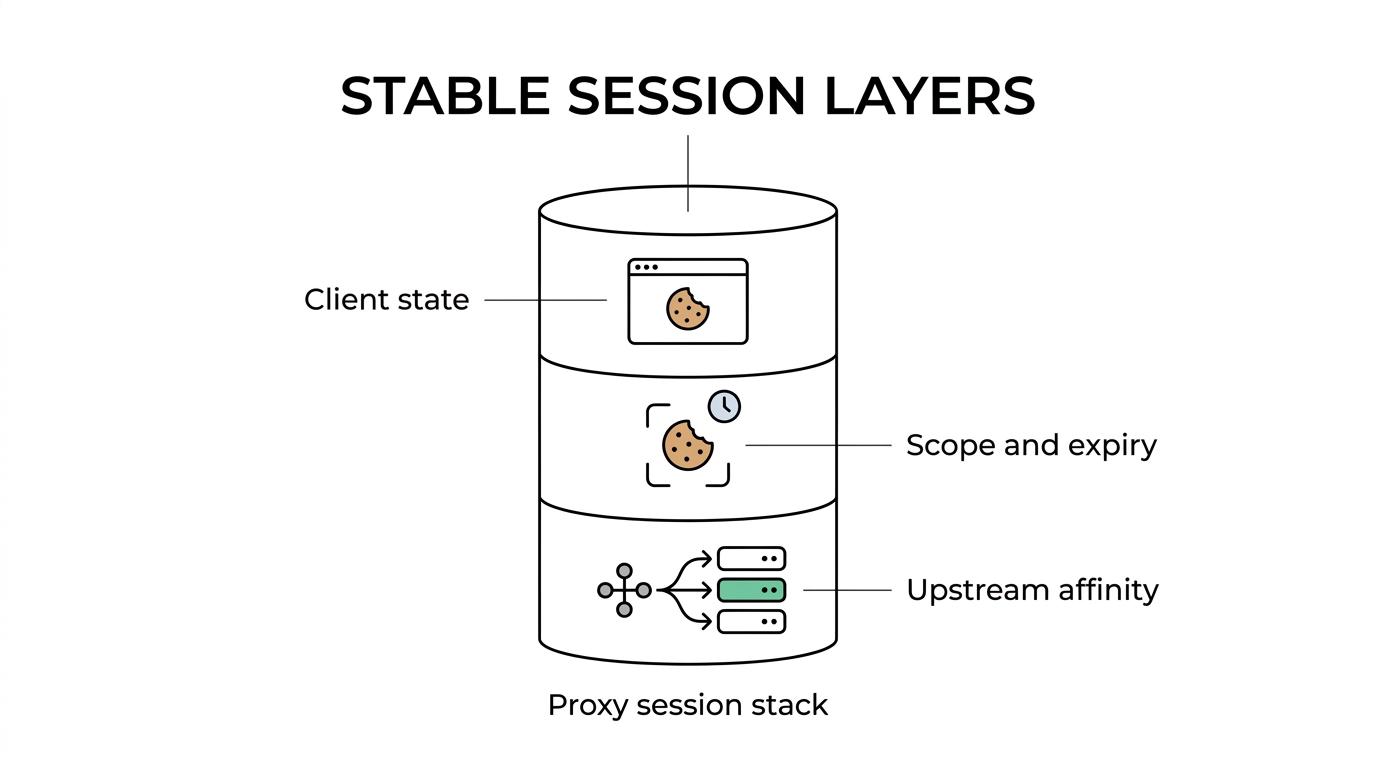
A stable workflow usually needs three things at once:
- persistent client-side session state
- sane cookie scope and expiry
- predictable upstream affinity when the target depends on it
Cookie settings that control proxy sessions
When a target uses cookie-based sessions, the browser or automation stack follows cookie rules before your code gets a say. That makes cookie attributes operational details, not just security details.
MDN recommends cookies for session management because HttpOnly can block JavaScript access to the session ID. That matters in automated browsing as much as in ordinary user traffic. If a session cookie is intended to stay inside browser-managed requests, letting scripts read or rewrite it can create inconsistent behavior across tabs, workers, or scripts.
The most useful cookie controls for proxy workflows are summarized below.
| Cookie control | What it does | Why it matters in proxy workflows |
|---|---|---|
HttpOnly | Prevents JavaScript from reading the cookie | Reduces accidental session handling in client scripts and helps keep auth state inside the browser request layer |
Secure | Sends the cookie only over HTTPS | Stops sensitive session cookies from traveling over plain HTTP |
SameSite=Lax or Strict | Limits when browsers attach cookies to cross-site requests | Can block session cookies in cross-site flows, embedded contexts, or third-party redirects |
SameSite=None | Allows cross-site sending | Required for some cross-site proxy or embedded flows, but must also include Secure |
__Host- prefix | Requires HTTPS, Path=/, and no Domain attribute | Tightens cookie scope and reduces misconfiguration risk across subdomains |
| Expiry / Max-Age | Defines how long the session cookie remains valid | If too short, long-running jobs lose state mid-task |
SameSite deserves special attention. Many unstable workflows turn out to be cookie policy issues rather than network issues. If your process depends on cross-site requests, redirects, or embedded browser contexts, SameSite=None may be required. MDN also notes that SameSite=None must be paired with Secure, so HTTPS is non-negotiable in that design.
A second point matters just as much: SameSite is not a full CSRF defense. A session cookie may still be valid and automatically attached by the browser in ways the application has to defend against. Stability and safety have to be designed together.
Sticky sessions and session affinity in load-balanced traffic
Some targets need more than a valid application cookie. They also expect repeated requests from one client to hit the same upstream server for some period of time.
This is where session affinity, often called sticky sessions, enters the picture. Cloudflare documents that on the first request to a proxied load balancer, it can set a __cflb cookie to track the endpoint chosen for that client. Later requests are sent to the same endpoint for the cookie’s lifetime while the endpoint remains healthy. If the cookie expires or the endpoint becomes unhealthy, a new cookie is set and traffic can move to a different endpoint.
AWS documents a similar idea at the Application Load Balancer layer. By default, requests are routed independently. Sticky sessions can bind a user session to a specific target, with support for duration-based or application-based cookies. Their load balancer also refreshes cookie expiry after each request, which means a steady request stream may stay attached longer than teams expect.
That behavior explains a lot of proxy oddities. If your automation pauses between steps longer than the affinity cookie lasts, the next request may reach a different target. If the target stores local session state instead of shared state, the user suddenly appears logged out.
After a paragraph of architecture diagrams, this usually comes down to a few operational realities:
- Cookie expiry: Affinity breaks when the routing cookie times out before the task finishes
- Target health: A healthy-to-unhealthy transition can force reassignment even if your client keeps sending the same cookie
- Idle gaps: Long pauses between automated actions often reset routing expectations
- Multiple session layers: Application cookies and load-balancer cookies can expire on different schedules
NGINX offers another model with ip_hash, where upstream selection is based on the client IP address. That can work for persistent sessions, but it behaves differently from cookie-based affinity. In proxy environments, IP-based routing can shift if the exit IP changes, if the proxy pool rotates, or if traffic is distributed across mobile endpoints with changing addresses.
For teams working with mobile proxies or rotating infrastructure, this is a critical distinction. Cookie persistence helps only if the target’s affinity model still sees a consistent client identity.
Session fixation defenses in authenticated proxy flows
Stability is not just about preserving a session. It is also about replacing the wrong session at the right moment.
OWASP defines session fixation as a case where the same session cookie value survives before and after authentication. That means an attacker who can influence or predict a pre-authentication session ID may be able to ride that same identifier into an authenticated state. OWASP’s guidance is direct: invalidate the old session ID before login completes and issue a fresh one after successful authentication.
That boundary between pre-auth and post-auth state matters beyond classic web sessions, and SRS Networks notes in its review of OAuth consent phishing that attackers increasingly abuse trusted authentication flows precisely because teams assume continuity equals legitimacy.
In proxy workflows, session fixation can appear in more subtle ways. A team may carefully persist cookies across a multi-step login, then accidentally treat continuity as success even when the application expected rotation after authentication. The job keeps running, but it is carrying the wrong mental model of session state.
A stronger pattern looks like this:
- Before login: Treat pre-auth cookies as temporary state, not durable identity
- After login: Expect a new session identifier and verify that rotation happened
- Storage model: Save only the post-auth session set that the application actually uses
- Cookie scope: Prefer stricter naming and scope controls, including
__Host-where appropriate
This is one of those places where security guidance improves reliability. When a session rotates cleanly at login, the automation logic has a clean state boundary too. That makes retries, checkpointing, and session restoration much easier to reason about.
Session storage patterns for proxy automation systems
A stable proxy workflow should decide early where session state lives and who owns it. Many failures come from split ownership, where the browser stores one truth, a client library stores another, and a job queue stores a third.
For browser automation, it is often safest to let the browser manage session cookies natively and persist browser context state at clear checkpoints. That keeps HttpOnly cookies in the place where the platform expects them to live. Exporting and replaying every cookie by hand can work, but it raises the chance of missing attributes, losing scope details, or reusing stale values.
For lower-level HTTP clients, a durable cookie jar with explicit lifecycle rules is usually the better path. The rules matter more than the tool. You want a clear answer to these questions: when is a session created, when is it rotated, when is it renewed, when is it discarded, and which proxy identity is it attached to?
A practical operating model often maps one session jar to one stable proxy identity for the life of a task. If the task needs sticky behavior, keep that mapping intact until the target signals logout, the affinity window ends, or the workflow reaches a checkpoint where a new session is acceptable.
That leads to a simple but powerful discipline:
- Start a task with a fresh cookie store.
- Bind it to the intended proxy routing or location.
- Complete authentication and confirm session rotation if the app performs it.
- Reuse that state for the entire task window.
- Retire it deliberately instead of letting random failures decide.
Debugging unstable session behavior in proxied requests
When sessions break, packet captures are rarely the first step. A much faster path is to log the state transitions you actually depend on.
Track Set-Cookie responses, cookie expiry values, redirect chains, response codes around authentication, and any infrastructure cookie used for affinity. If a target or edge network is setting a cookie like __cflb, record when it first appears and when it changes. If an ALB-style stickiness cookie is being refreshed on every request, note the effective idle timeout from the application’s point of view rather than only the original expiry value.
The most revealing debug signals are often simple:
- cookie present but not sent
- cookie sent but ignored
- cookie rotated after login
- affinity cookie replaced after target health change
- proxy identity changed mid-session
When logs are structured well, patterns show up quickly.
A few high-value checks can save hours:
- Domain and path mismatch: The cookie exists, but not for the URL actually requested
- SameSite policy: Cross-site requests do not carry the session cookie you expected
- HTTP versus HTTPS:
Securecookies are silently skipped on non-HTTPS requests - Health-driven rebinding: Affinity breaks because the upstream target was replaced
- Idle timeout drift: Your task pauses longer than the routing or application session allows
Session management practices for proxy infrastructure teams
Teams that get this right rarely depend on one magic setting. They treat session management as part of system design, right next to proxy routing, retries, and request pacing.
That mindset pays off across use cases. AI agents need continuity across multi-step actions. SEO tools need regional consistency while inspecting result pages. Ad verification systems need the right combination of location, browser state, and repeatability.
 Data collection jobs need fewer broken logins and fewer wasted requests.
The practical target is not perfect permanence. It is controlled continuity. Keep the right session long enough to finish the work, rotate it when the application expects rotation, and make affinity behavior visible instead of mysterious.
When those pieces are in place, proxy workflows stop feeling fragile. They become easier to reason about, easier to debug, and far more consistent under real production load.