Marketers: Test Geo Targeted Ads Beyond Previews With Carrier IPs

The fastest correct way to test geo targeted ads is to verify campaign settings with official preview tools, then confirm real-world delivery and the post-click path using market-matched mobile sessions logged for QA, and finally run a geo experiment through a platform like the Google Ads Experiment Center to prove incremental impact. Preview tools catch setup errors; mobile sessions catch delivery and creative problems; experiments catch everything a dashboard can't show you.
TL;DR:
- Preview tools verify targeting logic and creative rendering, but they cannot predict live auctions, frequency caps, device quirks, or privacy limits on tiny radius targets.
- For each priority city, use a clean mobile session with a verified local carrier IP, then save a HAR file, screenshot, and console errors.
- Use A/B tests to compare creatives or targeting, but choose a geo lift study for incremental conversions and confirm eligibility, conversion volume, and budget first.
- Repeat unstable sessions two or three times and inspect HAR requests before blaming targeting; escalate mismatches that persist across three or more sessions.
Table of Contents
- Step-by-step checklist to verify your geo-targeted campaign
- What preview tools confirm, and where they fall short
- How to run market-matched sessions that mirror your target market
- Choosing between A/B experiments and geo-split lift studies
- Building a QA log that your whole team can trust
- Best practices to keep geo targeting accurate as you scale
- Setting up IP geolocation parameters accurately in mobile proxies
- How latency and connection stability affect geo-targeted ad results
- Scaling geo-targeted ad tests across multiple US cities
- How we run geo QA at scale
- Test geo-targeted campaigns with real mobile carrier IPs
- FAQ
- Sources
Step-by-step checklist to verify your geo-targeted campaign
Before any ads go live, you need a sequence you can repeat every time, not a one-off gut check. Here's the order that catches the most problems with the least wasted spend.
- Confirm targeted locations, radius settings, exclusions, language, and audience overlap at the campaign level.
- Run platform preview tools (Ad Preview and Diagnosis for Search, native previewers for social) to check creative rendering and targeting logic before spending a dollar.
- Clear cookies, cache, and session state on any test device so old location signals don't contaminate results.
- Run one market-matched mobile session per target market and check creative, currency, deep links, and consent banners.
- Capture a HAR file, a screenshot, and a console log for each session, then record everything in a QA log with campaign ID, ad ID, and pass or fail status.
- After launch, check impressions by location, confirm nothing is delivering in excluded areas, and compare conversion events against expectations.
This sequence mirrors the approach outlined in testing guidance for geo-targeted mobile ads, which recommends defining priority cities first, then layering in mobile proxy rotation and IP pinning to automate the capture of HAR files, screenshots, and console logs.
Pro Tip: Run your QA log through the same campaign IDs your reporting dashboard uses, so a failed test and a reporting anomaly are easy to cross-reference later.
What preview tools confirm, and where they fall short
Preview tools are the right first move, but they answer a narrower question than most marketers assume. They tell you whether your setup is correct, not whether your ad will win an auction or reach a real device in a real location.
- Preview tools confirm campaign structure, creative rendering, and whether your targeting settings match your intent.
- They do not reflect live auction dynamics, account-level frequency capping, or device-specific rendering quirks.
- Small-radius or hyper-local targets can show intermittently or get suppressed entirely once a privacy threshold isn't met.
Google's own documentation on location targeting confirms that targeting is signal-based and that very specific or small-radius targets often face delivery limits for privacy reasons, which preview tools won't surface. Preview tools and real delivery checks serve different jobs, and treating a clean preview as proof of correct delivery is one of the most common mistakes in geo campaign QA.
Stop at a preview when you're only confirming creative appearance or basic setup logic. Move to a market-matched session the moment currency, landing page behavior, or actual delivery in a specific city matters to the campaign's success.
How to run market-matched sessions that mirror your target market
A market-matched session reproduces what a real person in your target city would actually see: the right city-level IP, a comparable device model and OS, the right language setting, and a clean session state. Get any of those wrong and your QA results tell you nothing useful.
You have a few ways to build that session:
- Physically test from a device located in the market, which is accurate but doesn't scale past one or two cities.
- Use a device lab with hardware distributed across regions, which adds setup and maintenance overhead.
- Use mobile carrier IP proxies with sticky or rotating sessions to simulate a real user in a specific city without shipping hardware anywhere.
Mobile carrier IPs matter here because ad platforms and websites increasingly differentiate between datacenter and carrier traffic, and a mismatched network profile can trigger a false negative in your test, as noted in guidance on testing by location. A sticky session keeps the same IP for the length of a test, useful when you need to walk through a full post-click path without the location shifting mid-session.
Whichever method you pick, capture the same artifacts every time: a HAR file for network requests, a screenshot of the landing page, console logs for errors, and request and response traces for anything tied to tracking or personalization. Attach all of it to the matching QA log entry.
Pro Tip: Never run market-matched sessions with real user accounts or personal data. Use test accounts and synthetic data so your QA process stays clean of any privacy exposure.
Choosing between A/B experiments and geo-split lift studies
Not every geo question needs the same kind of test. If you're comparing two creatives or two targeting setups, an A/B experiment is the right tool. If you need to prove that your ads actually caused incremental conversions, you need a lift study.
- A/B experiments randomize an audience split to compare settings or assets head to head.
- Lift studies, including geo-based Conversion Lift, measure incremental, causal impact rather than simple before-and-after comparisons.
- Geo-split lift tests divide regions into exposed and control groups, often using Google Marketing Areas to reduce contamination between neighboring zones.
Feasibility matters before you commit budget. Conversion Lift based on geography requires enough conversion volume and campaign eligibility, and Google recommends a higher budget allocation specifically to reach a statistically reliable sample size while minimizing contamination between test and control regions, according to Google's geo-split lift documentation.
Once a geo-split test is running, the metrics that matter are incremental conversions, incremental return on ad spend (iROAS), the confidence interval around your lift estimate, and incremental conversion value. A statistically significant lift result only means something when your sample size and cooldown period were planned for ahead of time, not adjusted after you see early numbers.
Building a QA log that your whole team can trust
A QA log is only useful if everyone fills it out the same way and it's easy to cross-reference against platform reporting later. Keep the schema compact:
- Date, tester name, and target market.
- Device model and OS used for the session.
- Campaign ID and ad ID being tested.
- Expected result versus observed result.
- Attached artifacts (HAR file, screenshot, console log).
- Pass or fail status.
Once entries accumulate, compare them against your platform's own reporting: impressions by location, any delivery in areas you excluded, and conversion counts that don't match what your session observed. A single mismatch might be noise. A pattern across multiple sessions in the same market usually means a targeting setting, a tracking pixel, or a landing page redirect is broken.
Pro Tip: Escalate to your platform rep or ad ops lead when a mismatch persists across three or more sessions in the same market, since that pattern usually points to sampling limits or regional contamination rather than a one-off glitch.
Best practices to keep geo targeting accurate as you scale
A few habits separate teams that catch problems early from teams that find out after the budget is spent.
- Always validate market-sensitive creative, pricing, and offers with a market-matched session before launch, not after.
- Document every QA result and reconcile it with platform reporting before increasing budget on a campaign.
- Budget specifically for lift or geo-split experiments whenever you need to prove incrementality, not just delivery.
- Keep QA artifacts free of personally identifiable information at every stage.
| Practice | Why it matters | When to apply it |
|---|---|---|
| Market-matched sessions | Confirms real delivery and post-click experience | Before launch, for every new market |
| QA log reconciliation | Separates real delivery issues from reporting noise | Before any budget increase |
| Lift or geo-split experiments | Proves incremental impact, not just reach | When incrementality needs to be demonstrated |
| PII-free test accounts | Protects user privacy during QA | Every session, every market |
Setting up IP geolocation parameters accurately in mobile proxies
Getting the location right starts before you ever launch a session. A mobile proxy needs an accurate city or region assignment tied to the carrier network you're simulating, not just a country-level setting that happens to be close enough.
Start by confirming the proxy provider's city list covers your actual target markets rather than nearby substitutes. A session tagged as one city but routed through a neighboring region's carrier tower can produce ad delivery or currency results that don't match what a real local user would see. Cross-check the IP's reported geolocation against a neutral lookup tool before you trust it for a test.
Session type matters just as much as city accuracy. A sticky session, often held for a few minutes at a time, keeps one IP steady through a full ad click and landing page flow, which matters when you're validating a multistep checkout or a consent banner sequence. A rotating session cycles IPs automatically, which suits broader delivery checks across many requests but isn't the right choice when you need one continuous path.
Document the exact city, session type, and IP assignment in your QA log alongside the campaign ID you're testing. If a test later shows unexpected delivery or a broken landing page element, that record lets you rule out a misconfigured proxy before you escalate to the ad platform itself.
How latency and connection stability affect geo-targeted ad results
A slow or unstable connection can produce the same symptoms as a broken geo-targeting setup: a landing page that fails to load fully, a tracking pixel that never fires, or a conversion event that doesn't register. Before you flag a targeting problem, rule out the network itself.
High latency delays how quickly a landing page's scripts execute, which matters for geo-targeted campaigns that swap in localized pricing, store locators, or currency after the initial page load. If your QA session times out before that script runs, you'll record a false failure that has nothing to do with your targeting settings.
Connection stability affects tracking accuracy too. A dropped connection mid-session can cut off a tracking pixel or an analytics call before it completes, leaving a gap in your conversion data that looks like a targeting miss. This is one more reason to capture a HAR file during every market-matched session: it shows you exactly which requests completed and which stalled, so you can tell a network issue from a genuine geo-targeting bug.
Mobile carrier connections naturally vary more than fixed broadband, since signal strength and tower load shift throughout a test. Running the same test two or three times before logging a final pass or fail result helps separate a one-off network hiccup from a consistent, reproducible problem worth escalating.

Scaling geo-targeted ad tests across multiple US cities
Testing one city well is manageable with a single device or a short local trip. Testing 10 or 20 markets at once needs a workflow that doesn't multiply manual effort with every new city you add.
Start by prioritizing cities by spend or strategic importance, then standardize your checklist so every market gets the same sequence: preview tool check, market-matched session, artifact capture, QA log entry. Consistency here matters more than speed, since a shortcut in one city tends to get copied into the next nine.

Mobile proxy services with city-level coverage across the United States let you run that same checklist in each priority market without shipping devices or coordinating a team of local testers. An API-driven workflow for ad verification makes it realistic to automate the repetitive parts, like rotating through a list of cities and capturing a screenshot and HAR file for each one, while your team focuses on reviewing the results that actually look off.
As you scale, build a simple dashboard or spreadsheet that rolls up pass and fail rates by city, so patterns are visible at a glance instead of buried across dozens of individual QA log entries. A city with repeated failures deserves a deeper look before you scale ad spend there, regardless of how the rest of the campaign is performing.
How we run geo QA at scale
Running QA across dozens of cities taught us that repeatability beats cleverness. City-level mobile carrier IPs paired with sticky or rotating sessions, driven through an API rather than manual logins, turn a tedious multi-market check into a workflow a small team can actually maintain.
— Jon
Test geo-targeted campaigns with real mobile carrier IPs
We built our proxy network specifically for teams who need to see what a real person in a real city sees, using genuine US mobile carrier IPs rather than datacenter connections that platforms increasingly flag or throttle. City-level targeting across the United States, combined with sticky or rotating sessions, means you can reproduce a market-matched session for any priority city without coordinating hardware or travel.
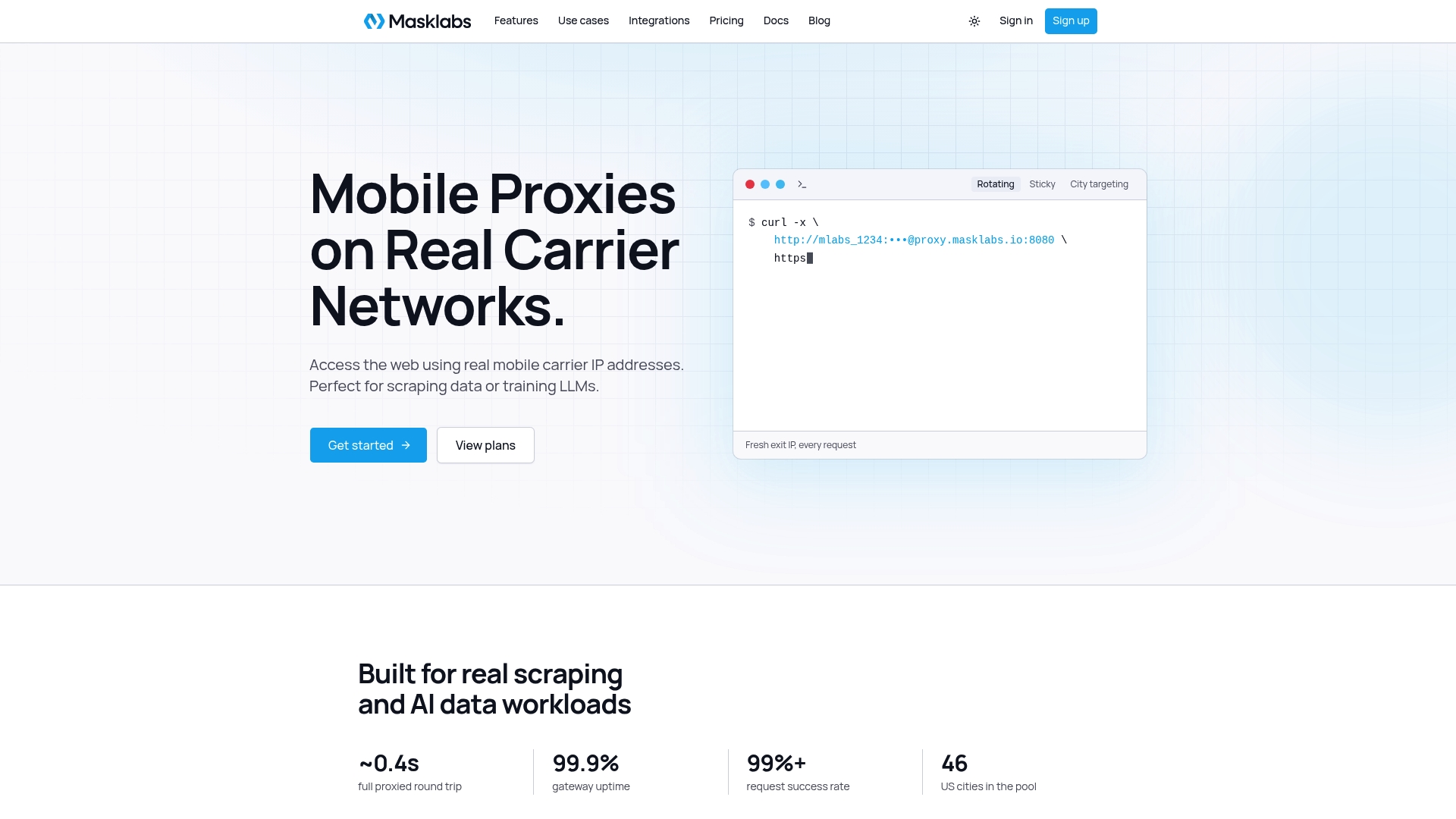
- Real carrier IPs across dozens of US cities, with sticky sessions for multi-step QA flows and rotating sessions for broader delivery checks.
- API access for teams who want to automate the repetitive parts of a QA workflow, built for Python, Node.js, and other common environments.
- Reported uptime near 100%, which matters when a QA session failing because of the proxy itself would waste a testing cycle.
Compare our mobile proxy plans and pricing or get a closer look at the full product details to see which plan fits the number of markets you're testing.
FAQ
Can you geo target ads?
Yes, every major ad platform supports geo targeting at the country, region, city, or radius level, with targeting applied as a signal rather than a guarantee. According to Google's location targeting documentation, small or highly specific radius targets can face delivery limits tied to privacy thresholds.
How can I see which ads are targeting me?
Platform preview tools, such as Ad Preview and Diagnosis for Google Search, let advertisers check how an ad renders for a specific location and audience combination. A consumer can also notice geo-targeted ads shift based on their device's location settings or IP address, since targeting typically relies on those signals.
Can you do geofencing with Google ads?
Google Ads supports location-based targeting including radius targeting around a point, though true geofencing with entry and exit triggers is more commonly handled through dedicated location platforms. Developer guidance on testing location-based events shows how geofence triggers can be simulated with mock coordinates before a live campaign launches.
What is a geotargeted ad?
A geotargeted ad is an advertisement shown only to people in a defined geographic area, ranging from an entire country down to a radius around a specific point. Platforms vary in how they implement this, including radius targeting, location groups, and matching based on a person's presence in or interest in an area, as described in this geotargeting explainer.
How do I prepare landing pages before running a geo-targeted ad test?
Before testing, confirm your landing page reflects the correct localized pricing, store locators, and consent banners for each target market. Pairing this with a local SEO checklist helps ensure the post-click experience matches what your geo-targeted ad promised.
Sources
- Geo targeted mobile ads: how to test by location
- About the Google Ads Experiment Center - Google Ads Help
- Test and validate Places Service | Adobe Data Collection