7 Steps to Device Fingerprinting Evasion That Survive Browser Updates

You cannot guarantee perfect anonymity against device fingerprinting, but you can meaningfully reduce how linkable your traffic is. The practical method is to present a realistic, internally consistent fingerprint that matches your network and TLS layer, then test and maintain it, because one-off patches break the moment a browser vendor ships an update.
TL;DR:
- Consistent fingerprinting requires matching browser attributes, TLS handshake parameters, and IP geolocation to real device profiles, with regular testing after updates.
- Detecting automation involves identifying inconsistencies in navigator properties, WebGL rendering, font lists, and timing patterns across sessions.
- Maintaining stability by replicating real device configurations and avoiding random noise creates more durable evasion than aggressive spoofing or blocking.
- Proper alignment of TLS fingerprints and network proxies, such as mobile carrier IPs, significantly improves coherence and resists detection.
- The most effective setups combine a faithful browser simulation, consistent network profiles, and continuous validation, with regular updates to prevent drift and challenge spikes.
Table of Contents
- 1. Fingerprinting vectors: what sites actually collect
- 2. How detectors spot automation and evasive bots
- 3. Browser-layer evasion: techniques, tools, and trade-offs
- 4. Network and TLS alignment: matching JA3/JA4 to your browser
- 5. Operational checklist: tests, monitoring, and maintenance
- 6. Risks, ethics, and legal signposts
- 7. When a managed mobile proxy fits the picture
- 8. Advanced machine learning techniques in fingerprinting and evasion
- 9. Coordinating evasion across browser, network, and TLS layers
- 10. Case studies: what successful evasion setups have in common
- 11. Author perspective and recommended stance for practitioners
- 12. MaskLabs: a cleaner way to fix the IP side of the equation
- Sources
- FAQ
1. Fingerprinting vectors: what sites actually collect
Every fingerprinting script is building a profile out of dozens of small signals, then hashing the combination into an identifier. Some of these signals come from JavaScript APIs the browser exposes; others come from the network layer, before a single line of JS ever runs.
The active, JS-exposed vectors include:
- Canvas rendering: how your GPU and drivers render a hidden 2D or WebGL canvas produces a hash that varies by hardware and software stack.
- Audio context: subtle differences in how the browser processes an audio signal create another stable, hardware-tied fingerprint.
- Font enumeration: the list of installed fonts, probed through rendering width measurements, narrows down your operating system and locale.
- Navigator properties: platform, hardware concurrency, device memory, and user agent strings all get compared for internal consistency.
- Media devices: enumerating cameras and microphones (even without permission) adds another dimension to the hash.
None of these signals is decisive alone. The strength comes from combination: a script that collects 20 to 30 attributes and hashes them together produces an identifier that is often unique to a single device, which is why the W3C fingerprinting guidance recommends minimizing exposed feature entropy at the API design level rather than relying on any single fix.
Contradictions between these attributes are what give evasion away fastest. A GPU string reporting Apple silicon while the platform property reports Win32 is a mismatch no real device produces, and detection systems flag it instantly. The same goes for a screen resolution that doesn't match the claimed device class, or a timezone that contradicts the IP's country. Consistency across the full attribute set matters more than hiding any individual value.
2. How detectors spot automation and evasive bots
Detection systems don't need to prove you're spoofing anything. They just need to find a signal that real hardware and software never produce together, and automated browsers leave plenty of those.
Common detection signals include:
- navigator.webdriver: still set to true by default in unmodified Selenium and Puppeteer sessions.
- Software WebGL renderer: headless environments frequently report a software rasterizer (like SwiftShader) instead of a real GPU vendor string.
- Locale and timezone mismatches: an Accept-Language header claiming English (US) from an IP that geolocates to a country where that's an unusual default.
- Missing window.chrome: a property real Chrome exposes but many automation frameworks strip out or never populate.
- Empty plugin arrays: real browsers on desktop typically report a nonempty plugin list, unlike bare automation setups.
- Temporal probes: scripts that check whether canvas or audio hashes stay perfectly identical across repeated calls, which flags naive randomization.
Academic work on this problem has moved past checking single attributes toward checking whether attributes are internally coherent over time and across categories. The FP-Inconsistent line of research measured how often evasive fingerprints show spatial inconsistencies (attributes that contradict each other at one point in time) and temporal inconsistencies (attributes that change in ways real hardware never would).
Detectors that specifically hunt for these inconsistencies can cut through a meaningful share of evasion attempts that pass simpler, single-signal checks. That's a strong argument against random noise injection: a fingerprint that changes canvas or audio output on every page load is not harder to track, it's easier to flag.
3. Browser-layer evasion: techniques, tools, and trade-offs
The goal at the browser layer is not to hide, it's to look like one specific, plausible device and stay that way. Random noise and aggressive blocking both tend to create the temporal and spatial inconsistencies that give evasion away, so the working principle is stability: build a profile that matches a real hardware and software combination, then keep it fixed for as long as it stays useful.
A practical sequence for building that profile looks like this:
- Pick a real device class first. Choose a specific, common OS, browser version, and GPU combination rather than an unusual one, since rare configurations stand out on their own.
- Patch navigator.webdriver and related automation flags so the session reports as a normal, non-automated browser.
- Whitelist a font set consistent with the chosen OS, avoiding font lists that mix Windows-only and macOS-only entries.
- Use deterministic canvas and WebGL outputs tied to a real GPU renderer string, rather than randomizing the hash on every request.
- Suppress or normalize media device enumeration so it matches what the claimed device would actually report.
- Align timezone, Accept-Language, and screen metrics to the region your traffic claims to come from.
- Handle permissions prompts realistically, since a browser that auto-denies every permission check behaves unlike a human-operated one.
Several tool categories handle pieces of this differently. Stealth plugins for Puppeteer and Playwright patch the most common automation tells directly in the browser runtime, which works well for quick jobs but tends to lag behind Chromium updates, creating brief windows where the patch itself becomes a tell. Firefox and Tor Browser take the opposite approach at the vendor level: the Firefox anti-fingerprinting design targets specific high-leakage vectors like canvas and rounds values like window dimensions, favoring selective spoofing over blocking outright, because blocking too aggressively breaks normal site functionality. Antidetect profile managers go further, packaging consistent, persistent hardware and software profiles that can be reused across sessions, which suits teams running many parallel identities. Real browser fleets, meaning actual Chrome or Firefox instances driven through automation rather than headless engines, avoid the software renderer tell entirely but cost more in compute and orchestration.
Pro Tip: Test any stealth patch against a public fingerprint checker after every browser version bump, not just once at launch.
The trade-off across all of these is maintenance versus control. Stealth plugins are fast to deploy but brittle. Full real-browser fleets are stable but expensive. Profile managers sit in between, and the right choice depends on how much drift you can tolerate before a challenge rate spike forces a rebuild.
4. Network and TLS alignment: matching JA3/JA4 to your browser
TLS fingerprints get computed before a single byte of your JavaScript runs, which makes them one of the earliest and hardest signals to fake convincingly. JA3 and JA4 fingerprints summarize the cipher suites, extensions, and negotiation order your TLS client uses during the handshake, and they vary meaningfully between a real Chrome instance, a real Firefox instance, and most HTTP libraries used in scripts.
The practical problem is mismatch: a request that presents a Chrome user agent at the HTTP layer but a Python requests library's TLS handshake underneath is trivially detectable, regardless of how well the browser-layer spoofing is done. Getting this right means:
- Capturing your own TLS fingerprint with a JA3/JA4 tool and comparing it against known fingerprints for the browser you're claiming to be.
- Choosing an HTTP client or TLS library that can replicate a real browser's handshake order, rather than defaulting to whatever your language's standard library produces.
- Matching proxy exit type to browser expectations, since a mismatch between a residential or mobile IP and a datacenter-grade TLS stack is itself a coherence signal detectors watch for.
- Aligning timezone, Accept-Language, and screen metrics to the IP's actual geolocation, not just to the browser profile you built.
Testing this alignment before you run at scale saves far more time than debugging a mystery challenge rate after the fact. A public JA3/JA4 lookup tool combined with a simple honey page that logs every header and TLS parameter gives you a fast way to confirm the whole request looks like it came from one coherent client.
5. Operational checklist: tests, monitoring, and maintenance
Building a consistent fingerprint once is the easy part. Keeping it consistent as browsers update and detection systems evolve is where most evasion setups quietly fail.
A repeatable validation workflow:
- Run a baseline test against public fingerprint testers and a custom honey page that logs canvas hashes, WebGL renderer strings, headers, and TLS parameters together.
- Capture your JA3/JA4 fingerprint and confirm it matches the browser identity your headers and navigator properties claim.
- Audit canvas and WebGL hashes for consistency across repeated calls, since a single session that returns different hashes on identical calls is a red flag.
- Check timezone, Accept-Language, and IP geolocation against each other on every profile before it goes into rotation.
- Version your profiles so you can roll back quickly when a Chromium or Firefox update changes default behavior underneath you.
- Run automated smoke tests after every browser update, not on a fixed calendar, since vendor release schedules don't wait for your maintenance window.
- Log non-PII metadata (challenge rates, response codes, session lifetimes) so drift shows up as a trend rather than a surprise.
Pro Tip: Treat a rising challenge rate as a leading indicator, not a lagging one; check it daily during the first week after any browser version change.
Whether you run sticky sessions (one identity, one IP, for the life of a task) or rotating sessions (a new identity per request or per short interval) depends on the job, but either way the audit cadence should be scheduled, not reactive.
6. Risks, ethics, and legal signposts
Evasion research sits close to a legal and ethical line, and it's worth being deliberate about which side of it you're on. Responsible testing means working against your own infrastructure or systems you have explicit permission to probe, and never exfiltrating data that belongs to someone else.
Regulatory treatment varies by jurisdiction, but guidance from bodies like the UK's ICO on PECR treats device fingerprints as online identifiers, meaning their use can create personal data subject to transparency and consent requirements in many cases. That's a signpost, not legal advice: consult counsel for your specific jurisdiction and use case. Separately, aggressive spoofing or blocking can disrupt legitimate security flows on the sites you're testing and may violate their terms of service, independent of any privacy law question.
7. When a managed mobile proxy fits the picture
Real carrier IPs solve a specific piece of this puzzle: they remove the IP and timezone contradictions that datacenter proxies create, since a mobile IP's geolocation, ISP, and expected latency profile all line up the way a real device's would. City-level targeting lets you match a proxy exit to the locale your browser profile already claims, and sticky or rotating sessions give you control over whether one identity persists or refreshes.
None of that touches the browser layer. A mobile proxy fixes IP-geo coherence, not canvas hashes or TLS handshakes, so it's one piece of the checklist above, not a replacement for it.
8. Advanced machine learning techniques in fingerprinting and evasion
Detection systems increasingly rely on machine learning models trained to spot the spatial and temporal inconsistencies described earlier, rather than checking a fixed list of rules. These models learn what combinations of attributes real devices produce and flag sessions that fall outside that learned distribution, which is harder to game with a static patch list because the model adapts to new spoofing patterns over time.
On the evasion side, the same logic applies in reverse: instead of hand-picking which attributes to spoof, some approaches use generative techniques to produce fingerprint attribute sets that match the statistical distribution of real devices, reducing the chance any single attribute stands out as synthetic. The Gummy Browsers research demonstrates a related but distinct threat model, where an attacker captures a real victim's fingerprint attributes through script injection or browser debugging tools and replays them to impersonate that specific device rather than generating a plausible one from scratch.
That distinction matters for anyone building detection systems as well as anyone evading them. A model trained only to catch statistically implausible fingerprints won't necessarily catch a replayed fingerprint that's statistically perfect because it was copied from a real device. Any serious detection or evasion strategy in 2026 has to account for both failure modes: fingerprints that look synthetic, and fingerprints that look real because they were stolen.
9. Coordinating evasion across browser, network, and TLS layers
The mistake most evasion setups make is treating browser attributes, network identity, and TLS handshake as three separate problems to solve independently. Detectors increasingly correlate across all three, so a setup that's flawless at the browser layer but mismatched at the TLS layer fails just as fast as one with no browser-layer work at all.
Coordinating across layers in practice means building a single profile definition that drives every layer at once: the browser identity (user agent, navigator properties, canvas and WebGL output, fonts) determines which TLS client library and handshake parameters you select, which in turn determines which proxy exit type and geolocation you choose. Automating the sync between locale, timezone, and header values with proxy selection removes the most common source of drift, which is a human updating one layer and forgetting the other two.

Versioning matters here as much as at the browser layer. When a proxy provider rotates its IP pool or a TLS library updates its default cipher order, the coordination has to be re-verified, not assumed. Regression testing after any component update, whether that's a Chromium release, a proxy pool refresh, or a TLS library patch, catches misalignment before it shows up as a spike in challenge rates.
10. Case studies: what successful evasion setups have in common
Evasion setups that hold up over time share a narrow set of traits, and none of them involve novel tricks. They use a real browser or a faithfully replicated one rather than a headless engine with a software renderer. They match TLS handshake parameters to the claimed browser identity rather than defaulting to a scripting library's stack. They align proxy geolocation to the timezone and language headers the profile presents. And they version and re-test that whole bundle every time a component in the chain updates.
The setups that fail, by contrast, tend to optimize one layer heavily and ignore the rest: a beautifully patched navigator object sitting behind a datacenter IP and a Python TLS stack, or a residential proxy paired with a headless browser that still reports a software GPU renderer. The failure isn't usually one glaring mistake, it's an accumulation of small mismatches that a modern detector, especially one built on the inconsistency heuristics described earlier, is specifically designed to catch.
The pattern holds across the research literature as well as practitioner writeups: coherence across every layer, checked repeatedly, outperforms any single clever patch.
11. Author perspective and recommended stance for practitioners
My own bias, after working through this material, is toward boring stability over clever randomization. A fingerprint that changes every request isn't invisible, it's a different kind of visible. The setups that hold up are the ones built once, tested often, and rebuilt only when a real browser update forces the issue.
Responsible research also means publishing reproducible methodology, not just results, so the next person testing a detection system can verify the claim rather than take it on faith.
— Jon
12. MaskLabs: a cleaner way to fix the IP side of the equation
Browser-layer consistency only gets you halfway if your IP still looks like a datacenter. Some managed proxy providers run on real US mobile carrier IPs across multiple cities. The geolocation, ISP, and network behavior your traffic presents actually match what a mobile device would produce, instead of the datacenter signature that gives so many evasion setups away.
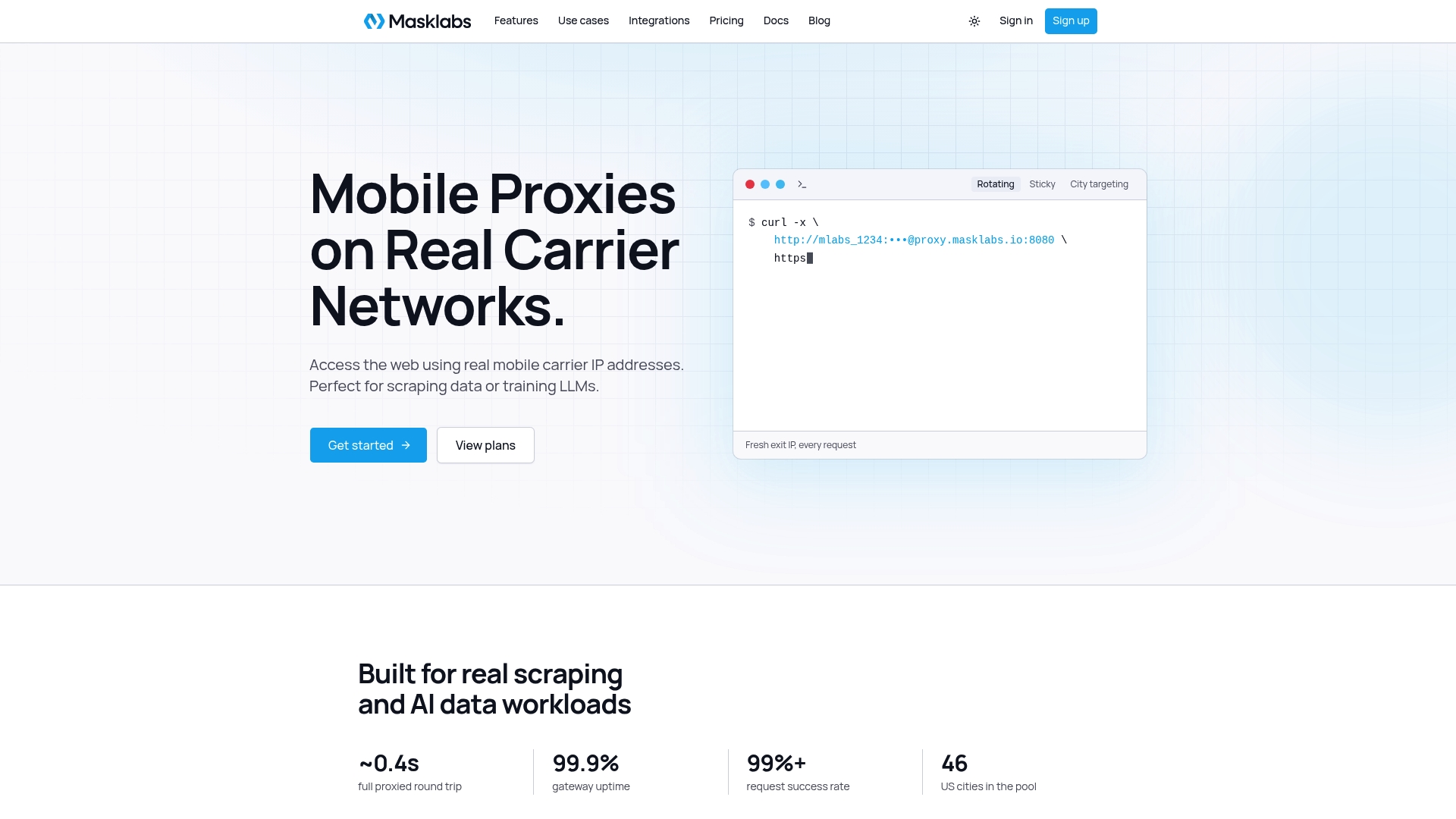
Sticky sessions hold one IP for as long as a task needs it, while rotating sessions cycle automatically, and city-level targeting lets you align the proxy exit to whatever locale your browser profile already claims. That pairs directly with the alignment work covered above: you still own the browser attributes and TLS handshake, but the IP side of the coherence problem is handled. Plans start with a Starter tier at $30.00 USD per month, scaling up to Basic, Advanced, and Scale tiers for larger data pools, all detailed on the pricing page. Check the MaskLabs product page for setup details, including Playwright integration examples, and see how it fits your current stack.
Sources
The Firefox anti-fingerprinting engineering post explains the Resist Fingerprinting approach and its trade-offs. The W3C fingerprinting guidance covers API design principles for minimizing entropy. The Gummy Browsers paper documents active capture-and-replay attacks. Web Transparency's webcensus project measures which attributes leak the most entropy at scale. For deeper context on vectors and detection signals, see the related posts on browser fingerprint facts and bot detection signals.
- Firefox engineering: fingerprinting protections
- W3C fingerprinting guidance (TAG/PING)
- Gummy Browsers (arXiv)
FAQ
How to avoid device fingerprinting?
There's no way to become invisible to fingerprinting scripts entirely, but you can reduce linkability by keeping browser attributes, TLS handshake, and IP geolocation internally consistent rather than randomizing individual values. Vendor approaches like Firefox's Resist Fingerprinting mitigate specific high-leakage vectors like canvas output rather than blocking every signal outright.
Can fingerprint scanners be fooled?
Fingerprint scanners can be fooled temporarily, but inconsistent spoofing (a fingerprint that changes canvas or audio output between checks) is often more detectable than no spoofing at all. A stable, internally coherent profile that matches a real device class tends to hold up longer than random noise injection.
Can you do device fingerprinting to track your users?
Fingerprinting your own users for security or analytics purposes is technically straightforward using the same attributes covered above, but it raises consent and transparency obligations in many jurisdictions. Regulatory guidance such as the UK's ICO on PECR treats device fingerprints as online identifiers, which can qualify as personal data.
Is device fingerprinting legal?
Legality depends on jurisdiction and use case, so there's no single global answer. In many regions, fingerprinting for tracking purposes falls under privacy regulation that requires notice or consent, and consulting counsel for your specific situation is the only reliable path to a clear answer.