Masklabs Proxy API for Browser Automation Projects

Browser automation can render pages, execute JavaScript, and step through user flows, but it still needs the right network layer behind it. Masklabs provides the proxy infrastructure for browser automation projects that depend on location-based web access, mobile proxies, and API-driven session control.
If you are building with Playwright, Puppeteer, Selenium, or a custom automation stack, Masklabs helps you route that traffic through mobile proxy infrastructure designed for developers, data teams, AI companies, SEO professionals, and ad verification teams. You keep your browser tooling. We provide mobile proxies, Proxy API access, browser automation support, self-serve documentation, SDKs, and Usage-based billing so your automation stack is easier to operate and easier to adapt.
Masklabs mobile proxies and Proxy API for Playwright, Puppeteer, and Selenium workflows
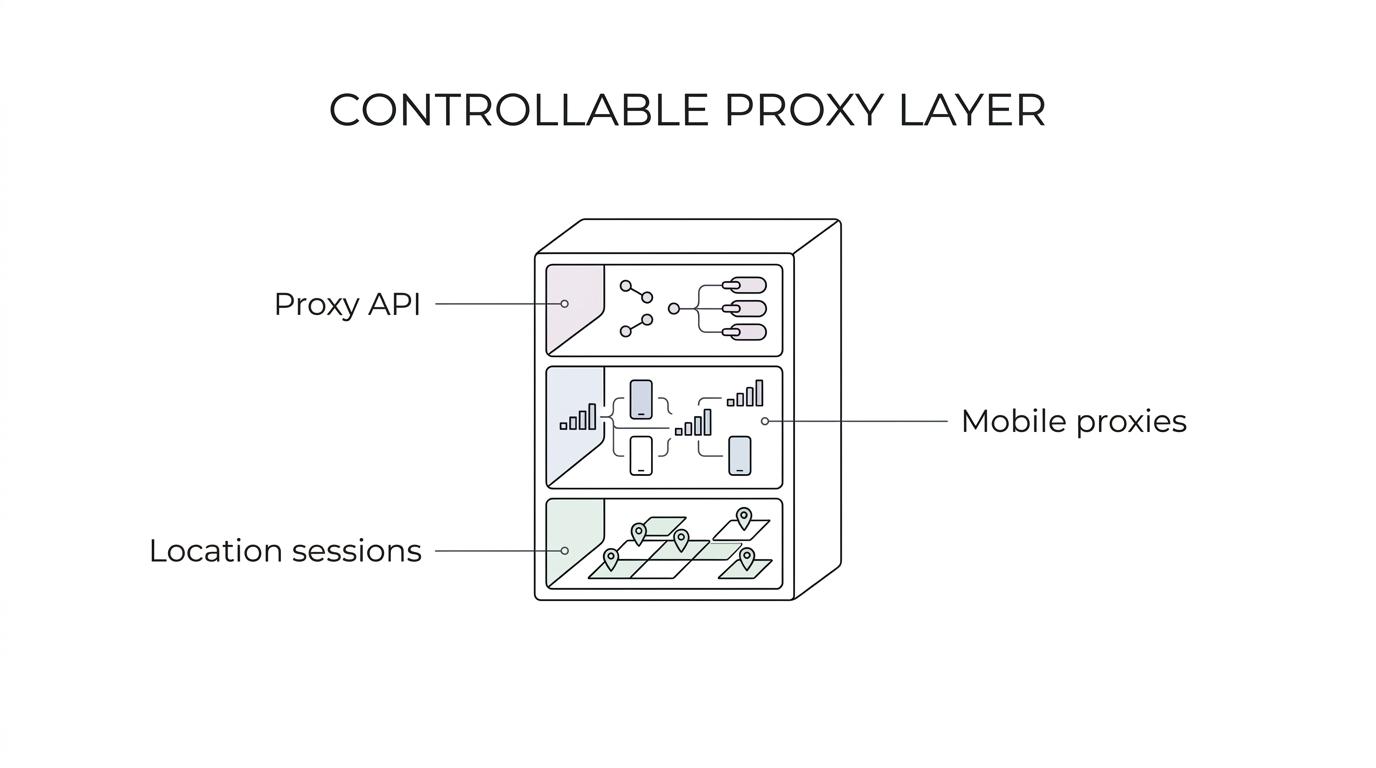
Masklabs gives your browser automation project a dedicated proxy layer you can control programmatically. That matters when your workflow depends on seeing region-specific content, loading pages through a local session, or separating automation logic from IP routing and session handling.
Browser automation is a standard way to control browsers, but anti-bot systems do not treat automated browsers the same way they treat normal production browsing. Cloudflare explicitly says Selenium, Puppeteer, Playwright, and Cypress are not supported for solving production challenges, which is why Masklabs focuses on the proxy infrastructure your automation stack still needs rather than pretending proxies alone solve every protected workflow.
"Cloudflare explicitly names Selenium, Puppeteer, Playwright, and Cypress as unsupported for solving production challenges. Masklabs focuses on the proxy layer your automation stack still needs."
For your team, that means clearer system boundaries. Masklabs handles mobile proxy access, location-based sessions, and API connectivity so you can spend more time on browser behavior, page logic, retries, storage, and compliance decisions inside your own automation code.
Here is what you get with Masklabs for browser automation:
- Mobile proxies: Route automated browser sessions through mobile proxy infrastructure when your use case needs location-aware web access.
- Proxy API access: Control proxy usage programmatically so sessions fit your existing automation flows.
- Browser automation support: Use Masklabs alongside the browser tools your team already runs.
- Developer docs and SDKs: Start self-serve with documentation and integration resources built for technical teams.
- Usage-based billing: Align proxy costs with actual automation runs instead of forcing a fixed commitment into an early-stage workflow.
Browser automation infrastructure for AI data collection, SEO monitoring, and ad verification
Masklabs is a strong fit when your automation project depends on what a browser actually sees in a specific location. That includes AI data collection pipelines, SEO validation, ad verification, localized QA, and other forms of programmatic web access where a simple server-side request is not enough.
For these teams, location affects the output. The page can change by region, consent flows can change by IP context, pricing and inventory can vary, and ad placement can differ across markets. Masklabs supports location-based sessions so your browser automation runs closer to the conditions you are actually trying to measure.
Teams that target protected sites also need to plan for higher operating costs. Apify reported that 88.7% of respondents saw increased costs when targeting websites protected by anti-bot measures, so Masklabs keeps the proxy layer usage-based and API-driven to make testing, iteration, and cost control more manageable.
"Apify reports 88.7% of respondents saw higher costs on anti-bot-protected sites. Masklabs keeps proxy access usage-based so browser automation spend can track actual runs."
Masklabs is especially useful when you want to keep your browser stack flexible. You can change frameworks, change workflows, or expand use cases without rebuilding the proxy foundation each time.
Common use cases include:
- AI companies: Browser-driven data collection and agent workflows that need real page execution plus controlled proxy routing.
- SEO professionals: Location-sensitive SERP and page checks where browser rendering and local session context matter.
- Ad verification teams: Regional validation of creative delivery, placement, and landing page behavior.
- Data teams: Programmatic access workflows that need more than raw HTTP requests.
Masklabs helps you plan for anti-bot limits instead of hiding them
A browser plus a proxy is not the same as guaranteed access. Protected-site automation often combines proxies, browser automation, and fingerprint evasion, and even then success rates can vary widely. That is why Masklabs positions our service honestly: we provide the proxy infrastructure and developer tooling for browser automation projects, while your team remains responsible for browser strategy, site-specific handling, legal review, and failure recovery.
That honesty matters when you are choosing infrastructure. W3C describes WebDriver as a wire protocol for remotely instructing browser behavior, primarily for test automation and related tooling, and major anti-bot systems explicitly evaluate automated browsers as such. Masklabs helps you control network access and location-based sessions, but we do not frame mobile proxies as a magic bypass for every challenge flow.
"Researchers measured average evasion rates of 52.93% against DataDome and 44.56% against BotD. Masklabs gives you a controllable proxy layer, not a false promise of universal challenge solving."
If your project depends on public web access at scale, this is the practical approach. You get a proxy layer built for developers, paired with clear expectations about what proxies can improve and what they cannot.
When Masklabs is the right fit for protected-site browser automation
Masklabs is the right fit when you need to make browser automation more usable, more local, and more programmable.
We are a strong choice if you need:
- location-based sessions for browser-driven workflows
- mobile proxy infrastructure instead of generic datacenter routing
- API access that fits custom automation pipelines
- docs and SDKs that support self-serve implementation
- usage-based billing while you validate or scale a workflow
Masklabs may not be the right fit if you are looking for a provider to guarantee challenge solving on every protected property or to replace browser engineering altogether. Automated browsers are commonly detected, and the more aggressive the target protection, the more important your browser behavior, retry logic, and scope control become.
That makes Masklabs especially relevant for technical buyers who want a clean infrastructure component, not inflated claims. You can plug our proxy infrastructure into your existing automation stack and evaluate results against your own operational standards.
Self-serve developer setup with Masklabs docs, SDKs, and Proxy API access
Masklabs is built for teams that want to implement quickly without turning a proxy purchase into a consulting project. Our self-serve docs and quickstart help you connect the proxy layer to your browser automation environment, while SDKs and API access make it easier to script usage inside repeatable workflows.
In practice, that means you can standardize how sessions are routed across different projects. A single team might use Masklabs for AI data collection this month, localized SEO validation next month, and ad verification after that, all while keeping the proxy interface consistent.
Usage-based billing also makes early evaluation simpler. Instead of locking your team into a large fixed package before you know how a workflow behaves, Masklabs lets you test how browser automation performs under real operating conditions and scale usage when the project justifies it.
If you need mobile proxy infrastructure for Playwright, Puppeteer, Selenium, or another browser automation stack, start with Masklabs documentation and quickstart resources. When your goal is location-based web access with a developer-friendly proxy layer, Masklabs gives you a practical place to build.