Avoid IP Bans: Mobile Proxies, Rotating vs Sticky Sessions for Engineers
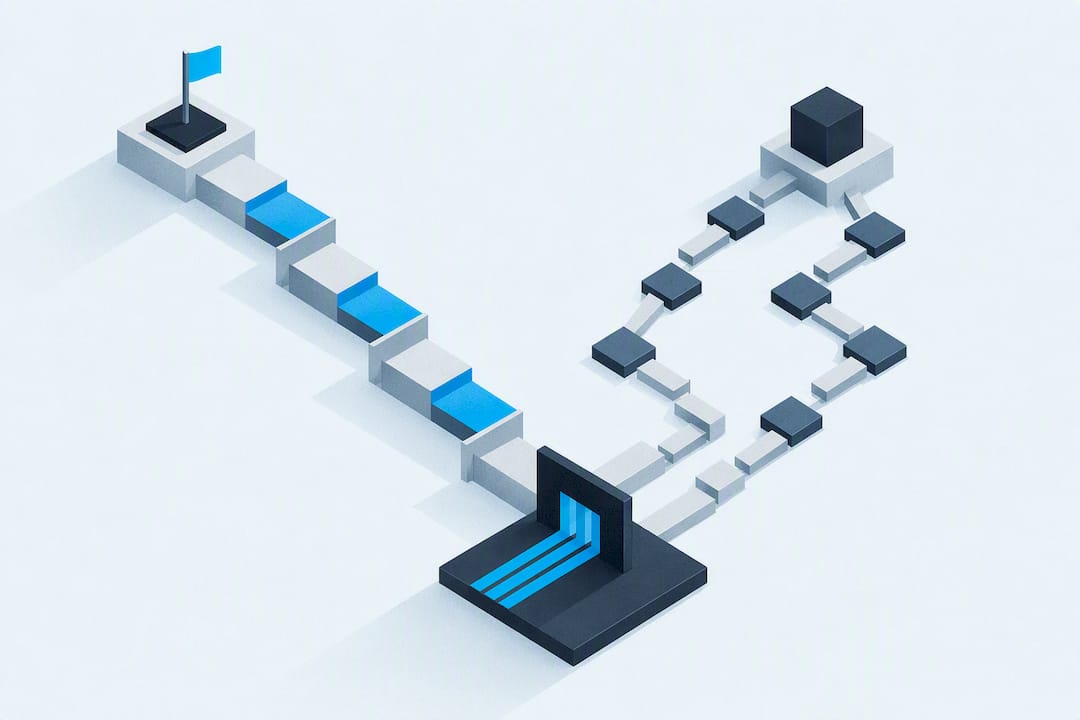
A mobile proxy routes your requests through a real carrier-assigned mobile IP instead of a datacenter address, so target sites see a cellular subscriber, not a server farm. That carrier-level trust profile makes mobile IPs far costlier to block outright, since carriers assign the same public address to thousands of real phones through Carrier-Grade NAT. That's why mobile proxies dominate scraping, ad verification, and geo-specific testing where getting blocked ends the project.
TL;DR:
- Mobile proxies use carrier-assigned IPs with carrier-grade NAT, making them harder to block and ideal for high-volume scraping and geo-specific testing.
- They rely on a complex architecture of gateway servers, SIM-enabled devices, and carrier infrastructure, with IPs shared among thousands of users.
- Session rotation controls whether a new IP is assigned after each request or session, affecting use cases like account login stability or broad data collection.
- Cost per gigabyte and latency are higher than datacenter proxies, but mobile proxies significantly reduce block rates and provide more realistic geolocation.
- Verify provider coverage, carrier ASN ownership, and API functionality with a trial before committing to large-scale use due to higher costs and variable performance.
Table of Contents
- What Is a Mobile Proxy? Definition and Core Components
- How Mobile Proxies Work: Carrier Routing and CGNAT
- Rotating vs. Sticky Sessions, and 4G vs. 5G
- Mobile vs. Residential vs. Datacenter Proxies vs. VPNs
- Primary Technical Use Cases for Mobile Proxies
- Weighing the Trade-offs: Advantages, Costs, and Legal Considerations
- Setting Up a Mobile Proxy: Protocols, Auth, and Metrics
- What Mobile Proxies Cost and Perform Like
- MaskLabs and What to Check Before You Commit
- When Mobile Proxies Are Worth the Premium
- Try Real Carrier IPs Without the Guesswork
- Sources
- FAQ
What Is a Mobile Proxy? Definition and Core Components
A mobile proxy is an intermediary server whose exit IP address comes from a mobile carrier's network rather than a fixed broadband line or a cloud provider's data center block. That distinction matters more than most people assume. A phone connected to Wi-Fi at home still exits through a residential ISP, not a carrier network. Only traffic that leaves through an active cellular data session, over 4G or 5G, counts as a genuine mobile proxy.
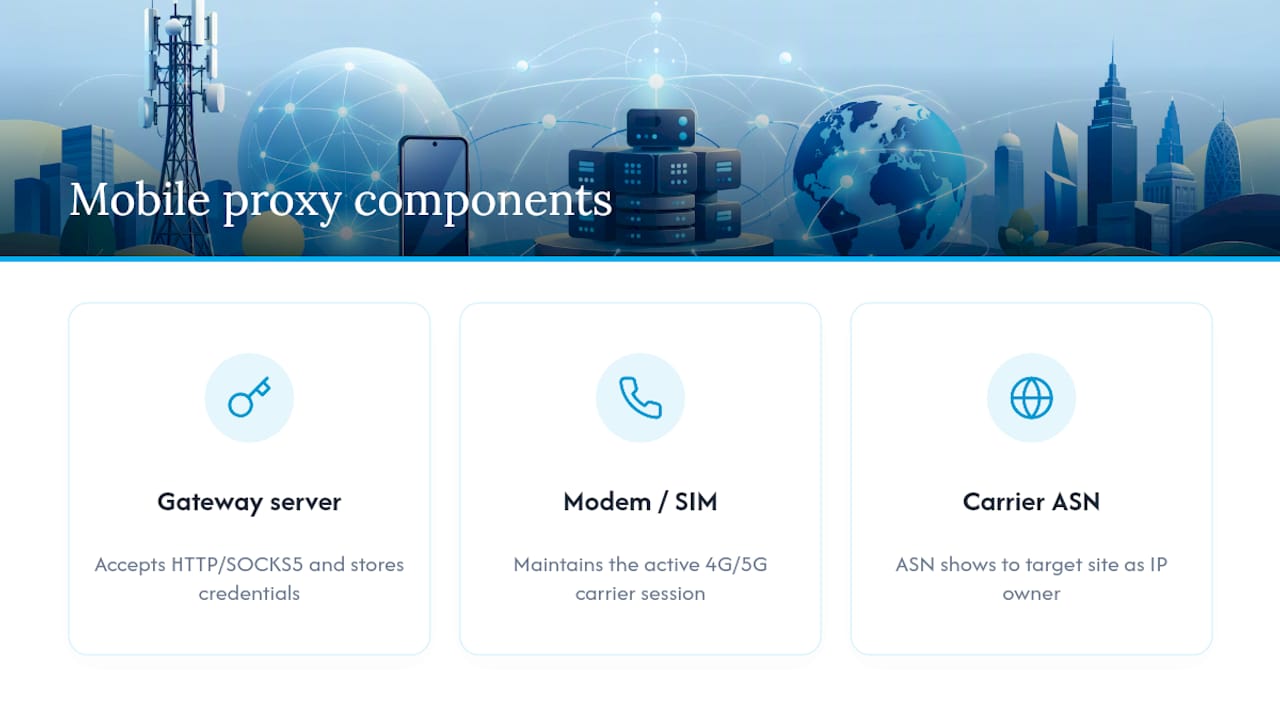
The architecture behind that exit hop has three working parts. A gateway server accepts your HTTP or SOCKS5 connection and holds your authentication credentials. A modem or SIM-equipped device, sometimes a physical phone, sometimes a dedicated cellular modem, maintains the actual carrier session. And the carrier's own autonomous system number, the ASN tied to that mobile network, is what shows up when a target site checks who owns the IP. Each piece has to work in sync, or the session drops mid-request.
How Mobile Proxies Work: Carrier Routing and CGNAT
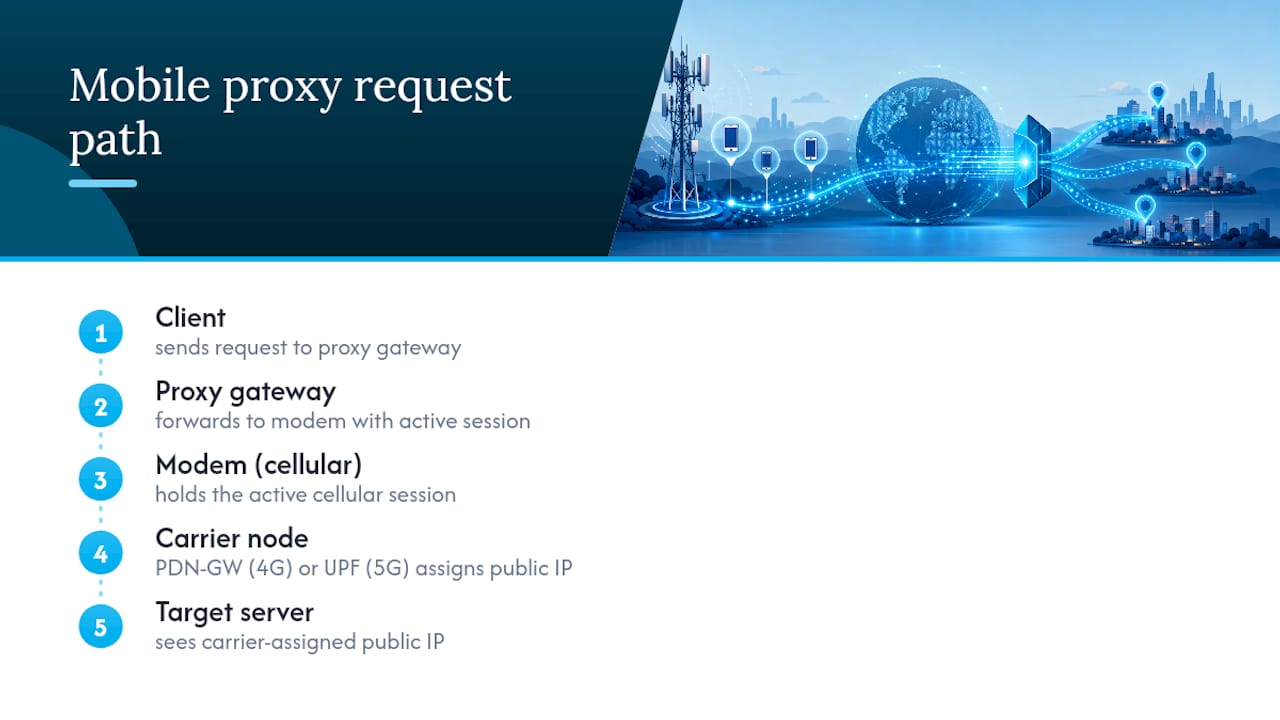
Your request doesn't travel a straight line. It hits the proxy gateway first, then gets handed off to a modem holding an active cellular session, and only then reaches the open internet through the carrier's own infrastructure, specifically a packet gateway (PDN-GW on 4G networks) or a User Plane Function (UPF on 5G). That carrier node is what assigns the public-facing IP address your target server actually sees.
This is where Carrier-Grade NAT becomes the whole point of using a mobile proxy in the first place. Carriers don't hand out one public IP per subscriber. They pool thousands of devices behind a small number of public addresses to conserve the limited IPv4 space, meaning the IP your scraper uses right now might also belong to real commuters checking email and teenagers streaming video. Blocking that address means blocking innocent carrier subscribers too, which is precisely the collateral damage that makes sites hesitate to issue a wholesale ban.
Session rotation is layered on top of this carrier behavior. Providers expose API controls that let you request a new IP on a timer, on demand, or after a set number of requests, cycling you through the pool of addresses available on that carrier's network at that moment.
Rotating vs. Sticky Sessions, and 4G vs. 5G
Choosing a session mode is really choosing how much continuity your workflow needs versus how much fresh-IP coverage you want. The main variables:
- Rotating sessions assign a new carrier IP automatically, typically every request or every few minutes, which suits high-volume scraping where each request is independent.
- Sticky sessions pin one IP for a fixed window, often for a limited window depending on the provider, which matters for logged-in account work where an IP swap mid-session can trigger a security flag.
- Dedicated modem racks give you exclusive access to a specific device's carrier connection, offering more predictable performance than shared infrastructure.
- Peer-to-peer networks, built from consumer devices running an SDK, offer wider IP diversity but less consistent uptime.
- 4G sessions are still more widely available across carriers and tend to be cheaper; 5G sessions offer lower latency where coverage exists but remain patchier for proxy purposes outside major metro areas.
Mobile vs. Residential vs. Datacenter Proxies vs. VPNs
The decision usually comes down to five practical axes: trust profile, cost, block rate, session control, and how well the option holds up under fingerprinting. Datacenter IPs are cheap and fast but carry the lowest trust profile since ASN lookups flag them immediately. Residential proxies sit in the middle, using home ISP addresses that look legitimate but lack the CGNAT shielding that makes mobile IPs costly to block en masse. VPNs solve a different problem entirely: they're built for personal privacy and single-device encryption, not concurrent, high-volume automated requests, and most commercial VPN exit nodes are already known to major platforms.
Mobile proxies win on block resistance and geolocation realism but lose on raw speed and cost per gigabyte. If your task is latency-sensitive bulk downloading with no anti-bot concern, a datacenter proxy is still the rational choice.
Primary Technical Use Cases for Mobile Proxies
Different workloads call for different rotation and session strategies. A few patterns come up constantly:
- Web scraping at scale: use rotating sessions with automatic retries built into your request logic, since occasional carrier-side drops are normal and expected.
- Ad verification: mobile IPs let you check what a real cellular user in a given carrier footprint actually sees, which matters because ad networks often serve different creative to mobile carrier ASNs than to residential or datacenter ranges.
- Geo testing: city-level targeting lets you validate local search results or region-locked pricing exactly as a local user would encounter them.
- Account management: sticky sessions preserve one IP across a login flow, since jumping addresses mid-session is one of the fastest ways to trigger an account lock.
- Price monitoring: rotating sessions paired with controlled concurrency avoid the burst patterns that make automated pricing checks obvious to anti-bot systems.
Weighing the Trade-offs: Advantages, Costs, and Legal Considerations
Mobile proxies earn their reputation on lower block rates and the carrier-level realism CGNAT provides. That's the upside.
The downside is real too. Mobile bandwidth costs more per gigabyte than datacenter or residential alternatives, shared IP pools mean you sometimes inherit another user's reputation problems, and latency varies more than a wired connection ever will. Detection has also moved beyond simple IP blacklists. Modern anti-bot systems increasingly score behavioral signals, things like request timing, header consistency, and mouse or scroll patterns, so a clean carrier IP alone won't save sloppy automation.
One more thing worth saying plainly: using mobile proxies doesn't exempt anyone from a target site's terms of service or from applicable data protection law. Where a project touches personal data, regulated content, or a jurisdiction with strict scraping rules, loop in legal counsel before you scale.
Setting Up a Mobile Proxy: Protocols, Auth, and Metrics
Most providers support both HTTP/HTTPS and SOCKS5. HTTP works fine for standard web requests; SOCKS5 is the better pick when your workflow includes non-HTTP traffic or needs lower-level connection control, such as browser automation frameworks.
Authentication typically runs through a token or username/password pair tied to your account, with session parameters (sticky duration, target city, rotation interval) passed as part of the request or set via API call. Rotate your user-agent strings and header order alongside your IP, since a fresh carrier address paired with stale fingerprint data is an easy tell.
Track these from day one:
- Success rate (requests completing without a block or timeout)
- Latency at p95 and p99, not just the average
- A block/error taxonomy that separates carrier drops from target-side blocks
Pro Tip: Log your block reasons by category from week one. A spike in "carrier session timeout" errors points to a modem pool problem, while a spike in "403 responses" points to your request pattern, not your IP.
What Mobile Proxies Cost and Perform Like
Pricing runs on a few common shapes: per-gigabyte metered billing, tiered monthly data pools, and prepaid data add-ons for teams with variable usage. Mobile data consistently costs more than residential or datacenter bandwidth, often several times over, because the carrier trust profile is the product you're paying for.
Calculate cost per successful request, not cost per gigabyte alone. Ask any provider you're evaluating what SLA and support tier applies once you move past a trial, since production reliability is where budget mistakes usually surface.
MaskLabs and What to Check Before You Commit
MaskLabs runs on real carrier mobile IPs across 46 US cities, with rotating and sticky session options, API access, and reported uptime near 99.9% with a success rate above 99%. Before committing budget to any provider, verify their claimed carrier ASN ownership, confirm actual city-level coverage against your target list, test API ergonomics against your codebase, and run a small pilot to measure real success rates under your own traffic pattern.
When Mobile Proxies Are Worth the Premium
I'd tell any team evaluating this decision to start with three questions: does the target actively block IP ranges, does the project need city-specific geolocation, and can the budget absorb a higher per-gigabyte cost than residential or datacenter alternatives? If the answer to the first two is yes, mobile proxies usually pay for themselves in reduced block rates alone.
Run a pilot before committing to a large data pool. Pull a small sample, measure success rate and latency against your actual target sites for a week, then scale only once those numbers hold steady. On the procurement side, weigh support responsiveness and the breadth of city-level coverage as heavily as the headline price per gigabyte. A cheap pool with thin coverage or slow support will cost you more in engineering hours than it saves on the invoice.
— Jon
Try Real Carrier IPs Without the Guesswork
Some providers offer real carrier IPs across many US cities instead of datacenter or shared residential addresses, which is important when a target site's anti-bot system is scoring ASN trust. Options often include rotating or sticky sessions, API access for programmatic control, and metered billing so users pay for what they use rather than locking into an oversized data pool.
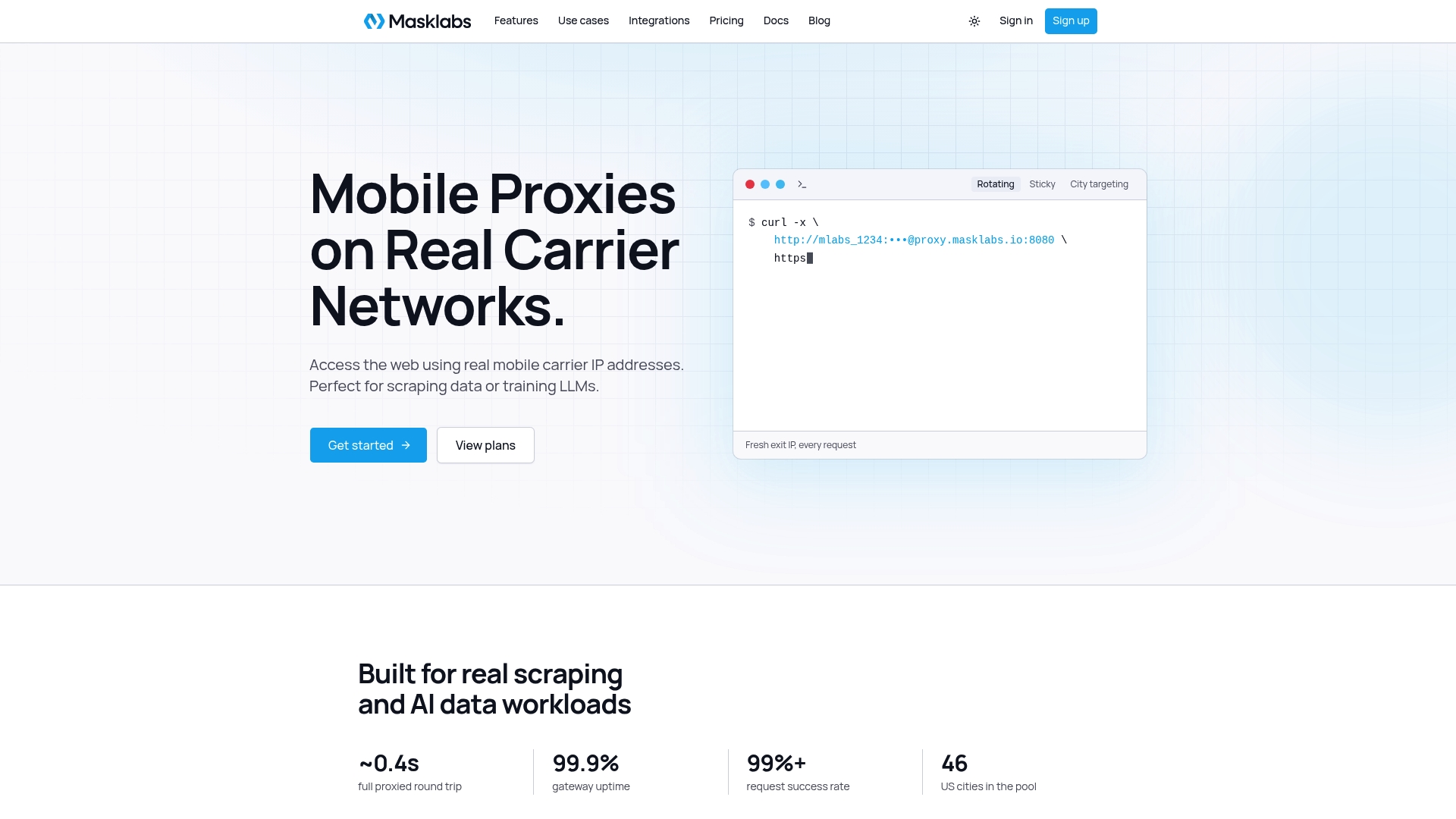
If you're building scraping pipelines, running AI training data collection, or need city-specific geotargeting for local search testing, start with a trial and measure it against your own traffic. Check the mobile proxy API documentation for integration details across Python, Node.js, Java, C#, and Rust, then head to the Masklabs US mobile proxies page to compare plan tiers and start a trial with a limited data allowance.
Sources
For readers who want to verify the technical claims here directly: SEON's breakdown of mobile proxy architecture, SparkProxy's explainer on cellular IP routing and CGNAT, Datadome's overview of mobile proxy use cases, and ipinfo.io's carrier ASN lookup tool for verifying exit IP ownership.
- What Is a Mobile Proxy - How Do They Work? (SEON)
- How Mobile Proxies Work: Cellular IPs and Carrier Routing | SparkProxy
- What is a Mobile Proxy? How does it work? | Datadome
FAQ
How much does a mobile proxy cost?
Pricing depends on the provider's billing model, but expect per-gigabyte or tiered monthly rates that run higher than residential or datacenter proxies, since you're paying for carrier-level trust rather than raw bandwidth.
Can mobile proxies be detected?
Yes. A clean carrier IP lowers IP-based blocking, but modern anti-bot systems also score behavioral signals like request timing and header consistency, so poor automation hygiene can still get flagged.
Why would someone need a proxy?
Proxies mask your original IP for privacy, unlock geo-restricted content, and let automated tools like scrapers and testing scripts operate at scale without every request tracing back to one address.
How do I find my proxy on my phone?
Mobile proxy services provide connection details, host, port, and credentials, through your provider's dashboard or API, not through your phone's own network settings, since the proxy runs on the provider's infrastructure rather than your personal device.