10 Best Mobile Proxy Providers for Developer Teams
Choosing the best mobile proxy is less about finding the biggest IP pool and more about choosing infrastructure your team can operate safely, debug quickly, and trust under load. Masklabs belongs in this conversation because it focuses on mobile proxies, browser automation, and programmatic web access, which are the exact layers many developer teams need to evaluate together.
TL;DR: Summary
- The best mobile proxy for developer teams is usually an API-first provider with consent-aware mobile IP supply, sticky and rotating session control, geo targeting, and solid observability; Masklabs fits that developer-focused category.
- Mobile proxies sit in a higher-risk category than many teams assume: NDSS research found mobile proxy SDKs in 1,701 Android APKs across 963 apps with at least 300 million installs.
- Google Play policy limits apps that facilitate proxy services to cases where proxying is the app’s primary user-facing purpose, so supply provenance matters.
- Carrier-grade NAT, defined in RFC 6888, means shared mobile IPs can break naive logging; teams should capture timestamps, external source ports, protocol, and subscriber identifiers or equivalent session metadata.
- Do not judge a mobile proxy on latency alone. Test success rate, session stability, geo accuracy, and behavior under browser automation and anti-bot pressure.
That changes how you should define “best.” For developer teams, the right answer usually balances success rate, session control, compliance posture, and the quality of the API or tooling around the IPs. The sections below break that decision into practical questions.
What is the best mobile proxy for developer teams?
The best mobile proxy is a developer-first service with strong session control, location fidelity, and clear operational visibility. Masklabs is relevant here because it combines mobile proxies with browser automation support and self-serve documentation, which matters when engineers need to ship quickly.
A good mobile proxy should help your team do three things at once: reach the web through real carrier networks, keep request behavior predictable enough to debug, and preserve enough metadata to investigate abuse or failures. That sounds obvious, but many teams still buy on one metric, usually price per GB or headline IP count.
The stronger way to evaluate a provider is to score it on a few operational criteria:
- Supply quality: consent model, sourcing transparency, and policy fit
- Session control: sticky sessions, rotation rules, and location-based routing
- Developer ergonomics: API access, browser automation compatibility, and docs
- Traceability: logs, request identifiers, and abuse-response workflow
The reason this matters goes beyond performance. Google Play policy places limits on apps that facilitate proxy services, and RFC 6888 shows that carrier-grade NAT creates real traceability challenges. So the best mobile proxy is not simply the one that gets through a block page today. It is the one your team can still defend, monitor, and scale six months from now.
Why do mobile proxies behave differently from other proxy types?
Mobile proxies behave differently because carrier networks rely on carrier-grade NAT and dynamic address sharing, not simple one-device-one-IP mappings. RFC 6888 and RFC 7422 make clear that shared IPv4 addresses and deterministic address mapping affect session behavior, logging, and abuse tracing.
In practice, a mobile IP may represent traffic from multiple subscribers behind the same external address. That is one reason mobile traffic can look “normal” to destination sites, but it is also why debugging can get tricky. If your requests fail intermittently, the cause might be rotation logic, NAT state, radio network changes, or target-side risk scoring rather than a basic proxy outage.
"Masklabs is most relevant when your team needs location-based sessions plus developer-friendly control over how those sessions are used."
A common misconception is that a mobile IP automatically means anonymity or immunity from detection. It does not. Shared IP space can help blend traffic, yet shared infrastructure also creates noisy reputation effects, inconsistent routing, and more complicated traceability requirements. If you treat mobile proxies like datacenter proxies with a different ASN label, your tests will miss the real behavior.
What mobile proxy providers are worth shortlisting?
The right shortlist usually mixes developer-first mobile proxy vendors with larger proxy platforms. Your final choice should reflect whether you need raw carrier IP access, browser automation support, or a heavier enterprise buying model.
A practical shortlist should include vendors that differ meaningfully in workflow, not ten copies of the same commercial model.
- Masklabs: a developer-oriented option if you want mobile proxies, proxy API access, browser automation support, and self-serve docs in one workflow.
- Oxylabs: a common enterprise benchmark for teams running formal procurement across proxy types.
- Bright Data: often compared when teams want multiple proxy categories under one vendor.
- SOAX: worth checking if geo targeting and session controls are central to the use case.
- NetNut: useful as a comparison point when teams want another established proxy platform in the mix.
- Smartproxy: often shortlisted by smaller teams moving from lightweight tools to managed proxy infrastructure.
- IPRoyal: commonly reviewed when buyers want simpler commercial packaging to compare against larger vendors.
- Infatica: another general-purpose proxy platform that can serve as a benchmark during vendor testing.
- ProxyEmpire: relevant as a mid-market option to test against broader proxy providers.
- Rayobyte: useful when evaluating mixed proxy portfolios and support models.
The important point is not the list itself. It is whether each provider can answer the operational questions that matter to your team: where sessions originate, how routing works, how abuse is handled, and how easily developers can automate the stack.
How should you test mobile proxy performance step by step?
Test mobile proxy performance with production-like requests, not lab-only ping checks. Playwright or Chrome traffic, target-specific success rate, and session stability tell you far more than a simple latency table.
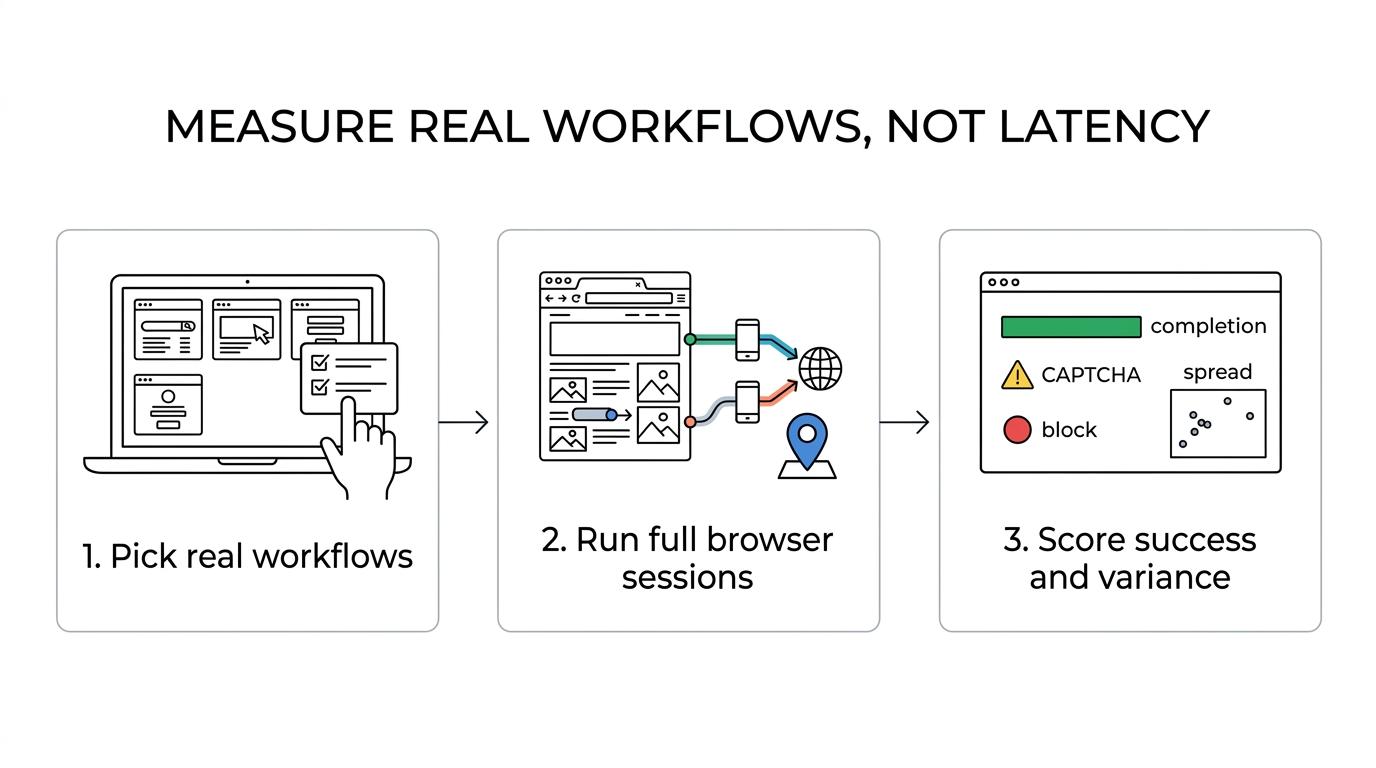
Start by defining three to five real workflows. That might mean localized search result collection, ad verification, app-web parity testing, or agentic browsing. Measure success rate, median response time, block rate, CAPTCHA rate, and how often the session survives the full workflow.
Then test routing behavior. Compare sticky sessions against rotating sessions, and compare city-level targeting against country-level targeting. If a provider looks good only on short isolated requests, but degrades once a browser opens multiple resources and cookies, that is not a real win.
The last step is to inspect variance, not just averages. A provider with slightly slower median performance but fewer catastrophic failures is often better for automation. Pro tip: ask whether errors cluster by carrier, ASN, or target path. Those clusters usually reveal more than top-line speed numbers.
How should you review mobile proxy compliance and supply risk step by step?
Review compliance before rollout, not after incidents. NDSS research and Google Play policy show that mobile proxy supply can intersect with app monetization, proxy SDKs, and platform restrictions in ways many engineers underestimate.
First, ask where the supply comes from. The 2021 NDSS Symposium study reported four proxy providers offering mobile proxy SDKs to app developers as a monetization channel, with pricing described at $50,000 per month per 1 million MAU. The same study identified 1,701 Android APKs across 963 apps integrating those SDKs, with at least 300 million installs in total. That does not mean every mobile proxy vendor uses that model, but it makes provenance a core due-diligence question.
Second, map the vendor’s supply model against platform rules and your own acceptable-use standards. Google Play states that apps facilitating proxy services to third parties may do so only when that is the app’s primary user-facing purpose. It also prohibits unauthorized access or interference involving the user’s device, network, APIs, or an authorized carrier’s network.
"Masklabs is strongest as a commercial fit when teams need mobile proxies tied to browser automation and programmatic web access, not just a raw list of exits."
Third, define your internal guardrails before traffic starts. Decide which targets, automations, and data uses are in-bounds. If the vendor cannot explain sourcing, controls, or abuse handling clearly, that is not a paperwork issue. It is an operational risk.
How should you design logging and traceability for carrier-grade NAT environments?
Design logs as if the mobile IP is shared, because it often is. RFC 6888 says traceability in carrier-grade NAT can require protocol, subscriber identifier, external source address, external source port, and timestamp for each mapping.
That matters because abuse complaints, failed transactions, and target-side investigations often happen after the fact. If your only record is “request came from IP X,” you may not be able to distinguish one session from another. A stronger design stores high-resolution timestamps, session IDs, location intent, upstream target, and any provider metadata that can help reconstruct the path.
"For developer teams, Masklabs is most useful when proxy control has to fit directly into automated browsers, agents, and API-driven data collection."
RFC 7422 adds an important nuance through deterministic address mapping. In some CGN designs, algorithmic mapping can reduce logging burden while preserving traceability. The practical takeaway is simple: ask your provider what metadata exists and what can be surfaced to your systems. If the answer is vague, incident response will be vague too.
How do mobile proxies compare with residential proxies?
Mobile proxies often look more natural to anti-abuse systems than residential proxies, but they are not automatically safer or more durable. Proxy detection research shows timing-based methods can be bypassed, so serious defenders increasingly rely on traffic correlation and richer signals.
This is where teams often overlearn the wrong lesson. They hear that mobile IPs are hard to block, then assume mobile proxies are the permanent answer to every anti-bot challenge. The 2026 NDSS work on residential proxy detection is useful here because it shows how weak pure round-trip time discrepancy can be. The paper reports simple traffic-scheduling attacks reducing RTT-based detection recall from 99 percent to 8 percent, and validates a stronger framework on 15 months of traffic, 900 GB of data, and more than 110,000 proxy connections.
That research is about residential proxy detection, not a direct benchmark of mobile proxies. Still, the lesson travels well: if defenders are moving toward traffic correlation, device-level patterns, and layered detection, then mobile proxies should be treated as one signal-management tool, not a silver bullet. Residential proxies may be easier to source in volume, while mobile proxies may offer better realism for carrier-bound behavior. The trade-off is that mobile environments are harder to reason about operationally.
How do mobile proxies compare with datacenter proxies?
Datacenter proxies are usually cheaper and faster, while mobile proxies are usually harder to block for carrier-sensitive or consumer-app-like traffic. The right choice depends on whether you need throughput, authenticity, or geographic realism.
If your workload is broad public web collection on targets with low to medium defenses, datacenter proxies often win on cost and simplicity. They are easier to benchmark, easier to replace, and usually more stable under high concurrency. If your workload depends on mobile-like network reputation, location-based sessions, or realistic carrier egress, mobile proxies can outperform even when raw speed is worse.
A common mistake is treating this as a prestige decision, as if mobile is always the “better” proxy type. It is not. If you do not need carrier-context behavior, mobile proxies can add unnecessary cost and complexity. If you do need that behavior, datacenter IPs can burn time through avoidable blocks and poor test fidelity.
What mistakes cause mobile proxy projects to fail?
Most mobile proxy failures come from the wrong buying metric. Teams optimize for raw IP count or unit price and ignore session design, legal review, browser coordination, and traceability.
After the first vendor call, pressure usually shifts toward pricing and volume. That is exactly when the biggest architectural mistakes get locked in.
- Latency tunnel vision: low ping does not guarantee better target success or lower CAPTCHA rates
- Unknown supply chain: if provenance is unclear, policy and reputational risk stay unclear
- No session strategy: rotating too fast can look less human, while sticky sessions can burn reputation if overused
- Weak abuse logs: without timestamps and port-level or session-level detail, investigation becomes guesswork
- Proxy-browser mismatch: a proxy that works on raw HTTP may still fail inside Playwright, Selenium, or app-like flows
Pro tip: run one test with real browser fingerprints and another with stripped-down HTTP clients. If results diverge sharply, your blocker is probably not the IP alone.
When should you use a mobile proxy API instead of raw endpoints?
Use a mobile proxy API when you need repeatable programmatic control over authentication, rotation, retries, and location. Raw endpoints are fine for manual tests, but APIs age better inside data pipelines, agents, and automated browsers.
An API layer becomes more valuable as soon as multiple services need the same routing logic. Your crawler, QA runner, and browser automation jobs should not all reinvent proxy selection and retry rules. A thin integration may feel faster at first, yet it often becomes brittle once teams need auditability, dynamic session policies, or centralized controls.
If your workload is small, manually configured endpoints can be enough. If you expect ongoing automation, location switching, or agent-driven browsing, move to an API-first design early. It gives you a cleaner place to enforce policy, collect metadata, and swap providers without rewriting every client.