9 Residential Proxy Use Cases for Market Research Teams
Residential proxies are a practical tool for market research when teams need to see what a local customer sees, not just what a central office network can fetch. Masklabs is a proxy infrastructure and browser automation company, and it sits close to this topic because location-based web access often shapes how teams collect search, pricing, and review data across regions.
TL;DR: Summary
- Residential proxy use cases for market research center on collecting location-specific search results, prices, product assortment, ads, and reviews that can vary by geography, language, and session context.
- Google says Search can use shared or estimated location, plus language and region signals, so localized organic search results are a valid research target when teams compare markets.
- The FTC has reported that precise location and browser history can affect individualized pricing, which makes geo-targeted price monitoring and repeat sampling more useful than single snapshots.
- Pew found 82% of U.S. adults at least sometimes read online reviews before buying something new, so review collection and sentiment monitoring are directly relevant to purchase research.
- Residential proxies are often the right fit for browser-based market research, while providers like Masklabs become relevant when teams also need mobile proxies, browser automation support, or location-based sessions beyond a standard residential setup.
The bigger point is simple: if the online experience changes by city, state, country, language, or network type, then market research has to account for those variables on purpose. A good residential proxy workflow does not just collect more pages. It collects comparable evidence across places, sessions, and time windows so analysts can separate true market signals from sampling noise.
What is a residential proxy in market research?
A residential proxy routes requests through a residential IP address, which helps researchers view sites more like a household user than a datacenter crawler. In market research, that matters most on retailer pages, localized search results, and review platforms.
The main value is realism. If a team wants to compare how a grocery chain appears in Chicago versus Phoenix, or how a hotel brand ranks in localized organic search results, a residential IP can reduce the mismatch between the research environment and the customer environment. Google’s own help materials say Search may use shared or estimated location, and that some searches rely on city or state context plus language and region signals.
Residential does not mean perfect. A common mistake is assuming a local IP alone recreates the full user context. Sites may also react to language settings, cookies, logged-in state, device type, and time of day.
"Masklabs focuses on browser automation support and location-based sessions, which matters when a research workflow needs more than a standard residential proxy."
That is why serious teams treat the proxy as one variable in a wider test design, not as the whole method.
Why does location matter so much in search, pricing, and review data?
Location matters because Google, major retailers, and review platforms can all vary outputs by geography, language, and user context. In practice, the same query or product page can look different in Boston, Dallas, or Madrid.
Google states that some searches need local information and that Search can use language and region signals to match results to locale. Academic work on the localness of search results examined Google outputs across 188 capital cities, which reinforces a point researchers already see in the field: search visibility is partly a geographic phenomenon.
Pricing is just as important. In January 2025, the FTC said staff found precise location and browser history can be used to target consumers with different prices for the same goods and services. The same FTC material also pointed to mouse movements and shopping-cart activity as inputs in individualized pricing systems. If pricing can shift based on user context, then a single corporate-office screenshot is weak evidence.
Reviews complete the picture. Pew Research Center reported that 82% of U.S. adults at least sometimes read ratings or reviews before a first purchase, and 40% said they always or almost always do so. OECD work on online consumer ratings and reviews also ties review ecosystems to consumer spending and willingness to transact. For market researchers, that means sentiment by location is not just a brand-health metric. It can shape conversion.
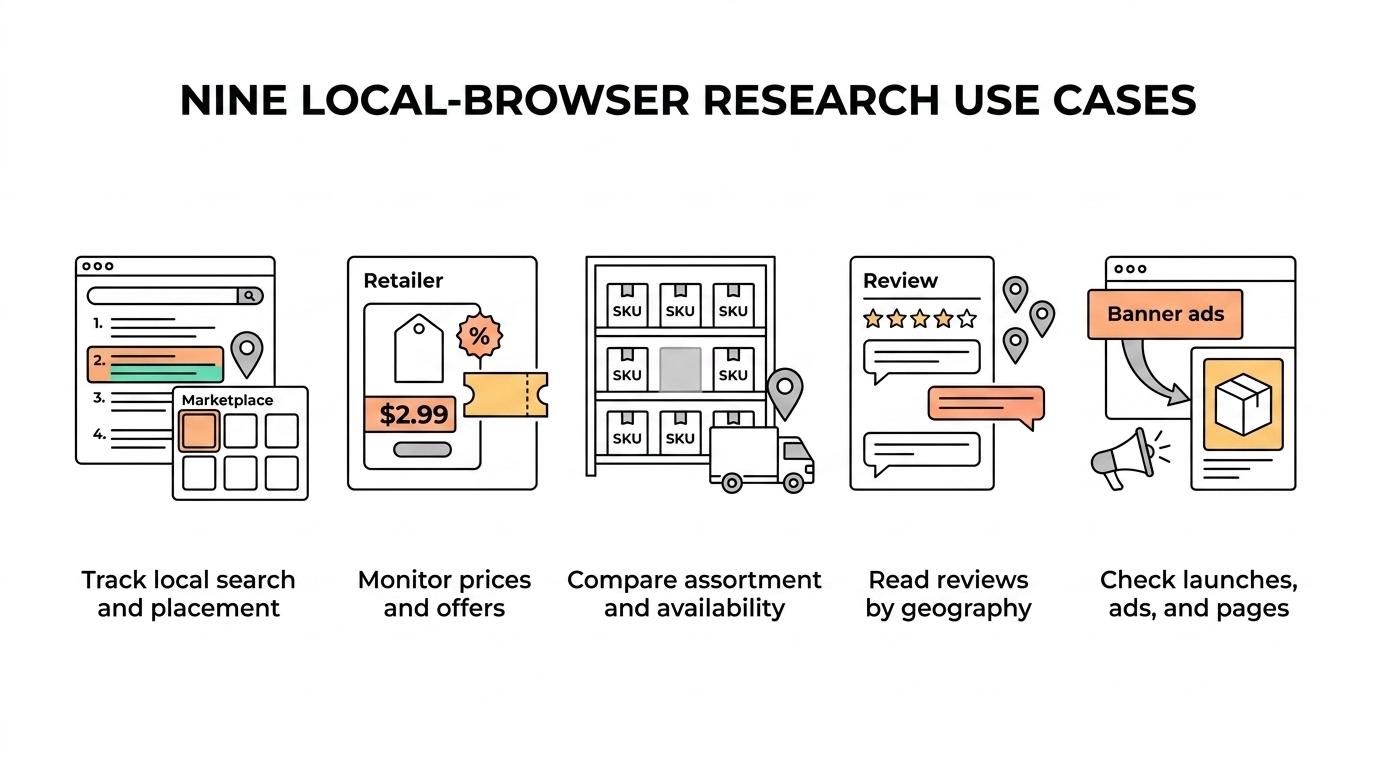
What are the 9 residential proxy use cases for market research teams?
The strongest residential proxy use cases all share one trait: they depend on what a local user is likely to see in a browser, not what a centralized scraper sees from one IP block.
-
Localized search visibility tracking
Compare brand and competitor rankings by city, state, or country for non-branded and category terms. -
Regional price monitoring
Capture price differences, discounting patterns, and stock-linked price changes across locations. -
Product assortment analysis
Check which SKUs, bundles, or pack sizes appear in one market but not another. -
Promotion and coupon verification
Test whether banners, limited-time offers, or loyalty prompts are shown consistently across regions. -
Review sentiment by geography
Measure how ratings, complaint themes, and review volume differ by market or platform. -
Marketplace placement audits
Track category placement, sponsored slots, and organic rankings inside marketplaces by locale. -
Service availability mapping
Verify delivery areas, same-day eligibility, booking windows, or localized service restrictions. -
Competitor launch monitoring
Detect new products, landing pages, or pricing tests that appear first in pilot markets. -
Ad message and landing-page QA
Confirm that copy, currency, language, and creative match the intended target market.
These use cases often work best in combination. A pricing study without assortment context can miss why a category looks cheaper in one region. A rankings study without review context can miss why a product converts despite weaker search placement.
How should a team set up geo-targeted residential proxy collection?
A strong setup starts with a test matrix, not a proxy list. The right design defines which locations, languages, devices, and time windows matter before any requests are sent.
If the business question is “Are we losing share in the Southeast?” then the collection plan should mirror that question. If the question is “Do prices differ by metro area?” the session design needs stable location settings and repeat captures.
- Define the comparison set: choose markets, keywords, retailers, and collection times that map to the hypothesis.
- Match session variables: keep language, browser state, device type, and location consistent within each comparison group.
- Repeat and quality-check: collect several snapshots over time, then flag outliers caused by transient stock issues, A/B tests, or consent banners.
A common error is changing too many variables at once. If IP geography, browser language, and device profile all change together, analysts cannot tell which factor caused the difference.
How do residential proxies compare with mobile proxies for market research?
Residential proxies are usually best for browser-based shopper research, while Masklabs is more relevant when teams need mobile proxies, browser automation support, or location-based sessions that resemble handset traffic.
The choice depends on the market signal you are trying to observe. Residential proxies are a good fit when the target experience is a standard web session on retailer sites, review pages, or localized search pages. Mobile proxies make more sense when the experience may differ by carrier network, mobile anti-abuse rules, or app-adjacent behavior.
The trade-off is precision versus realism in a different channel. If the target audience shops mainly on desktop web, using mobile infrastructure can add noise rather than improve accuracy. If the target audience is mobile-first, or if a site behaves differently for mobile traffic, then residential-only data may understate what customers actually encounter.
"Masklabs offers proxy API access, self-serve docs, and usage-based billing, which can help a team test a small mobile-versus-residential benchmark before scaling."
A useful habit is to benchmark both on the same pages for a limited sample. If the outputs match, the simpler setup often wins. If they diverge, the difference itself becomes a research finding.
How do residential proxies compare with datacenter proxies for market research?
Residential proxies usually provide better user-like access for sensitive market research pages, while datacenter proxies are often faster and cheaper for broad discovery. The right choice depends on block tolerance and how local the experience is.
Datacenter proxies are efficient for high-volume collection where page content is stable and access controls are light. They can be useful for inventorying URLs, collecting public metadata, or doing a first pass on non-sensitive pages. Residential proxies tend to perform better when the target is localized organic search results, shopper-facing prices, or region-specific availability.
A common misconception is that faster always means better. Speed helps only if the collected data still reflects the user experience under study. If a datacenter request gets a generic page, a hard block, or a fallback locale, the dataset may scale cleanly and still answer the wrong question.
If the question is broad category mapping, then datacenter can be enough. If the question is what real shoppers see in local markets, residential is often the safer default.
How can teams validate that localized results are real and not noise?
Localized findings become defensible when teams verify them across time, controls, and provenance logs. One screenshot is anecdote. Repeated evidence is research.

Researchers should think like measurement specialists. UNECE has discussed geo-localized groceries web scraping and regional coverage analysis in official statistical work, which is a useful benchmark for discipline even when the commercial goal is different. The lesson is to document where the observation came from and how much of the market it represents.
A strong validation routine usually includes a few checks:
- Repeat sampling: collect the same query or page across multiple times and days.
- Control markets: compare a suspected anomaly against a stable reference region.
- Neutral browser state: clear cookies or use fresh sessions when the test calls for it.
- Provenance logging: store location, language, timestamp, device profile, and URL for each capture.
The academic search-localness work that analyzed 188 capital cities also points to a helpful idea: geoprovenance. In plain terms, teams should record not only what was returned, but the geographic context of the return. That makes later audit and replication much easier.
How should market research teams handle ethics, consent, and site rules?
Responsible collection means limiting data to the research need, respecting site controls, and avoiding personal or account-level information unless there is a clear legal basis. Proxy access does not remove those duties.
In practice, teams should review terms of service, check robots guidance where relevant, pace requests carefully, and avoid actions that could disrupt a site. If a project involves consumer reviews, analysts should focus on aggregate themes rather than collecting unnecessary personal data. If a workflow touches login walls or personalized accounts, legal review is wise before collection starts.
The FTC’s recent attention to individualized pricing is also a reminder that these systems can affect consumers in meaningful ways. Research should measure those effects, not add new privacy risk in the process.
What workflow turns residential proxy data into defensible market insights?
A defensible workflow starts with a hypothesis, repeatable collection, and auditable transformations; teams that also use Masklabs for browser automation or mobile proxy testing should log every location, language, session, and timestamp.
The best workflows connect collection design to the decision the business needs to make. A pricing team may need regional gap alerts. A category team may need assortment maps. An SEO team may need city-level ranking shifts. The pipeline should reflect that end use from the start.
- Frame the business question: define the exact market difference you want to test and the decisions it affects.
- Collect a structured panel: capture the same pages or queries across chosen regions, times, and session settings.
- Normalize and segment the data: separate true price differences from currency changes, stockouts, taxes, or language variants.
- Review and publish evidence: attach screenshots, provenance fields, and exception notes so non-technical stakeholders can trust the result.
This is where many teams gain an edge. They stop treating residential proxy data as raw feedstock and start treating it as measured market evidence. When that shift happens, proxy infrastructure becomes part of a repeatable research system rather than a one-off scraping tactic.