46 City Mobile IPs to Bypass Geo Blocks for Reliable Scraping

For reliable scraping of geo-restricted pages, use geo-targeted residential or mobile proxies with session stickiness and coherent browser locale, not a consumer VPN or Smart DNS. IP location alone won't fool modern anti-bot systems: you also need matching headers, timezone, and behavioral signals. Treat compliance as part of the build, not an afterthought, and you'll cut block rates dramatically.
TL;DR:
- Residential and mobile proxies with session stickiness and consistent locale settings are essential for bypassing modern anti-bot systems, unlike VPNs or Smart DNS.
- Choosing the right exit nodes involves geolocation validation and matching request headers, timezone, and behavior to avoid detection during high-volume scraping.
- Anti-bot signals such as TLS fingerprint, header order, browser attributes, and behavioral patterns often trigger blocks more than IP location alone.
- Managing compliance involves respecting robots.txt, minimizing personal data collection, and maintaining audit logs to mitigate legal risks.
- City-level targeting with real mobile IPs ensures precise regional data retrieval and reduces the infrastructural overhead of running self-built proxy fleets.
Table of Contents
- What Is the Best Way to Bypass Geo Blocks for Scraping?
- How Do You Build a Geo-Targeted Scraping Pipeline?
- What Anti-Bot Signals Trigger Geo Blocks?
- What Compliance Rules Apply to Geo-Restricted Scraping?
- How Masklabs Maps to a Geo-Targeted Scraping Stack
- Build vs. Buy: A Developer's Take
- Get Geo-Targeted Mobile IPs Without the Infrastructure Overhead
- Sources
- FAQ
What Is the Best Way to Bypass Geo Blocks for Scraping?
Geo-blocking works by checking the IP address behind every request against a location database, then allowing or denying access based on where that IP is registered. A site serving US-only pricing, for instance, checks whether your request originates from a US IP block before it renders content. Bypassing that check means presenting a request that looks like it comes from a real device in the target region, and that's where the method you choose matters enormously.
Not all bypass methods are built the same way, and for programmatic scraping, most of them fail fast.
- Datacenter proxies run from cloud hosting IP ranges. They're cheap and fast, but their ranges are well documented, and anti-bot systems maintain blocklists specifically because datacenter ranges rarely correspond to real residential or mobile traffic.
- Residential and mobile proxies route requests through real user devices and carrier networks. Professional scraping workflows increasingly favor these pools over consumer VPNs or free proxies precisely because they're harder to distinguish from ordinary traffic.
- Consumer VPNs work fine for a person watching video content, but they weren't built for concurrency, IP rotation, or programmatic session control, and most commercial VPN IP ranges are already flagged.
- Smart DNS reroutes DNS resolution to make a service think you're in another region, but it does not change your actual IP address, so it's essentially useless against the IP-based checks that most scraping targets rely on.
- Tor offers strong anonymity through onion routing, but its exit node pool is small, publicly known, and painfully slow for anything beyond light, occasional requests. It's a poor fit when you need throughput or predictable session behavior.
For scraping at any real scale, residential and mobile proxies are the only category built to survive contact with modern detection systems.
How Do You Build a Geo-Targeted Scraping Pipeline?
Picking the right exit node is only step one. The pipeline that surrounds it determines whether your scraper survives past the first few requests.
- Select exit nodes by geography, then validate. Choose country, then region, then city if the target site's geo-check is granular (some retail and streaming platforms serve different data by metro area). Confirm the exit IP actually resolves to that location using a geolocation lookup before you run your main job.
- Choose rotating or sticky sessions based on the task. Rotating IPs suit high-volume, stateless scraping like price checks across thousands of product pages. Sticky sessions matter for anything involving logins, carts, or multi-step flows, since account-based workflows need session continuity that a mid-session IP swap will break, often triggering re-authentication challenges.
- Align headers and locale with the proxy's region. Set
Accept-Language, timezone, date formatting, and cookie behavior to match where the exit node actually sits. A New York exit IP paired with a browser reporting Central European Time is an obvious mismatch that flags the session immediately. - Decide between browser rendering and lightweight HTTP loaders. Static pages usually don't need a full browser; a plain HTTP client with the right headers is faster and cheaper. JavaScript-heavy sites often require a headless browser like Playwright or Puppeteer to render content and execute anti-bot challenge scripts correctly.
- Build retry and backoff logic with concurrency limits. Exponential backoff on failures, capped concurrency per IP, and randomized delays between requests all reduce the request pattern that signature-based detection looks for.
Pro Tip: Pin a single mobile IP for the duration of a multi-page checkout flow, roughly the time it takes a real shopper to browse and pay, then release it. Holding a sticky session too long looks as suspicious as rotating too fast.
What Anti-Bot Signals Trigger Geo Blocks?
IP location is just one signal among many that anti-bot systems cross-check, and mismatches between them are often what actually trips a block, not the IP itself.
- TLS fingerprint (JA3/JA4). Every TLS handshake has a fingerprint based on cipher suites and extensions. Automation libraries often produce a fingerprint that doesn't match a real Chrome or Safari client, giving detection systems an immediate tell before a single byte of page content loads.
- HTTP/2 and HTTP/3 parameter ordering. Header order and frame settings differ between real browsers and most scripted HTTP clients, and inconsistency here is a well-known giveaway.
- Browser runtime attributes. Canvas rendering, WebGL parameters, installed fonts, and screen resolution all get fingerprinted; a headless browser with default settings looks nothing like a typical consumer device.
- Behavioral patterns. Mouse movement, scroll timing, and click intervals that are too uniform (or too fast) read as scripted rather than human.
- Locale and timezone mismatch, covered above, remains one of the more overlooked signals. Aligning behavioral and locale data to the proxy's actual region closes a gap that IP quality alone can't fix.
Managed unblocker services combine proxy selection with fingerprint coherence and challenge handling, automatically matching TLS and browser signatures to the proxy's profile and solving CAPTCHAs or JS challenges in the process. That's a reasonable shortcut for teams that don't want to own fingerprint engineering in-house; building it yourself gives you more control but demands ongoing maintenance as detection vendors update their checks.
What Compliance Rules Apply to Geo-Restricted Scraping?

Bypassing a geo-block is a technical act, but scraping the content behind it can carry legal weight, especially when personal data is involved. EDPB guidance from 2026 on scraping for generative AI sets out purpose limitation, data minimization, and case-by-case assessment as the operating principles for any project touching personal data.
A few practices keep a scraping pipeline defensible:
- Check the target's robots.txt directives before crawling and honor disallow rules where the content isn't essential to your purpose.
- Avoid bulk collection of personal data beyond what your stated purpose requires.
- Keep audit logs of what was collected, when, and why, in case you need to demonstrate compliance later.
- Get legal review before scaling any commercial-scale project into jurisdictions with strict data protection regimes.
How Masklabs Maps to a Geo-Targeted Scraping Stack
Everything above points to one conclusion: IP quality and location precision are the foundation, and everything else (locale, headers, session behavior) has to align with it. Masklabs is built around that requirement. It routes traffic through real US mobile carrier IPs across 46 cities, so requests carry the same network signature as an ordinary phone on a cellular network, not a datacenter block that's already on every anti-bot vendor's list.
- City-level targeting lets you validate localized pricing, search results, or availability exactly where the discrepancy actually shows up, rather than approximating at the country level.
- Sticky and rotating sessions are both available through the same API, so you can hold a mobile IP for a login flow or rotate for high-volume page checks without switching providers.
- API access with HTTP, HTTPS, and SOCKS5 support slots into existing Python, Node.js, or browser automation stacks without a rebuild.
- Uptime around 99.9% and a success rate above 99%, by Masklabs's own measurement, matter most on long scraping runs where a single dropped session can cost hours of re-authentication.
For the session mechanics behind sticky versus rotating choices, the session management guide walks through configuration patterns that pair well with browser automation frameworks like Playwright.
Build vs. Buy: A Developer's Take
Custom bypass tooling gives full control but costs months of fingerprint maintenance. A managed mobile-proxy service gets you reliable geo-coverage faster. Ask yourself: how much engineering time is compliance and detection upkeep actually worth?
— Jon
Get Geo-Targeted Mobile IPs Without the Infrastructure Overhead
Building and maintaining your own fleet of geo-targeted exit nodes means constant fingerprint upkeep, IP reputation management, and infrastructure costs that scale with every new city you need to cover. Some providers skip that overhead by giving you access to real US mobile carrier IPs across many cities, with sticky or rotating sessions selectable through the same API call.
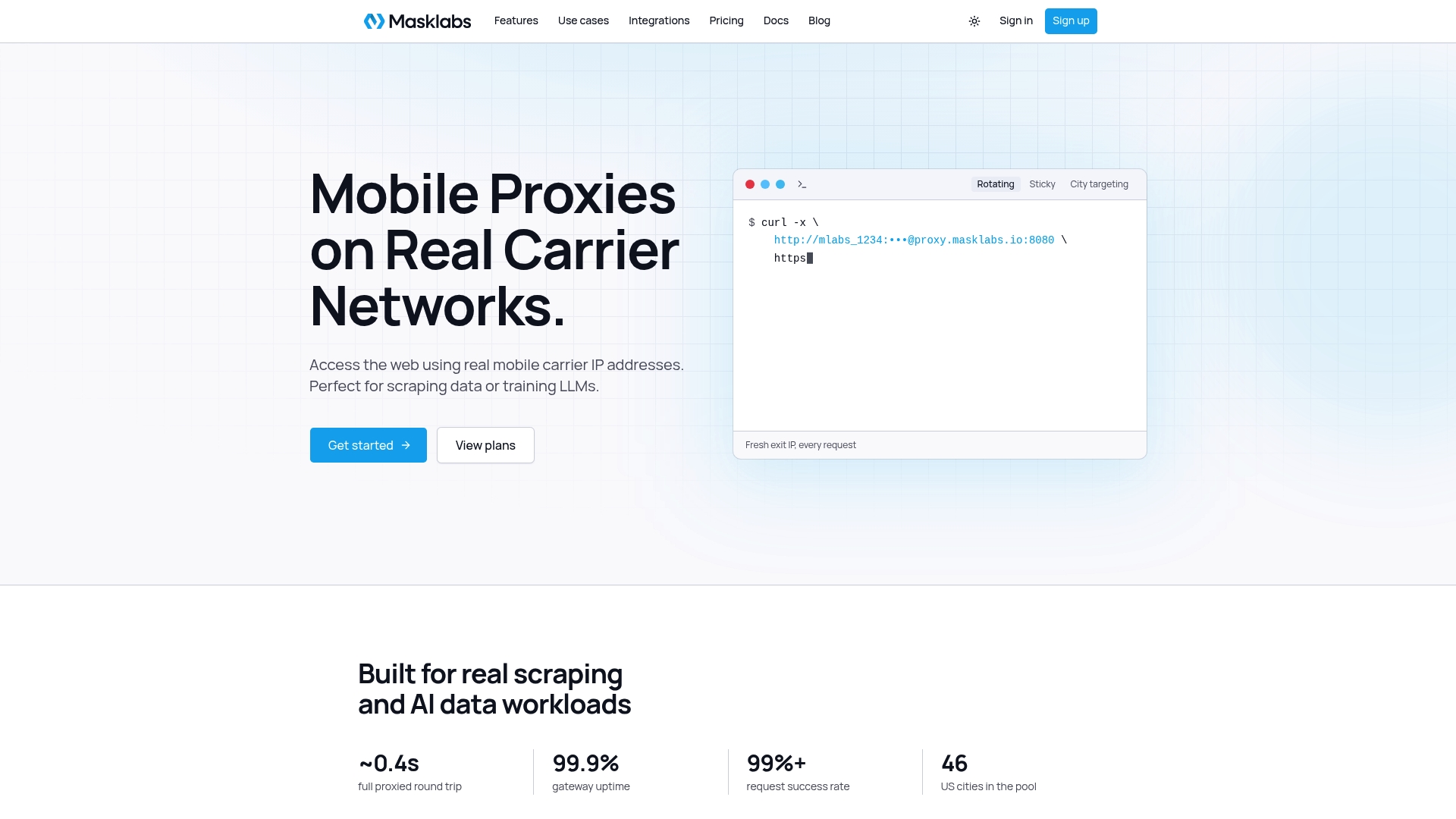
Whether you're running price monitoring across metro areas or training an AI model on geographically diverse data, city-level targeting means you're pulling from the exact location your project needs, not a nearby approximation. Plans scale from the Starter tier at $30 per month up through Advanced and Scale plans as your data pool grows, with no long-term contract locking you in. Check current plan details and start a trial on the Masklabs pricing page.
Sources
- Google developers: robots.txt specification
- Scrapfly Unblocker documentation
- 01net: Geo-blocking and VPN/Smart DNS explanations
FAQ
Is There a Free Way to Bypass Geo-Blocking?
Free methods like public proxies or Tor exist, but they're unreliable for scraping because their IP ranges are widely known and quickly blocked. Sticky, city-level mobile IPs offer far more consistent access, and Masklabs plans start with a free trial period before you commit to a paid tier.
Is Bypassing Geo-Blocking Illegal?
Bypassing a geo-block itself isn't inherently illegal in most contexts, but what you do with the data afterward can raise legal questions, especially with personal data. Following EDPB guidance on purpose limitation and data minimization and getting legal review for commercial-scale projects reduces that risk.
Is AI Scraping Illegal?
Scraping to build AI training datasets isn't automatically illegal, but regulators are paying closer attention to how personal data gets collected and used for that purpose. The EDPB's 2026 guidance recommends case-by-case assessment rather than treating all scraping the same way.
How Do You Circumvent Geo-Blocking for Scraping?
The reliable approach combines geo-targeted residential or mobile proxies with session management, coherent browser headers, and locale settings that match the proxy's region. VPNs and Smart DNS fall short here because Smart DNS does not change your actual IP address, making it ineffective against IP-based geo-blocking used in automated scraping.