Masklabs Selenium Proxy for Automated Testing Teams

Your Selenium tests only tell the truth when they run through the same network conditions your users actually see. Masklabs provides mobile proxy infrastructure, proxy API access, and browser automation support so your team can route Selenium WebDriver sessions through real, location-based proxy endpoints without building that layer yourself.
If you need Selenium proxy routing for geo-specific QA, restrictive network environments, ad verification flows, or browser-based data collection, Masklabs gives you a developer-focused way to plug proxy infrastructure directly into your automation stack. We serve developers, testing teams, data teams, AI companies, SEO professionals, and ad verification teams that need reliable programmatic web access.
Selenium proxy infrastructure from Masklabs for WebDriver and automated browser testing
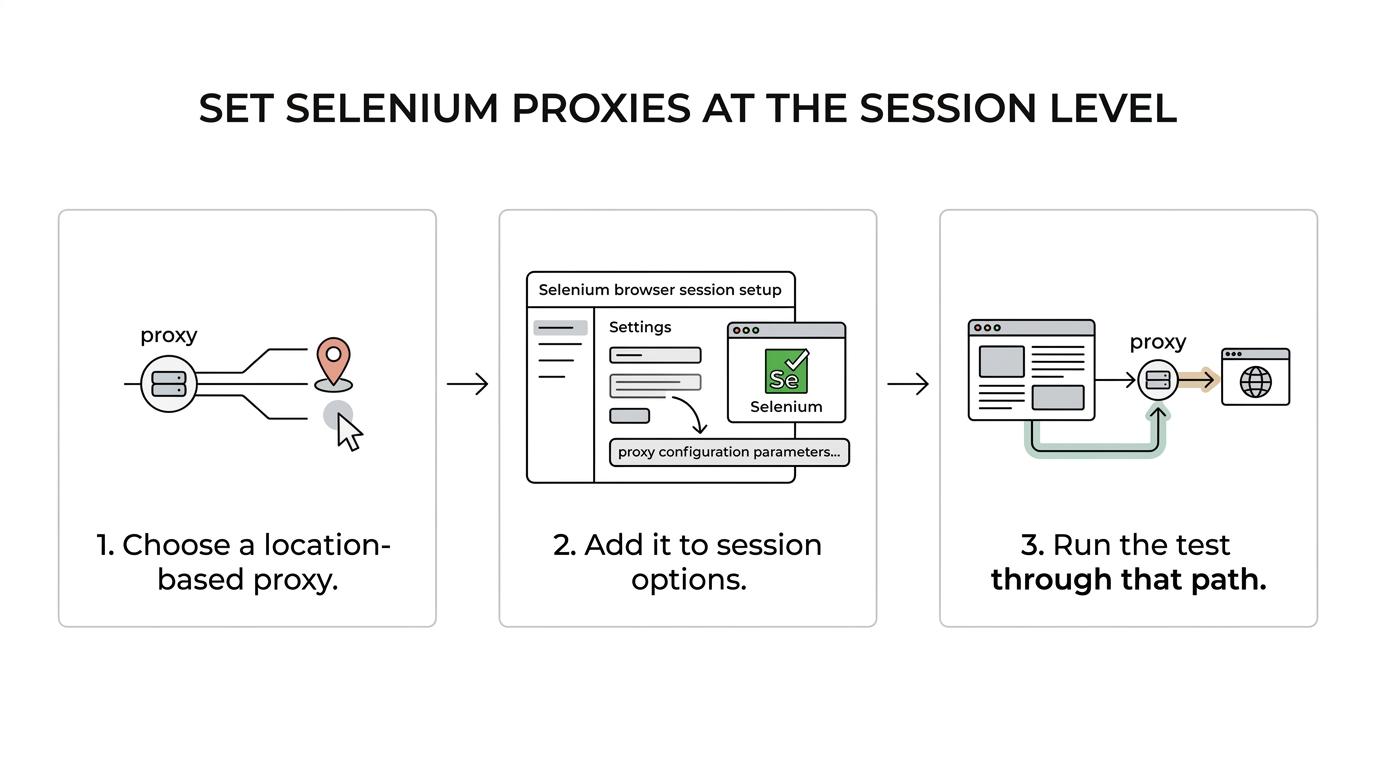
Selenium and the W3C WebDriver spec treat proxy configuration as a first-class session capability. That matters because your team can define proxy behavior at the browser session level, using capabilities or browser options, instead of trying to patch network behavior inside test code.
Masklabs fits that model well. We provide mobile proxies, proxy API access, and browser automation support that you can connect to Selenium sessions when you need location-based traffic, controlled routing, or a cleaner way to run tests through external networks.
"Masklabs combines mobile proxies, proxy API access, and browser automation support for Selenium-based workflows."
Selenium documentation specifically points to proxies for network traffic capture, mock backend calls, and access under complex network topologies or strict corporate restrictions. Masklabs helps your team operationalize those proxy-driven workflows with infrastructure built for programmatic use, not manual browser setup.
Masklabs helps automated testing teams run Selenium through location-based mobile proxies
A standard Selenium proxy setup routes automated browser traffic through a proxy for testing, inspection, or access requirements. With Masklabs, that becomes useful when your test outcome depends on where traffic appears to come from and how the target site responds to that network path.
That is especially relevant for teams testing:
- geo-sensitive page behavior and localized content
- login, checkout, or verification flows that vary by network origin
- restrictive or filtered network paths
- browser automation that needs external proxy control through WebDriver capabilities or ChromeOptions
Masklabs gives you mobile proxy infrastructure designed for location-based sessions, so your automation can better reflect user-facing conditions instead of always coming from a single static environment.
"Masklabs supports location-based sessions, which makes Selenium proxy routing more useful for geo-aware test coverage."
Selenium proxy configuration that matches how WebDriver actually works
Your team does not need a proxy product that fights the browser automation stack. WebDriver defines proxy configuration inside primary capabilities, and browser tooling like ChromeDriver exposes that through capabilities and options. In practice, that means your developers need proxy endpoints and a setup path that can be inserted directly into session configuration.
Masklabs is built for that developer workflow. We provide the proxy layer and programmatic access, while your team keeps control over how proxy settings are passed into Selenium sessions, ChromeOptions, or other browser automation tooling.
Because proxy behavior sits at the session and browser level, you can use Masklabs without redesigning the application under test. That keeps your automation architecture cleaner when the real need is network routing, location-based access, or proxy-backed browser traffic.
Browser automation support for testing, inspection, and restricted network access
Some Selenium proxy use cases are about much more than IP routing. Selenium’s own documentation highlights network traffic capture, mock backend calls, and access inside complex network environments. Those are practical buying concerns for automation teams that need repeatable test runs and predictable browser behavior.
Masklabs supports browser automation use cases where proxy control is part of the requirement, including:
- browser sessions that need a specific external network path
- web access workflows that depend on geographic origin
- testing or verification jobs that need programmatic proxy access
- automation systems used by QA, data, SEO monitoring, ad verification, or AI teams
"Masklabs is built for developers who need programmatic web access and browser automation support, not just a manual proxy login."
If your challenge is simply "make Selenium use a proxy," many providers can offer an endpoint. If your real challenge is "make Selenium use the right proxy in a way our developers can automate and maintain," Masklabs is the stronger fit.
What your team gets with Masklabs Selenium proxy access
Masklabs is designed for teams that want to move from one-off proxy experiments to repeatable automation workflows. Instead of piecing together generic proxy access and separate developer tooling, you get a focused stack for browser automation and programmatic web access.
With Masklabs, your team gets:
- Mobile proxies: Useful when Selenium traffic needs to originate through mobile proxy infrastructure rather than a fixed server network.
- Proxy API access: Better for programmatic session control, automation pipelines, and systems that need to manage proxy usage in code.
- Developer documentation and SDKs: Faster onboarding for engineering teams that want a self-serve path instead of long implementation cycles.
- Usage-based billing: More practical when your proxy demand changes by environment, workload, or test volume.
Those details matter because they reduce friction at the exact points where proxy projects often stall: setup, integration, repeatability, and cost control.
When Masklabs is the right Selenium proxy provider
Masklabs is a strong choice when your team already understands Selenium and needs proxy infrastructure that works with developer tooling, browser automation, and location-based access.
We are a good fit if you need to:
- route Selenium sessions through mobile proxies
- support location-based browser testing
- give developers API-driven workflows access
- connect proxy infrastructure to AI agents, data workflows, or automated browser systems
- start with self-serve documentation and quickstart resources
Masklabs may be especially relevant if your QA or automation work overlaps with data collection, ad verification, SEO monitoring, or AI-driven browsing, because those environments often need the same core capability: controlled, programmatic web access tied to browser automation.
Price clarity, implementation effort, and day-to-day maintainability
Buying a Selenium proxy service is rarely just about access. You also need to know how much engineering effort it will take, whether the setup matches your existing stack, and whether cost scales sensibly as usage changes.
Masklabs addresses those concerns in a practical way. Our developer documentation and SDKs support self-serve implementation, and our usage-based billing helps teams align spend with actual proxy activity rather than forcing a fixed commitment for every workflow.
That makes Masklabs easier to evaluate when you want to test a specific browser automation use case first, then expand once the Selenium proxy path is proven in your environment.
Why testing teams trust Masklabs for developer-first proxy workflows
Trust in this category comes from fit, clarity, and technical alignment. Masklabs is a technology company focused on proxy infrastructure and developer tools, with an offer centered on mobile proxies, browser automation, and programmatic web access.
That focus matters for Selenium users. You are not trying to buy a generic consumer proxy service for occasional browsing. You need infrastructure that maps to WebDriver capabilities, browser-level proxy configuration, and automated execution. Masklabs is built around those exact needs.
If your team needs a Selenium proxy solution that supports location-based sessions, works with browser automation, and can be integrated through API-driven workflows, Masklabs gives you a practical place to start.
Ready to route your Selenium traffic through developer-friendly proxy infrastructure? Explore Masklabs documentation and quickstart resources, then choose the proxy setup that fits your automated testing workflow.