Developers: Four proxy failover strategies that stop wasted retries

The proxy failover strategy that holds up under real traffic combines four layers: conservative retries with jitter, circuit breakers that eject failing endpoints, session-aware fallback pools, and short hedged probes for latency-sensitive calls. Together they stop wasted retries against dead endpoints and cut downtime without the complexity of a full custom routing layer. We rely on these same patterns when guiding teams through session management for mobile proxy workflows.
TL;DR:
- Retry with exponential backoff and jitter should be limited to 3 to 5 attempts, with delays capped around 60 seconds to prevent excessive wait times.
- Circuit breakers eject endpoints after about five consecutive failures and typically keep them out for 30 seconds, avoiding wasteful retries on dead hosts.
- Fallback pools should promote secondary endpoints based on reliability, and hedged probing is effective for latency-sensitive reads by sending parallel requests.
- Sticky sessions require backup or replicated session options to minimize disruption if an IP fails, whereas rotating sessions are less affected by individual endpoint failure.
- Instrumentation, including success and failure metrics, is crucial to accurately monitor failover effectiveness and prevent over-retrying or blind failover actions.
Table of Contents
- A quick catalog of proxy failover patterns
- Retry and backoff: safe defaults and configuration knobs
- Circuit breakers and outlier detection for proxy endpoints
- Session handling: rotating vs sticky sessions and failover behavior
- Multi-endpoint failover: ordered pools, hedging, and probing
- Health checks, detection thresholds, and probe timing
- Implementation checklist and short config examples
- Monitoring, logging, and metrics to validate failover behavior
- What breaks most failover setups in practice
- Try a proxy built for failover-friendly session control
- FAQ
- Sources
A quick catalog of proxy failover patterns
Each pattern solves a different failure mode, and picking the wrong one for your workload wastes requests or adds latency you didn't need to accept.
- Retry with backoff: resends a failed request after a delay, best for transient errors on idempotent calls.
- Circuit breaker: stops sending traffic to an endpoint after repeated failures, protecting your request budget.
- Fallback pool: routes to a secondary endpoint or session when the primary is unhealthy, suited to planned redundancy.
- Hedged probing: fires a second request in parallel after a short delay, trading extra load for faster success on latency-sensitive reads.
Non-idempotent operations (form submissions, account actions) need careful handling before any of these patterns apply, since a retry or hedge can duplicate the effect of the original request.
Retry and backoff: safe defaults and configuration knobs
Truncated exponential backoff with jitter is the standard approach: each retry waits longer than the last, up to a cap, with randomness added so retries from many clients don't collide. The AWS SDK retry guidance describes common settings worth adopting as a starting point.
- Base delay around 100 milliseconds to 1 second.
- Multiplier of 1.5x to 2x per attempt.
- A cap near 60 seconds so retries never balloon into minutes of waiting.
Common configurations use 3 to 5 max retry attempts with backoff multipliers of 1.5x to 2x, according to AWS's retry documentation, a range that balances recovery against request budget.
Retry on 429, 408, and 5xx responses, since these usually signal transient load or rate limiting. Avoid retrying most other 4xx codes: a 401 or 404 won't resolve itself on a second try, and retrying it just burns your proxy allocation. A retry budget, a hard cap on retries per time window, keeps one flaky endpoint from exhausting your data pool before healthier requests get a turn.
Circuit breakers and outlier detection for proxy endpoints

Circuit breaking stops sending requests to an endpoint once it crosses a failure threshold, giving it time to recover instead of hammering it with retries that are statistically unlikely to succeed. Outlier detection is the mechanism that watches for that threshold and ejects the bad host temporarily.
Envoy's documentation on transient failures lays out a workable model:
- Eject a host after a set number of consecutive failures, commonly 5.
- Apply a base ejection time, often 30 seconds, before the host is eligible again.
- Cap the share of the pool that can be ejected at once, often 50%, so you don't strand yourself with zero healthy endpoints.
Circuit breaking isn't a replacement for retries. It's backpressure: it stops the retry logic from wasting cycles on an endpoint that's already down, which is exactly how the two mechanisms are meant to cooperate.
Session handling: rotating vs sticky sessions and failover behavior

Rotating sessions assign a new IP on each request or at a set interval, so a single dead IP barely registers, the next request just gets a different one. Sticky sessions pin one IP for a longer window, often a few minutes, to preserve login state or a shopping cart, which means a failure mid-session is more disruptive.
For sticky sessions, three fallback options cover most cases:
- Backup sticky session: pre-request a second sticky IP and switch to it on failure, preserving continuity where possible.
- Session replication: keep lightweight state (cookies, headers) portable so a new sticky IP can resume the task.
- Rotation fallback: drop to a rotating IP temporarily when session continuity isn't essential to finishing the task.
Pro Tip: Pin a sticky session for only as long as the task needs, usually a few minutes, so a failed IP costs you less recovery work.
Our guide on rotating versus sticky sessions breaks down which choice fits scraping, account management, or geotargeted research, and the proxy checker tools roundup is useful for confirming rotation speed and session stability before you commit to a configuration.
Multi-endpoint failover: ordered pools, hedging, and probing
An ordered fallback pool ranks endpoints by recent reliability and tries them in sequence: primary first, then secondary, then tertiary. Promote a secondary to primary once it shows a consistently lower failure rate over a rolling window, rather than switching on a single success.
Hedged probing sends a second request after a short delay if the first hasn't responded, which speeds up success for latency-sensitive reads at the cost of extra load on the pool. MONET's research on web availability found that probing the first two paths returned by waypoint selection within a few hundred milliseconds, then committing to whichever responds first, substantially cuts wasted connection attempts compared to trying paths one at a time.
- Use lightweight TCP or DNS probes to check reachability before committing a full request.
- For HTTP proxies, a quick CONNECT or OPTIONS call confirms the tunnel works without the cost of a full fetch.
- Reserve hedging for idempotent GET-style requests, since duplicate attempts against a non-idempotent endpoint can cause real side effects.
Health checks, detection thresholds, and probe timing
Per-try timeouts and overall timeouts answer different questions: a per-try timeout bounds a single attempt, while the overall timeout has to account for every retry inside it, or your client will give up before the retry logic even finishes.
Choosing a detection threshold works best from data rather than guesswork. Sample your latency distribution and set the threshold just past the observed peak, the approach MONET researchers used to separate normal variance from genuine path failure, rather than picking a round number that feels safe.
- Active health checks (periodic synthetic pings) catch dead endpoints before real traffic hits them.
- Passive health checks (tracking live request outcomes) catch degradation that synthetic pings miss.
- Refresh health status often enough to react within a few retry cycles, but not so often that checks themselves add meaningful load.
Implementation checklist and short config examples
Rolling this out in order keeps each layer testable before you add the next one.
- Instrument every endpoint with success/failure counters before changing any routing logic.
- Set retry defaults: base delay, multiplier, cap, and max attempts.
- Configure circuit breaker thresholds for consecutive failures and ejection time.
- Define your ordered fallback pool and promotion criteria.
- Add lightweight probes for hedging and pre-flight checks.
- Wire up monitoring and alerting before you trust the system in production.
| Setting | Typical starting value |
|---|---|
| Base retry delay | 100ms to 1s |
| Backoff multiplier | 1.5x to 2x |
| Max retry attempts | several |
| Consecutive failure threshold | 5 |
| Base ejection time | 30s |
| Max ejection percent | 50% |
A retry-with-jitter routine checks the response code, skips non-retriable 4xx errors, and waits a jittered interval before the next attempt. A circuit breaker tracks consecutive failures per endpoint and removes it from rotation once the threshold is crossed, reinstating it after the ejection window closes, a pattern modeled directly on Envoy's retry and outlier detection behavior. Never retry a POST-style operation unless you've confirmed the endpoint treats it as idempotent.
Monitoring, logging, and metrics to validate failover behavior
Export per-endpoint success rate, consecutive failure counts, retry counts, hedged-probe win rate, ejection events, and latency distribution, since these together tell you whether failover is actually working or just adding noise.
- Alert when the retry ratio stays elevated for several minutes straight, a sign retries are masking a bigger problem.
- Alert when the ejected percentage of your pool exceeds a set share for five minutes or more.
- Run synthetic tests against your fallback pools regularly using proxy checker tools to confirm failover paths still work before you need them for real.
What breaks most failover setups in practice
The most common mistake we see is over-retrying: teams set five attempts on every error type, including ones that will never succeed, and burn through their proxy allocation chasing a dead endpoint. The second is ignoring idempotency, retrying or hedging a write operation and quietly duplicating it. The third is skipping instrumentation, so when failover does kick in, nobody can tell if it helped.
A high uptime and success rate above 99% across the mobile proxy network is a baseline worth checking against when you're deciding how aggressive your own retry and fallback logic needs to be.
Prioritize instrumentation first, retries second, and run a controlled failover test, deliberately killing a healthy endpoint, before trusting the system with production traffic.
— Jon
Try a proxy built for failover-friendly session control
Patterns like sticky-session fallback and ordered endpoint pools work best when the underlying proxy supports real session control rather than forcing you to guess at IP behavior. We built MaskLabs around real US carrier IPs across 46 cities, with both sticky and rotating sessions available through the same API, which gives you a cleaner foundation to apply the patterns above.
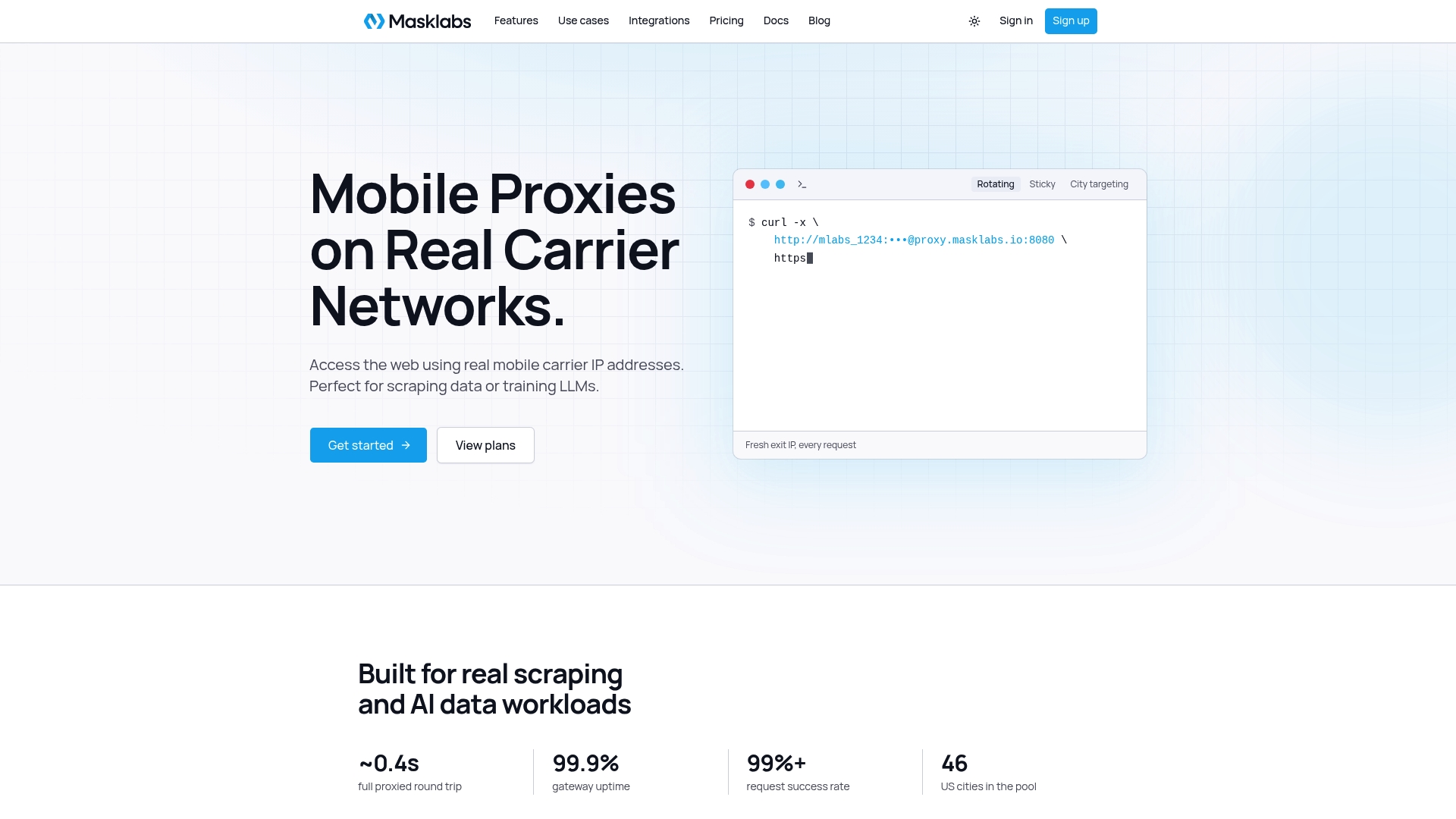
If you're setting up failover logic now, our Starter, Basic, Advanced, and Scale plans cover everything from a first integration to larger data pools, and the free trial gives you room to test retry and fallback configurations against real carrier IPs before committing. Pair that with our proxy checker tools to confirm rotation speed and session stability as you build out your pools.
FAQ
What is the safest default for retry attempts on proxy requests?
Most teams start with 3 to 5 max attempts using exponential backoff with jitter, as AWS's retry guidance recommends. Going higher tends to exhaust your request budget without meaningfully improving success rates.
Should I retry every failed proxy request?
No, only retry transient errors like 429, 408, and 5xx responses, since most other 4xx codes indicate a problem a retry won't fix. Non-idempotent operations need extra caution, since a retry can duplicate the original request's effect.
How is a circuit breaker different from a retry policy?
A retry policy tries the same or a similar request again after a failure, while a circuit breaker stops sending requests to an endpoint entirely once it crosses a failure threshold. Envoy's documentation frames circuit breaking as backpressure that protects resources, not a substitute for retry logic.
Do sticky sessions need a different failover approach than rotating sessions?
Yes, sticky sessions need a backup session or replicated state ready to take over, since losing one sticky IP mid-task is more disruptive than losing a rotating IP. Our guide to rotating versus sticky sessions covers which approach fits different workloads.
What does MaskLabs offer for teams building failover logic?
Plans range from Starter at 30.00 USD per month to Scale at 1000.00 USD per month, with a free trial available to test configurations first.
Sources
- AWS SDK retry behavior guidance
- Envoy docs: handling transient failures
- Improving Web Availability for Clients with MONET