Avoid Blocks: Rust Proxy Requests with 46 City Mobile IPs

Use reqwest::ClientBuilder::proxy(...) for most outbound proxied HTTP and HTTPS calls, and build one Client you reuse across requests instead of creating a new one each time. Reach for hyper-proxy when you need connector-level control over headers and TLS. If you're building a proxy server rather than calling one, pick axum-proxy or tower-proxy for middleware-style forwarding, pingora for programmable lifecycle hooks and failover logic, or rpxy for edge reverse-proxy and TLS termination work.
TL;DR:
- Most request failures stem from incorrect proxy rule order, proxy type mismatches, or missing support for SOCKS5 in your Cargo setup.
- Use
Proxy::allfor general routing but place more specific host or scheme rules before broad fallbacks to avoid shadowing.- Proxy authentication should be configured with
basic_authorcustom_http_authand tested with intercepting proxies to debug credential issues.- For direct protocol control or request header manipulation,
hyper-proxyprovides necessary features, especially for HTTP-specific behaviors.- Masklabs offers real mobile carrier IPs with session control, helping improve success rates in scraping by mimicking genuine mobile traffic.
Table of Contents
- Configuring reqwest for Rust Proxy Requests
- Proxy Authentication and Custom Headers
- Does reqwest Support SOCKS5 Proxies?
- How Do You Bypass Proxies for Specific Hosts?
- When to Reach for Hyper and hyper-proxy
- Building a Proxy Server in Rust: Which Pattern Fits?
- Best Practices and Troubleshooting Checklist
- What Rust Developers Get Wrong About Proxy Requests
- Test Your Rust Proxy Setup With Real Carrier IPs
- Sources
- FAQ
Configuring reqwest for Rust Proxy Requests
The reqwest::Proxy type gives you four entry points, and choosing the right one matters more than most developers expect. Proxy::http(url) intercepts only plain HTTP traffic. Proxy::https(url) intercepts only HTTPS. Proxy::all(url) routes everything through a single proxy, which is what most scraping and data collection projects reach for first. Proxy::custom(closure) lets you write routing logic based on the destination URL itself, useful when different targets need different exit points.
A typical setup looks like this:
let proxy = reqwest::Proxy::all("http://proxy.example.com:8080")?;
let client = reqwest::Client::builder()
    .proxy(proxy)
    .timeout(std::time::Duration::from_secs(30))
    .build()?;
Build the reqwest Proxy once and attach it to a ClientBuilder, then reuse that Client for the life of your application. Reqwest's Client holds a connection pool internally, and recreating it per request throws away that pool, forcing new TCP and TLS handshakes on every call. That's a real cost when you're firing hundreds of requests through the same proxy.
Rule ordering matters when you register more than one proxy. Register specific scheme or host matchers before a catch-all Proxy::all, since a broad rule added first will shadow anything more targeted that comes after it.
- Add host-specific or scheme-specific rules first.
- Add
Proxy::alllast, as your fallback. - Use
Proxy::customwhen routing depends on request-time logic rather than a fixed pattern. - Test each rule in isolation before combining them.
Pro Tip: Log the resolved proxy URL for a sample of outbound requests during development. It's the fastest way to catch a shadowed rule before it costs you an afternoon of debugging.
Proxy Authentication and Custom Headers
Proxy authentication is a separate concern from the Authorization header you send to your destination server, and mixing the two up is one of the most common mistakes developers make with Rust HTTP proxy requests. The proxy authenticates you at the network hop; the destination authenticates you for the resource itself.
For standard username and password credentials, Proxy::basic_auth(username, password) sets a Proxy-Authorization header with Basic scheme encoding automatically. The reqwest Proxy documentation covers this alongside custom_http_auth, which you'll need when a provider uses a non-Basic scheme, like a bearer token or a custom signature header.
- Use
basic_authfor standard username/password proxy credentials. - Use
custom_http_authwhen the provider requires a token or custom scheme instead of Basic. - Attach additional headers through
Proxy::headerswhen a provider expects session identifiers or rotation flags on every request. - Never put proxy credentials inside a request's
Authorizationheader; that field belongs to the destination server.
Testing auth failures blind is painful. Run requests through a local intercepting proxy like Burp Suite or mitmproxy during development, so you can see exactly what headers left your client and whether the proxy provider's logs match what you sent. That comparison usually reveals the problem in minutes instead of hours.
Does reqwest Support SOCKS5 Proxies?
Yes, but only after you enable it explicitly. Reqwest gates SOCKS5 support behind a Cargo feature flag, and if you skip that step, adding a socks5:// URL to your Proxy won't throw a clear error. It just fails silently or falls back in confusing ways.
Enable it in Cargo.toml:
reqwest = { version = "0.12", features = ["socks"] }
Then point your proxy at a SOCKS5 endpoint:
let proxy = reqwest::Proxy::all("socks5://127.0.0.1:1080")?;
SOCKS5 and HTTP proxies behave differently under the hood. HTTP proxies see and can modify request headers; SOCKS5 operates at a lower level and tunnels raw traffic, which matters if a provider's authentication or rotation logic depends on header inspection. Run a smoke test for each scheme you support, since a working HTTP proxy configuration tells you nothing about whether your SOCKS5 path is wired up correctly.

How Do You Bypass Proxies for Specific Hosts?
Proxy::no_proxy lets you exclude specific hosts from an otherwise active proxy rule, which matters for destinations like cloud metadata endpoints (169.254.169.254) or local services on localhost that should never route through an external proxy. Environment variables HTTP_PROXY, HTTPS_PROXY, and NO_PROXY can also drive this behavior at the OS level, and reqwest respects them by default unless you disable that with no_proxy() on the builder.
Don't confuse this with Cargo's own proxy resolution. Cargo resolves its proxy settings independently, checking Cargo config, then Git config, then environment variables, purely to fetch crates during a build. That resolution has nothing to do with how your compiled application routes its own HTTP traffic at runtime. Keep the two mental models separate or you'll spend time debugging the wrong layer.
When to Reach for Hyper and hyper-proxy
Reqwest hides a lot of protocol detail that some applications need direct access to, and that's where hyper-proxy comes in. ProxyConnector::from_proxy wraps a base connector with proxy awareness, but the behavior splits by protocol in a way that trips people up.
For plain HTTP requests, you often need to manually append the headers returned by proxy.http_headers(&uri) to your outgoing request. For HTTPS, that step isn't needed because the connection tunnels through a CONNECT request instead, and the proxy never sees the encrypted payload or its headers. hyper-proxy's documentation lays out both paths, and missing the HTTP header step is a common source of requests that silently bypass the proxy entirely.
hyper-proxy also exposes feature variants for TLS backend choice, native-tls or rustls, so pick based on whatever your existing connector stack already uses to avoid pulling in a second TLS implementation.
Building a Proxy Server in Rust: Which Pattern Fits?
Client-side proxying and server-side proxying solve different problems, and the crate you pick should match the role you're actually building. A forward proxy sits in front of clients and routes their outbound traffic. A reverse proxy sits in front of servers and distributes inbound traffic. A transparent or service-mesh proxy intercepts traffic without either side configuring it directly.
Three Rust options cover most of this ground:
- axum-proxy or tower-proxy for middleware-style forwarding, when you're already running an Axum service and want proxy behavior as another layer in your Tower stack.
- pingora when you need programmable lifecycle hooks, retries, dynamic upstream selection, and other production concerns baked into the request path.
- rpxy for edge reverse-proxy work, particularly TLS termination and HTTP/2 or HTTP/3 handling in front of backend services.
Pingora's design separates pooling, retries, TLS handling, and observability into distinct concerns rather than bundling them, which is worth studying even if you end up choosing a lighter crate.
Pro Tip: Pick your runtime and connector features before you write any forwarding logic. Retrofitting Tokio configuration or TLS backend choice after the fact usually means rewriting your connection layer.
Whatever you choose, Tokio provides the async runtime underneath nearly all of them, since std::net lacks the scheduling and timers a high-concurrency proxy needs.
Best Practices and Troubleshooting Checklist
Most Rust proxy request failures trace back to a handful of repeat offenders: a shadowed rule from registering Proxy::all too early, an auth header placed in the wrong slot, a missing socks feature flag, or a TLS verification mismatch between your client and the proxy's certificate.
- Reuse one
Clientinstance; never rebuild it per request. - Set explicit timeouts so a hung proxy doesn't stall your whole pipeline.
- Verify the proxy scheme matches what you configured (
http://versussocks5://). - Reproduce failing requests with
curl -xagainst the same proxy before debugging your Rust code. - Check
NO_PROXYand rule order any time traffic bypasses the proxy unexpectedly.
Tokio's non-blocking model keeps idle threads cheap, but it doesn't set your timeouts or concurrency caps for you. Capture request duration, retry counts, and proxy response codes as metrics from day one. Reconstructing that data after a production incident is far harder than logging it up front.
What Rust Developers Get Wrong About Proxy Requests
The mistake I see most often isn't a bad API call. It's treating the proxy layer as an afterthought bolted onto working code, instead of a first-class part of the request path that needs its own error handling, timeouts, and testing.
Developers will get their reqwest::Client working against a residential or datacenter proxy in a local test, ship it, and then get blindsided when the same target site starts blocking or throttling requests in production. The proxy worked. The IP reputation behind it didn't. That's a distinction the reqwest docs can't teach you, because it has nothing to do with the API and everything to do with what's on the other end of that proxy connection.
Mobile carrier IPs change that equation, since traffic looks like it's coming from a real phone on a real network rather than a data center block that's already been flagged. Combined with city-level targeting and sticky or rotating sessions, that's the layer worth testing before you scale any Rust scraping or data collection pipeline past a proof of concept. Masklabs' quickstart guide walks through getting credentials and making a first proxied request if you want to see that difference directly.
— Jon
Test Your Rust Proxy Setup With Real Carrier IPs
Masklabs gives you real US mobile carrier IPs across 46 cities instead of datacenter addresses, so the requests your Rust client sends look like genuine mobile traffic rather than a flagged proxy block. That distinction is what keeps scraping and data collection jobs running instead of getting throttled mid-run.
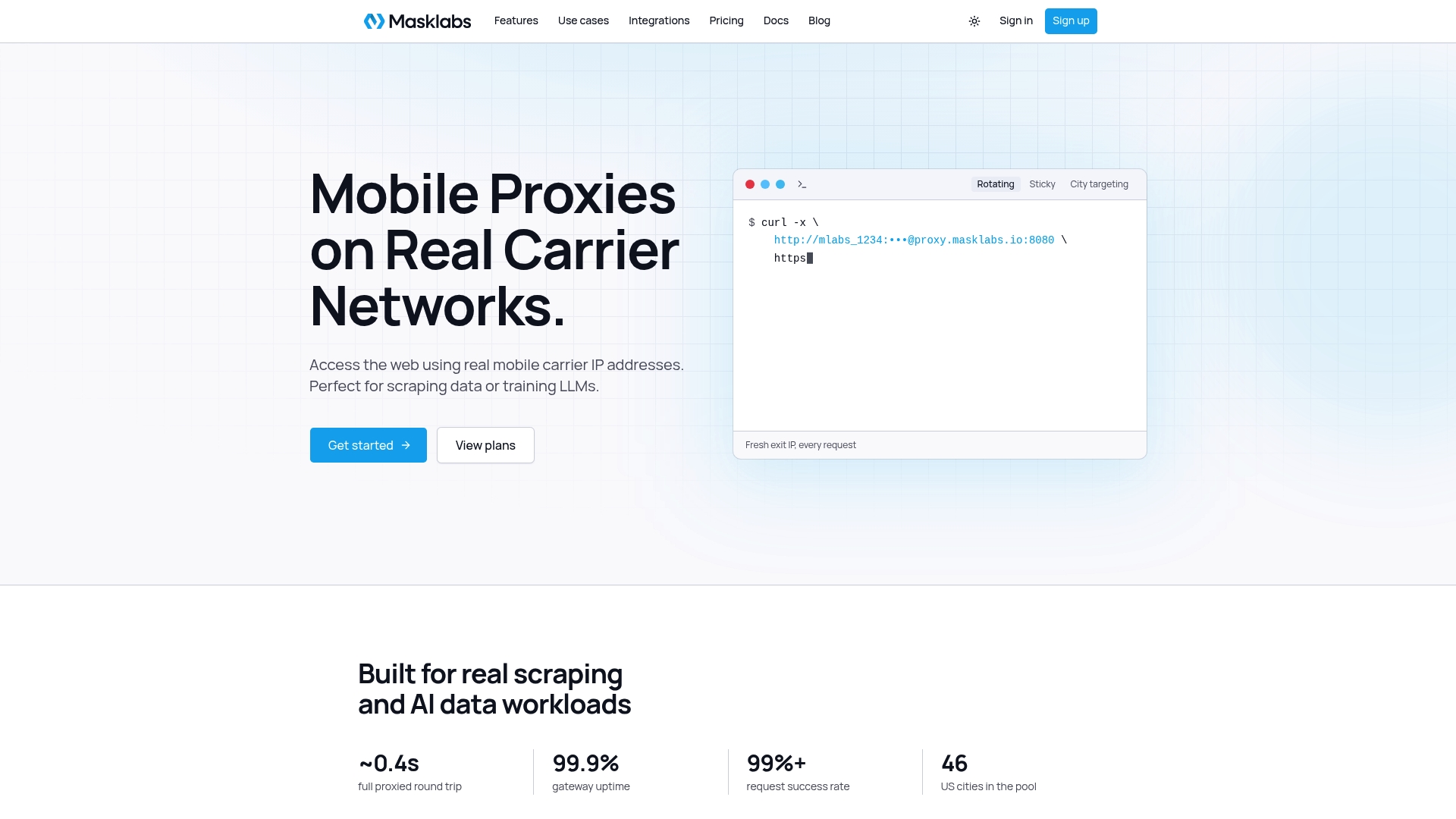
You get sticky or rotating sessions, full HTTP, HTTPS, and SOCKS5 support compatible with common Rust proxy client patterns, and self-serve credential management. If you're testing rotation and latency before committing to a plan, the proxy checker tools guide is a solid next stop, and the session management guide covers sticky session strategy for longer-running jobs.
Start with the free trial, wire up your Rust client using the quickstart guide, and check the Starter, Basic, Advanced, and Scale plans once you know how much data your project needs.
Sources
FAQ
Should I use reqwest or hyper-proxy for Rust proxy requests?
Use reqwest for most application code since its Proxy type covers HTTP, HTTPS, and SOCKS5 through a simple builder API. Reach for hyper-proxy only when you need direct control over connector behavior, like manually inspecting CONNECT tunneling or appending proxy headers yourself.
Why does my SOCKS5 proxy fail silently in reqwest?
The most common cause is a missing socks feature flag in Cargo.toml. Reqwest gates SOCKS5 support behind that flag, and a socks5:// URL without it won't produce a clear error message.
How do I stop a proxy from intercepting local requests?
Use Proxy::no_proxy to exclude specific hosts, or set the NO_PROXY environment variable to bypass the proxy for destinations like localhost or cloud metadata endpoints. This is separate from Cargo's own proxy resolution, which only affects crate downloads.
What's the difference between axum-proxy and pingora for building a proxy server?
axum-proxy and tower-proxy fit middleware-style forwarding inside an existing Tower or Axum service. Pingora is built for programmable lifecycle hooks, retries, and dynamic upstream selection when you need more control over the proxy's request lifecycle.
Does Masklabs work with Rust HTTP clients like reqwest?
Yes. Masklabs supports HTTP, HTTPS, and SOCKS5 protocols, which plug directly into reqwest::Proxy and hyper-proxy connector patterns. Full setup details are in the quickstart guide.