Engineering Managers: 5 Ops Rules to Scale Scraping, Avoid Legal Risk

The workflow pattern that works reliably across growing teams is orchestration plus fetch, extract, validate, store, and monitor, run as separate stages with clear handoffs. This separation stops one broken selector from taking down an entire pipeline, gives you a place to catch compliance issues before data lands in a warehouse, and gives data engineers, analytics teams, and automation managers a shared vocabulary for diagnosing failures fast.
TL;DR:
- Use clear separation of stages in the scraping pipeline to prevent failures from cascading and improve failure diagnosis.
- Implement a minimal data contract requiring source URL, fetch timestamp, schema version, and extraction status to facilitate debugging and validation.
- Prioritize source management, collection frequency, and explicit ownership to avoid scope creep, quality decay, and silent failures.
- Choose tooling based on target site complexity, scaling needs, and IP strategy, with headless browsers for dynamic content and proxies for anti-bot defenses.
- Maintain strict security practices for credentials, sensitive data, and network access, and establish incident response protocols tailored to scraping-specific errors.
Table of Contents
- Core components teams must implement
- How teams plan scraping projects and manage ownership
- Tooling and architecture patterns for reliable scraping
- Operational practices to scale safely and predictably
- Practical patterns for validation, deduplication, and storage
- Regulatory and privacy signals teams must treat as constraints, with mitigations
- MaskLabs as an operational example: proxy features that help teams
- Team roles and responsibilities in scraping projects
- Collaboration and communication practices within scraping teams
- Version control and codebase management for scraper development
- Security best practices for scraping workflows
- Incident response and troubleshooting protocols specific to scraping operations
- Author perspective for engineering managers
- Try MaskLabs for mobile-proxy-backed scraping
- FAQ
- Sources
Core components teams must implement
A scraping pipeline breaks down into distinct jobs, and the teams that scale smoothly keep those jobs separate instead of bundling everything into one script.
Crawlers (or agents) handle navigation and fetching only: following links, paginating, and respecting rate limits. The extractor layer takes raw HTML or API responses and turns them into structured fields with advanced extraction techniques, isolated from network concerns so a layout change doesn't require touching your crawl logic. Between the two sits a task queue that handles scheduling, retries, and back off, letting failed fetches get dequeued without blocking the rest of the run.
Storage decisions come next: raw payloads usually belong in object storage or a data lake for replay and debugging, while cleaned, validated records move into a warehouse or database for analytics. Cleaning and enrichment should run as a distinct step after extraction, never inline inside the crawler.
A minimal data contract keeps every stage honest. We'd recommend requiring at least:
- Source URL and timestamp of the fetch.
- Worker or job ID that produced the record.
- Schema version so downstream consumers know what shape to expect.
- Extraction confidence or status flag marking partial or failed parses.
Without this contract, debugging a bad batch means guessing which stage introduced the error.
How teams plan scraping projects and manage ownership
Planning prevents the two most common scraping failures: scope creep and silent data quality decay. A short checklist before any project starts keeps both in check.
- Define the objective and data SLA. State what question the data answers and how fresh it needs to be, daily, hourly, or near real time.
- Prioritize sources by value and volatility. Rank targets by how often their structure or content changes, and spend engineering time where that risk is highest.
- Set collection frequency against cost. More frequent runs mean more proxy usage and more chances to trigger blocks, so match frequency to actual business need rather than defaulting to "as often as possible."
- Assign explicit ownership. Someone owns selectors and parsing logic, someone owns the transform layer, and someone owns monitoring and alerts. Overlap causes drift; gaps cause silent failures.
- Run a staging pass before production. Test selectors and rate limits against a small sample, confirm schema compliance, and check for unexpected redirects or CAPTCHAs before scaling up.
Treating these steps as a gate, not a formality, catches most downstream data quality problems before they reach a dashboard.
Tooling and architecture patterns for reliable scraping
Tool choice should follow the target, not the other way around. Lightweight HTTP clients are faster and cheaper when a site serves static HTML or exposes a usable API. Headless browsers like Playwright earn their overhead when content renders client-side, requires interaction, or sits behind login flows.
For orchestration, most teams land on one of three patterns:
- Task queues (Celery, RQ) for moderate scale with straightforward retry logic.
- Kubernetes-based worker pools when you need horizontal scaling and resource isolation across many concurrent jobs.
- Serverless functions for burst, infrequent crawls where paying for idle workers makes no sense.
Scrapy Cluster's production guidance recommends running spiders light per machine and scaling horizontally instead of stacking many processes on one host, with heavy transforms pushed into downstream consumers rather than item pipelines. That advice holds regardless of which orchestration layer you pick.
Proxy strategy belongs in this layer too. Datacenter IPs get flagged quickly on sites with real anti-bot defenses, while mobile and residential IPs look like ordinary user traffic and tend to see lower block rates. For teams wiring scrapers into CI/CD, add a staging environment that runs the full pipeline against a small target set, gated behind the same tests that cover selector output and schema validation before anything ships to production.
Pro Tip: Run your staging crawl against a cached snapshot of the target site when possible, so test failures point to your code, not the target's uptime.
Operational practices to scale safely and predictably
Scaling a scraper is less about adding workers and more about controlling how those workers behave under load. A few operational habits separate stable pipelines from ones that get blocked every week.
- Per-domain throttling, implemented with a token-bucket limiter, keeps request rates proportional to what each target can tolerate rather than applying one global limit everywhere.
- IP pool management matters as much as request pacing: sticky sessions preserve a single identity through multistep flows like logins or checkouts, while rotating sessions spread requests across many IPs for high-volume, stateless crawling. Health checks should flag and retire IPs that start returning elevated error rates.
- Autoscaling worker counts against queue depth, rather than a fixed schedule, keeps throughput matched to actual backlog instead of over-provisioning during quiet periods.
- Alerting and runbooks need to cover the error classes that actually recur: timeout spikes, selector mismatches after a layout change, sudden CAPTCHA rates, and authentication failures on logged-in flows.
MaskLabs' guidance on rate limiting walks through how throttle patterns affect large-scale automation, which is worth reviewing when setting per-domain limits for the first time. Teams that skip this step tend to discover their rate limits the hard way, through a block, not a graph.
Practical patterns for validation, deduplication, and storage
Data that isn't validated at the point of extraction becomes a debugging problem weeks later, usually discovered by whoever is building a report on top of it.
Schema-first contracts, whether JSON Schema or Protobuf, force every extracted record through a validation step before it moves downstream. Fields that fail validation should get flagged and quarantined, not silently dropped or silently passed through.
Provenance metadata matters just as much as the data itself: source URL, fetch timestamp, worker ID, and relevant request headers let you trace any record back to exactly how and when it was collected; this is essential when a value looks wrong.
- Deduplication should rely on a canonical identifier derived from stable fields, not the full record, since minor formatting differences otherwise create false uniques.
- Event streams (Kafka, Kinesis) fit the ingestion layer, where records arrive continuously and need buffering before processing.
- Warehouses (Snowflake, BigQuery, Postgres) fit the analytics layer, where cleaned, deduplicated data needs to support queries and dashboards.
Keeping these layers distinct avoids a warehouse full of near-duplicate rows that nobody trusts.
Regulatory and privacy signals teams must treat as constraints, with mitigations
Scraping operates inside real legal constraints, and treating robots.txt, CAPTCHAs, and anti-scraping meta tags as pure technical obstacles rather than risk signals is a common mistake. The European Data Protection Board's 2026 guidelines state that web scraping for AI training often falls within GDPR's scope, and that controllers should apply a legitimate-interest balancing test alongside data minimization and technical mitigations such as excluding sensitive sources.
France's data protection authority gives a concrete mitigation checklist for teams relying on legitimate interest: predefine collection criteria, maintain exclusion lists for sensitive sites, delete irrelevant sensitive data immediately, and publish transparency notices about what gets collected, according to CNIL's guidance on legitimate interest.
Practical mitigations worth building into any pipeline:
- Automated exclusion lists that block known sensitive domains before a crawl starts.
- Filters that flag special-category data (health, biometric, political) for manual review rather than automatic storage.
- Monitoring dashboards that surface when a scrape touches a new, unnetted source.
- Documentation of which party acts as data controller versus processor when scraping is contracted out.
EDPB guidance also treats robots.txt and CAPTCHAs as meaningful signals of a site owner's expectations, not merely technical speed bumps, when assessing collection risk.
MaskLabs as an operational example: proxy features that help teams
Mobile carrier IPs solve a specific problem in team workflows: requests that come from real phones on real carrier networks look like ordinary consumer traffic instead of flagged datacenter traffic, which lowers block rates on sites with aggressive anti-bot defenses.
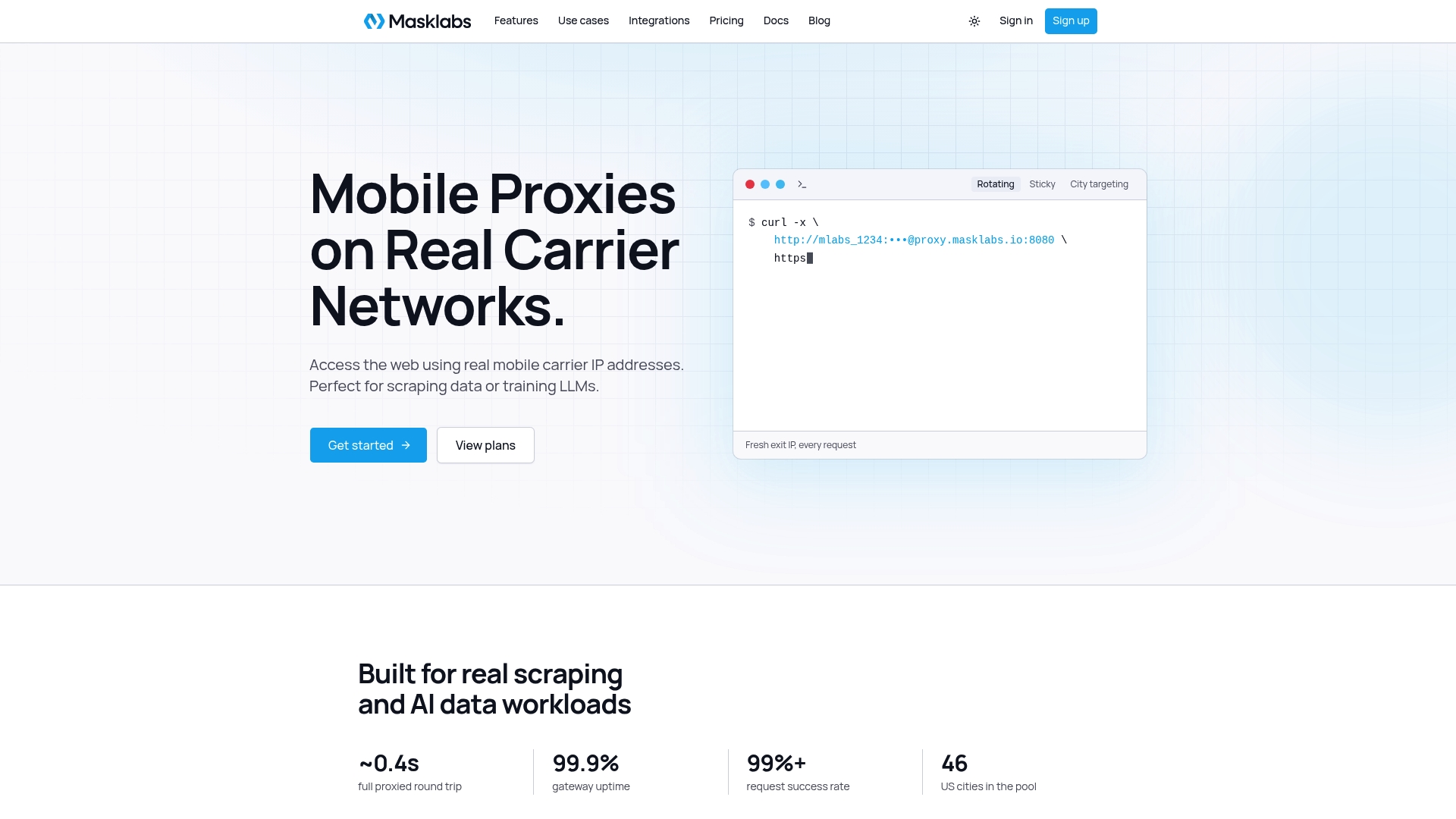
Our proxy service at MaskLabs provides real US mobile carrier IPs with city-level targeting across 46 US cities, along with sticky and rotating session options and full HTTP, HTTPS, and SOCKS5 support through a single API.
For team integration, a few patterns work well:
- Use sticky sessions for any flow that requires maintaining login state across multiple requests.
- Use rotating sessions for high-volume, stateless crawling where spreading load across many IPs matters more than identity persistence.
- Build health checks into your IP pool manager so degraded connections get retired automatically rather than silently dragging down success rates.
Our mobile proxy API documentation covers credential setup and session parameters for teams wiring this into existing pipelines.
Team roles and responsibilities in scraping projects
Scraping projects tend to fail less from bad code and more from unclear ownership. A working team structure usually assigns four distinct roles, even when the same person covers more than one.
A pipeline engineer owns crawler and extractor code, including selector maintenance when target sites change layout. A data engineer owns the transform and storage layer, schema evolution, and warehouse integration. An operations or SRE-minded owner handles monitoring, alerting, and incident response when scrapers start failing at scale. A compliance or legal liaison, even part time, reviews new sources against privacy and robots.txt signals before they go into production.

Smaller teams often collapse these into two people, but the responsibilities themselves don't disappear, they just get split unevenly. The failure pattern to avoid is one person owning everything informally: when that person is out, nobody knows which selector broke or why a job silently stopped producing records.
Clear role boundaries also make on-call rotations possible. If monitoring and incident response are explicitly owned, you can rotate that duty across the team instead of always paging the person who wrote the original scraper. That single change tends to reduce burnout on teams running dozens of concurrent jobs, since no one person becomes the permanent bottleneck for every 2 AM alert.
Collaboration and communication practices within scraping teams
Scraper code changes more often than most software, since target sites update their layouts without warning. That churn makes code review and documentation habits more important here than in many other engineering contexts.
Code reviews for scrapers should check three things beyond normal logic review: whether a selector change is resilient to minor layout shifts, whether rate limits and retry logic match the target's actual tolerance, and whether the change respects any exclusion rules already in place for that source. A reviewer who only checks syntax will miss the failure modes that actually take scrapers down.
Documentation standards matter more here than in typical backend work because tribal knowledge about "why this selector is weird" or "this site blocks after 200 requests per hour" disappears fast if it only lives in one engineer's head. A shared runbook per source, covering known quirks, rate limits, and recent breakage history, saves hours during incident response.
Regular syncs between the pipeline engineer and whoever owns compliance review catch problems early, particularly when a new source gets added. A five-minute conversation before onboarding a target site is cheaper than discovering a legal concern after three months of collected data.
Shared dashboards showing crawl health, success rates, and recent errors give the whole team the same picture, instead of forcing people to ask "is the scraper down?" in a chat channel.

Version control and codebase management for scraper development
Scraper codebases benefit from the same discipline as any production software, with a few scraping-specific additions. Branching by source or domain, rather than by feature alone, makes it easier to isolate the blast radius when one site's layout changes and breaks a selector.
Selectors and extraction rules should live as data, not hardcoded strings scattered through logic, ideally in a single configuration file or table per source. This gives you one place to update when a layout shifts, and makes diffs in pull requests actually readable.
Tagging releases by which sources they affect helps with rollback: if a deploy breaks extraction for one domain, you want to revert that domain's logic without touching the fifteen other pipelines running fine. Automated tests that run known HTML fixtures through your extractors on every commit catch most regressions before they reach production, since fixture-based tests don't depend on the live site being reachable during CI.
Keep a changelog tied to source-specific breakage, separate from your general release notes. When a selector breaks six months from now, the fastest path to a fix is often "what did we change last time this site redesigned," and that history only helps if it's searchable.
Security best practices for scraping workflows
Scraping pipelines handle credentials, proxy keys, and sometimes personal data, which makes basic security hygiene non-negotiable rather than optional.
Credential management should keep API keys, proxy authentication, and database passwords out of source code entirely, stored instead in a secrets manager or environment-specific vault with access scoped to the services that actually need them. Rotating these credentials on a schedule, rather than only after a suspected leak, limits how long a compromised key stays useful.
Data protection extends to what you store, not just how you authenticate. Encrypt sensitive fields at rest, limit retention of anything that resembles personal data to what your compliance review actually justifies, and apply access controls so that raw scraped payloads aren't broadly readable across the engineering org.
Network-level protections matter too: route scraper traffic through proxies configured with authenticated access rather than open relays, and log proxy usage so unusual spikes in requests or failed authentications get flagged quickly. Teams running scrapers against sites with login flows should treat stored session cookies and tokens with the same care as passwords, since a leaked session can expose far more than a leaked password alone.
Incident response and troubleshooting protocols specific to scraping operations
Scraper incidents look different from typical application outages: the code often works fine, but the target changed, got blocked, or started serving a CAPTCHA wall. Treating every failure as a generic bug wastes time.
A useful first triage step is classifying the failure: is it a layout change breaking extraction, a rate-limit or CAPTCHA block, a proxy health issue, or a genuine code regression? Each points to a different fix, and dashboards that separate error types by category cut diagnosis time significantly compared to one undifferentiated error log.
Runbooks should document the known fix path for each category: rolling back a selector change, rotating to a fresh IP pool, pausing a specific source's crawl frequency, or escalating to compliance if a new blocking pattern suggests a site has changed its stance on automated access. Keeping a short history of past incidents per source, similar to the changelog recommended for version control, speeds up recognition when a familiar failure pattern reappears.
Post-incident reviews for scraping outages should ask one extra question beyond the usual "what broke": did we have the right monitoring in place to catch this sooner, or did we only notice because someone downstream flagged bad data?
Author perspective for engineering managers
Build observability before you build throughput. A team with retries, staging, and shared selector configs can survive a slow proxy pool, but a fast pipeline with no monitoring just fails faster and quieter. Invest in schema contracts and staging first, scale second.
— Jon
Try MaskLabs for mobile-proxy-backed scraping
If block rates or geotargeting gaps are slowing your team down, real US mobile carrier IPs with city-level targeting and sticky or rotating sessions give you a more authentic request profile than datacenter proxies.
We offer a range of plans so you can match data allowance to project size. Check current pricing on our MaskLabs pricing page and start a trial to test it against your own targets.
FAQ
Is AI scraping illegal?
AI scraping isn't automatically illegal, but it often falls within GDPR's scope when personal data is involved, according to the EDPB's 2026 guidelines. Controllers are expected to apply a legitimate-interest balancing test and minimize data collected from sensitive sources.
Is web scraping illegal in the US?
Scraping publicly available data generally isn't illegal in the US on its own, but specific practices can create legal exposure depending on what's collected, how it's accessed, and the terms of the site involved. Teams handling personal data should still apply privacy-minimizing practices regardless of jurisdiction.
Is web scraping illegal?
Web scraping itself isn't inherently illegal, but legality depends heavily on what data gets collected, from where, and under which country's rules apply. The EDPB guidelines and CNIL's guidance both treat privacy compliance as the key constraint rather than scraping as a blanket prohibition.
Does Microsoft Teams have a workflow tool?
Microsoft Teams includes workflow and automation features through its integration with Power Automate, which can trigger actions based on Teams events. It isn't built for scraping orchestration specifically, so most scraping teams rely on dedicated task queues or orchestration frameworks instead.
Sources
- Guidelines 03/2026 on web scraping in the context of generative AI
- The legal basis of legitimate interest: focus sheet on the measures to implement in the case of data collection by web scraping | CNIL
- Production Setup — Scrapy Cluster docs