HTTP vs HTTPS Proxy: 5 Decision Rules for Network Admins

Practically, an HTTP proxy can read and modify requests, while HTTPS traffic is typically tunneled through an HTTP proxy with CONNECT, so the proxy cannot read it. "HTTPS proxy" usually refers to one of two different things: an encrypted client to proxy hop, or a TLS terminating intercepting proxy that breaks that encryption on purpose.
TL;DR:
- HTTPS proxies that decrypt traffic require clients to install trusted certificates, breaking TLS end-to-end security and enabling inspection capabilities.
- Using CONNECT tunnels limits the proxy's visibility to destination IP addresses and byte counts, with no access to headers or content unless TLS is decrypted.
- Client environments often misconfigure or rely on default library settings, leading to proxies inadvertently falling back to plaintext connections, compromising security.
- For untrusted networks, TLS to the proxy is recommended, while strict access controls and limited logging are critical to mitigate interception risks.
- MaskLabs offers real US mobile carrier IPs with support for HTTP, HTTPS, and SOCKS5, providing predictable exit points for scraping and geo-testing workflows.
Table of Contents
- What each proxy mode actually sees: headers, paths, and bodies
- Step-by-step workflows: HTTP, CONNECT, TLS-to-proxy, and interception
- Configuration notes for common clients and environment variables
- What is leaked and what remains private during interception risks
- Latency, caching, and protocol evolution effects
- Admin checklist and decision rules for proxy behavior
- MaskLabs resources for testing and building proxy workflows
- The overlooked variable in this whole comparison
- Getting reliable exit IPs once your proxy logic is sorted
- Sources
- FAQ
What each proxy mode actually sees: headers, paths, and bodies
The visibility difference between these modes is the whole story, and it is easy to get wrong if you only look at the name "HTTPS proxy" without asking what it actually does to the traffic.
A plain HTTP proxy handling plaintext HTTP requests sees everything: the full URL path, all headers, cookies, and the request body. It can cache responses, rewrite headers, or block specific paths because nothing is hidden from it.
Once HTTPS enters the picture, the proxy typically switches to the CONNECT method, which changes what it can see entirely.
- Plaintext HTTP proxy: sees the full path, headers, and body, and can cache or rewrite any of it.
- CONNECT tunnel: the proxy sees only the destination host and port plus byte counts, with no visibility into headers or body content.
- TLS to proxy: encrypts the client to proxy hop itself, but the proxy still relays a CONNECT request and destination information once that hop is established.
- Intercepting or TLS terminating proxy: decrypts and re-encrypts traffic, which requires a trusted root certificate on the client and breaks the end-to-end guarantee that TLS is designed to provide.
That last point matters for audits: if a proxy claims to "secure" HTTPS traffic by inspecting it, someone had to install a certificate to make that possible.
Step-by-step workflows: HTTP, CONNECT, TLS-to-proxy, and interception
Mapping each mode to its actual packet flow makes proxy logs and TLS errors much easier to diagnose.
- Plain HTTP through a proxy: the client sends an absolute-form request directly to the proxy, the proxy fetches the resource from the origin server, and it returns the response to the client, caching or modifying it along the way if configured to do so.
- HTTPS via CONNECT: the client sends
CONNECT host:443to the proxy, the proxy opens a TCP connection to that host, replies with a200status, and then the TLS handshake happens directly between client and origin with the proxy simply relaying encrypted bytes, as RFC 9110 describes. - HTTPS to an HTTPS proxy: the client first completes a TLS handshake with the proxy itself, then sends the CONNECT request inside that encrypted session, nesting one tunnel inside another.
- Intercepting proxy: the proxy terminates the client's TLS session, inspects the plaintext, then opens its own TLS connection to the origin server, which only works if the client trusts the proxy's certificate authority.
Reading a packet capture or proxy log against this sequence tells you immediately which mode you are dealing with and where a failure occurred.
Configuration notes for common clients and environment variables
Most command-line tools and scripting environments rely on the http_proxy and https_proxy environment variables to decide where to send traffic, and inconsistent casing is a frequent source of confusion. Some systems read only lowercase variables, others accept uppercase too, so setting both variants together is safer than assuming one convention.
Client libraries add another layer of nuance. libcurl exposes CURLOPT_PROXYTYPE, and using CURLPROXY_HTTPS tells the library documentation to perform a TLS handshake with the proxy itself before issuing CONNECT, rather than assuming a plaintext hop.
- Set explicit proxy type flags in automation scripts instead of relying on URL scheme guessing.
- Java applications separate
http.proxyHostfromhttps.proxyHost, so a proxy configured for one protocol will not automatically apply to the other. - Browsers generally expose separate HTTP and HTTPS (or "secure") proxy fields in their network settings, and mixing them up is a common cause of requests silently bypassing the intended proxy.
- TLS handshake failures against a proxy almost always trace back to a certificate mismatch or an outdated client library that lacks HTTPS proxy support.
Pro Tip: Before rolling out TLS-to-proxy across a fleet, confirm your client library version explicitly supports it, since older builds may silently fall back to plaintext CONNECT.
What is leaked and what remains private during interception risks
Even with TLS fully in place end to end, some metadata stays visible to anyone watching the network path. The destination IP address, the port, and in many configurations the SNI hostname sent during the TLS handshake are readable, along with approximate byte counts.
Interception proxies change the privacy calculation entirely. Because they need a trusted certificate authority installed on every client device, someone controls that decryption capability, and losing control of that certificate authority is a serious operational risk, not just a theoretical one.
- On public Wi-Fi or an untrusted ISP link, prefer TLS to the proxy so the first hop itself is encrypted, not just the tunnel it carries.
- Restrict CONNECT to known ports, generally 443 and a small allowlist, following the operational guidance in RFC 9110.
- Require Proxy-Authorization on every CONNECT request rather than trusting network location alone.
- Keep proxy logs limited to connection metadata and set a short retention window, since CONNECT logs already reveal destination patterns even without content.
Practitioner guidance is consistent on this point: the Stack Overflow discussion on HTTP versus HTTPS proxies notes that the term "HTTPS proxy" is overloaded and can mean opposite things depending on context, which is exactly why so many teams misconfigure it.
Latency, caching, and protocol evolution effects
TLS to the proxy adds a small but measurable handshake on the client to proxy hop, and that hop also removes the proxy's ability to cache anything, since it never sees plaintext content. CONNECT tunnels have the same limitation: nothing inside them can be cached, because the proxy only relays encrypted bytes.
- Plain HTTP proxy caching only works on readable, unencrypted requests, so as more traffic moves to HTTPS, cache hit rates on legacy proxies tend to shrink.
- Traditional proxies are typically TCP-based, and HTTP/3's reliance on QUIC over UDP means a proxy needs explicit support to relay it at all.
- Benchmark TLS-to-proxy against plain CONNECT in your own environment before enabling it broadly, since the overhead varies with network conditions and client library implementation.
Admin checklist and decision rules for proxy behavior
A short set of rules covers most real-world deployments without turning proxy policy into a research project.
- Default to CONNECT for HTTPS traffic. It preserves end-to-end encryption and needs no certificate distribution.
- Enable TLS to the proxy only when the client to proxy hop crosses an untrusted network, such as public Wi-Fi or an unmanaged ISP link.
- Set explicit policy on CONNECT ports, Proxy-Authorization, and log retention before opening the proxy to a wider user base.
- Reserve certificate-based interception for managed fleets only, where you control the trust store and can revoke certificates cleanly.
- Watch for non-200 responses to CONNECT requests in logs, since they usually indicate a blocked port or a denied destination rather than a network fault.
Pro Tip: If you are debugging a proxy that seems to "lose" HTTPS sessions, check whether it is silently attempting interception without a matching client certificate, a common cause of handshake failures that look like network errors.
Avoid interception entirely on unmanaged devices or third-party networks. Endpoint-based controls, like application allowlisting or device management policies, usually get you the same security outcome without the certificate distribution headache.
MaskLabs resources for testing and building proxy workflows
Once your proxy logic is sorted out, the next question is usually where to get proxy exit IPs that behave predictably under load. MaskLabs provides real US mobile carrier IPs with support for HTTP, HTTPS, and SOCKS5 protocols, city-level targeting across 46 US cities, and both sticky and rotating sessions depending on whether your workflow needs session continuity or fresh identities per request.
For teams building scraping or geo-testing pipelines, the proxy checker tools guide walks through validating that rotation and speed behave as expected before you commit to a rollout. The session management tips article covers when sticky sessions beat rotating ones for stability, which matters just as much as the CONNECT versus TLS-to-proxy decision covered above.
The overlooked variable in this whole comparison
Most guides to HTTP versus HTTPS proxies focus entirely on the protocol mechanics and skip the part that actually breaks production systems: client library defaults. Two teams can run identical proxy infrastructure and get completely different security outcomes because one used an outdated library that silently fell back to plaintext CONNECT while the other explicitly set a proxy type flag.

The conventional advice, "just use HTTPS proxies for security," misses that the phrase itself is ambiguous, a point practitioner discussions have flagged for years without much changing in how vendors market the term. What actually matters is asking one specific question before any deployment: does this proxy see my plaintext, or does it only see where I am going? Everything else, caching behavior, latency, protocol support, follows from that single answer.
If you take one thing from this article, prioritize verifying your client's actual behavior with a packet capture over trusting a configuration flag's name. Flags get renamed and defaults get changed between library versions far more often than documentation catches up.
— Jon
Getting reliable exit IPs once your proxy logic is sorted
Understanding CONNECT tunnels and TLS-to-proxy handshakes solves the protocol side of the equation, but scraping, ad verification, and geo-testing projects also need exit IPs that will not get flagged or throttled the moment traffic volume increases. That is the specific problem MaskLabs is built around.
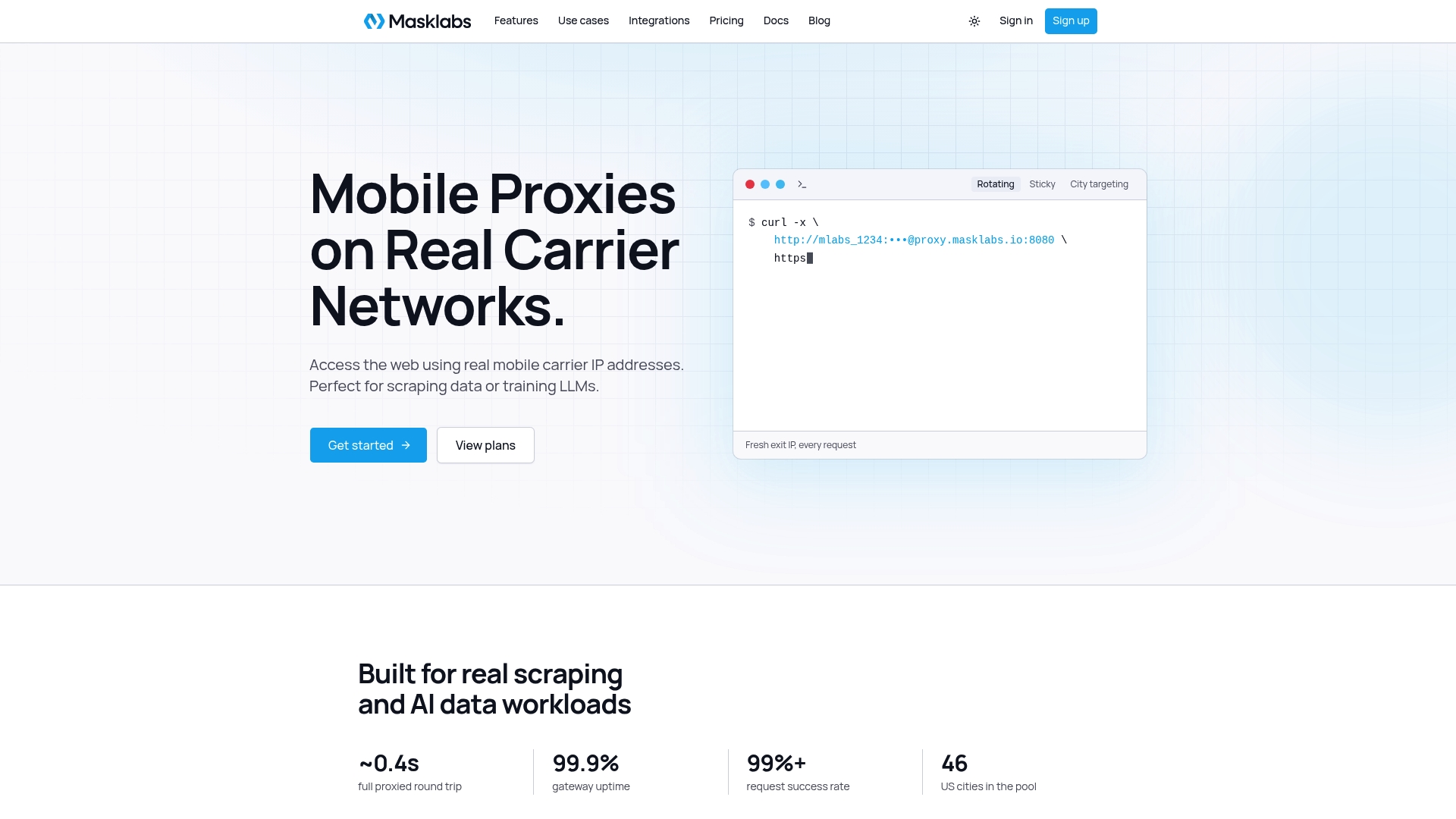
MaskLabs routes traffic through real US mobile carrier IPs rather than datacenter ranges, with city-level targeting so requests appear to originate from a specific location rather than a generic data center block. Full support for HTTP, HTTPS, and SOCKS5 means the CONNECT and TLS-to-proxy workflows covered in this guide apply directly, whether you are integrating through Python, Node.js, or a browser automation stack. Sticky sessions keep one IP pinned for workflows that need continuity, while rotating sessions cycle identities automatically for high-volume collection.
Plans start with a Starter tier on the MaskLabs pricing page and scale up to Basic, Advanced, and Scale tiers as data volume grows. Check current availability and set up credentials directly from the dashboard, no sales call required.
Sources
- MDN Web Docs — CONNECT method
- RFC 9110 — HTTP Semantics
- libcurl — CURLOPT_PROXYTYPE
- Stack Overflow — Pros and cons of using a HTTP proxy vs HTTPS proxy
FAQ
Should you turn on HTTP proxy?
A plain HTTP proxy setting only affects unencrypted HTTP traffic, so turning it on makes sense when you need caching, filtering, or logging of plaintext requests. It does nothing for HTTPS traffic, which typically routes through the same proxy via CONNECT regardless of the HTTP proxy setting.
Is a VPN technically a proxy?
A VPN and a proxy both reroute traffic, but a VPN typically encrypts and tunnels all traffic at the network layer, while a proxy usually operates at the application layer for specific protocols like HTTP or HTTPS. They solve overlapping problems but through different mechanisms, and neither term should be used interchangeably with the other in a technical configuration document.
Which proxy is better, HTTP or SOCKS5?
Neither is universally better, since they serve different purposes: an HTTP proxy understands and can act on HTTP-specific data like headers and paths, while SOCKS5 is protocol-agnostic and simply relays raw traffic. Choose based on whether your workflow needs HTTP-aware features like caching or whether it just needs a generic tunnel for various protocols.
Are web proxies illegal?
Using a web proxy is generally legal in most jurisdictions for legitimate purposes like testing, research, or accessing your own services. Legality depends heavily on local law and how the proxy is used, so check the rules that apply in your jurisdiction and the terms of service of any site you access through one.
What is the practical difference between HTTP and HTTPS proxy encryption?
An HTTP proxy relays plaintext requests it can read and modify, while HTTPS traffic through that same proxy is usually tunneled via CONNECT so the proxy only sees the destination host and port. A separate "HTTPS proxy" configuration adds TLS encryption on the client-to-proxy hop itself, which is a different security property from what CONNECT provides.