Dev: Stop Mobile Blocks With 5 Client Hints and Mobile Proxy Checks

Start by emulating a real mobile browser with matching Sec-CH-UA client hints and a mobile carrier IP for most mobile-only targets. When the target hides data behind a native app, switch to API interception by monitoring network traffic, and fall back to real-device UI automation only when certificate pinning or emulator detection blocks that path. A quick checklist for any job: correct User-Agent, synced client hints, a mobile proxy, and a consistent session.
TL;DR:
- Using a matching mobile User-Agent and low-entropy client hints on the first request helps avoid early detection by server-side fingerprint checks.
- API interception is faster and more reliable than UI automation for native app scraping but requires managing TLS pinning and obfuscated endpoints.
- Mobile carrier IPs, especially from NAT pools, mimic real user traffic more convincingly than datacenter proxies, reducing the likelihood of blocking.
- Maintaining consistent TLS fingerprints and navigation timing signals is essential to bypass modern behavioral bot detection systems.
- MaskLabs provides managed US mobile carrier proxies with city-level targeting and session options, suitable for scaling mobile scraping efforts efficiently.
Table of Contents
- Quick checklist of methods and trade-offs
- Mobile-friendly website scraping: headers, client hints, and emulation
- Native mobile app scraping: API interception, APK analysis, and UI automation
- Proxies and networking: why mobile carrier IPs change the success rate
- Anti-bot defenses and fingerprint consistency
- Why MaskLabs mobile proxies are a practical option
- Trade-offs worth weighing before you commit resources
- How MaskLabs helps: quick CTA and link to get started
- FAQ
- Sources
Quick checklist of methods and trade-offs
Mobile-only scraping splits into two categories: mobile-friendly website scraping, where you render a responsive site or single-page app through browser emulation, and native mobile app scraping, where content only exists inside an Android or iOS app and you need API interception or UI automation to reach it. Each path has different speed, detection risk, and build cost.
- Browser emulation gets you production-ready fast and works for responsive sites, but it needs careful header and fingerprint matching to avoid bot defenses.
- API interception is usually the fastest and cleanest method once you locate the app's back-end endpoints, since you parse structured JSON or protobuf data directly.
- UI automation on real devices or emulators costs the most in setup and maintenance but is sometimes the only option against apps with certificate pinning or integrity checks.
For a proof-of-concept, start with browser emulation against the mobile site. It is the fastest way to validate that your target data exists and confirm what headers and proxy setup you will need before committing to a native-app pipeline.
Mobile-friendly website scraping: headers, client hints, and emulation
A User-Agent string alone no longer convinces modern servers that a request comes from a real phone. User-Agent reduction means browsers now expose less detail in the UA string itself, shifting that information into Sec-CH-UA-* client hints, which servers increasingly rely on for device identification. Skipping them, or sending a mobile UA with desktop client hints, is one of the fastest ways to get flagged.
Here is the sequence that produces a convincing mobile fingerprint:
- Set a mobile User-Agent and matching low-entropy client hints (Sec-CH-UA, Sec-CH-UA-Mobile, Sec-CH-UA-Platform) on the very first request.
- Respond to the server's Accept-CH header by sending high-entropy hints (platform version, model, full version list) on subsequent requests, since servers must explicitly request these via the Accept-CH flow.
- Emulate device characteristics in your automation tool, matching viewport size, device pixel ratio, and touch input flags for the phone model you claim to be.
- Keep TLS and HTTP fingerprints consistent with the browser engine your headers describe, since a mismatch between what you claim and what your stack produces is a known detection signal.
- Handle lazy loading and infinite scroll by triggering intersection observer events or scrolling programmatically, since mobile pages frequently defer content until it enters the viewport.
Playwright and Puppeteer both support mobile device emulation profiles out of the box, which handle viewport, DPR, and touch input together rather than one at a time. A quick check of your own site's served headers and content negotiation behavior under different client hints, using a tool like Scanza's website health checks, can reveal how much your target's server actually varies its response based on device signals before you build around assumptions.
Pro Tip: Send your low-entropy client hints on the very first request. Sites that check for Accept-CH compliance before serving mobile-specific content will reject requests that jump straight to high-entropy headers.
Native mobile app scraping: API interception, APK analysis, and UI automation
When content lives only inside a native app, the most scalable path is almost always API interception: capturing the network calls the app makes and reconstructing them directly. This approach, which lets you parse JSON or protobuf responses and rebuild pagination and authentication flows, is typically far faster and more reliable than any method that depends on rendering a UI.
- API interception works by proxying the device's traffic through a tool like mitmproxy, inspecting the calls, and replicating them with your own HTTP client, which scales cleanly once the endpoints are mapped.
- Certificate unpinning with Frida becomes necessary when an app enforces TLS pinning, since standard proxy interception will otherwise fail silently or throw connection errors.
- APK reverse engineering helps when endpoints are obfuscated or encrypted, letting you trace the app's logic to understand how requests are built and signed.
- UI automation on real devices is the fallback when API interception is blocked entirely, using tools like Droideer, a Puppeteer-like API for Android automation, or mobile-use, an open-source agent that controls Android and iOS devices through natural-language commands.
- Device farms give you a way to run UI automation across multiple real phones in parallel when a single emulator instance cannot keep pace with your data needs.
Choose your approach based on how the app behaves rather than by default. If traffic inspection shows clean, unencrypted JSON endpoints, build your pipeline around API interception from the start. If the app pins certificates or detects emulators aggressively, plan for real-device automation and budget accordingly for its higher maintenance cost.
Proxies and networking: why mobile carrier IPs change the success rate
The IP address behind your request matters as much as the headers you send. Datacenter proxies are the easiest to detect since their IP ranges are well cataloged by bot-management systems. Residential proxies improve on that by using real home internet connections, but mobile carrier proxies go further: because carriers assign IPs through NAT pools shared by thousands of real phones, a mobile carrier IP looks statistically identical to normal mobile traffic, which is exactly the traffic pattern a mobile-site scraper is trying to imitate.
- Sticky sessions keep the same IP for a set window, useful when you need to maintain a login state or multi-step flow without the server noticing an IP change mid-session.
- Rotating sessions assign a new IP on each request or at short intervals, which works well for high-volume, stateless scraping where each request is independent.
- Protocol support matters for integration, since HTTP, HTTPS, and SOCKS5 cover most scraping stacks without extra configuration work.
Billing in this space is usually metered per gigabyte rather than per request, so plan your data budget around page weight and session length rather than request count alone. City-level geo-targeting is also worth checking for, since local content, pricing, and search results often vary by location in ways a single national IP pool cannot replicate. We cover this in more detail in our piece on local search testing with city-level mobile proxies.
Anti-bot defenses and fingerprint consistency
Static headers are no longer the main battleground. Cloudflare's own bot detection documentation describes systems that analyze behavioral signals, including navigation timing and touch or mouse event patterns, alongside client-side fingerprints and session traversal paths. A scraper with perfect headers but a mouse-driven navigation pattern on a "mobile" session is still an easy flag.
The other common failure is mismatch: claiming a mobile User-Agent and Sec-CH-UA-Mobile value while your TLS handshake or HTTP/2 frame ordering matches a desktop Chrome build. These inconsistencies are a known trigger for modern bot-management detection, and they are easy to overlook because they live below the application layer. Our deeper breakdown of the signals bot defenses check beyond headers walks through this in more depth, as does our look at browser fingerprint consistency.

For sustained scraping, managed browser farms or real-device farms that preserve consistent session lifecycles tend to outperform one-off scripted sessions, and building in backoff and retry patterns reduces the chance that a rate limit turns into a permanent block.
Pro Tip: Run your scraping stack's TLS fingerprint through a checker before deployment. A mismatch between your claimed browser and your actual handshake is often the single easiest flag to catch, and the easiest to fix.
Why MaskLabs mobile proxies are a practical option
We built MaskLabs around real US mobile carrier IPs with city-level targeting, giving you the authentic network fingerprint that the methods above depend on. Sticky sessions preserve login state during browser emulation, while rotating sessions suit high-volume API interception work. Our API access and dashboard controls let you configure proxy endpoints directly in Playwright or Selenium, which is how most teams move from a quick proof-of-concept into a production-grade collection pipeline without rebuilding their stack.

Trade-offs worth weighing before you commit resources
Building an in-house real-device farm only pays off once you are running sustained, high-volume collection against apps with aggressive pinning or integrity checks. For most mobile-only projects, pairing browser emulation or API interception with a managed mobile proxy gets you production results with far less maintenance overhead than racking physical phones.
— Jon
How MaskLabs helps: quick CTA and link to get started
If you are building a mobile scraping pipeline and need IPs that behave like real phones, MaskLabs gives you carrier-grade US mobile proxies with city-level targeting, sticky or rotating sessions, and full HTTP, HTTPS, and SOCKS5 support.
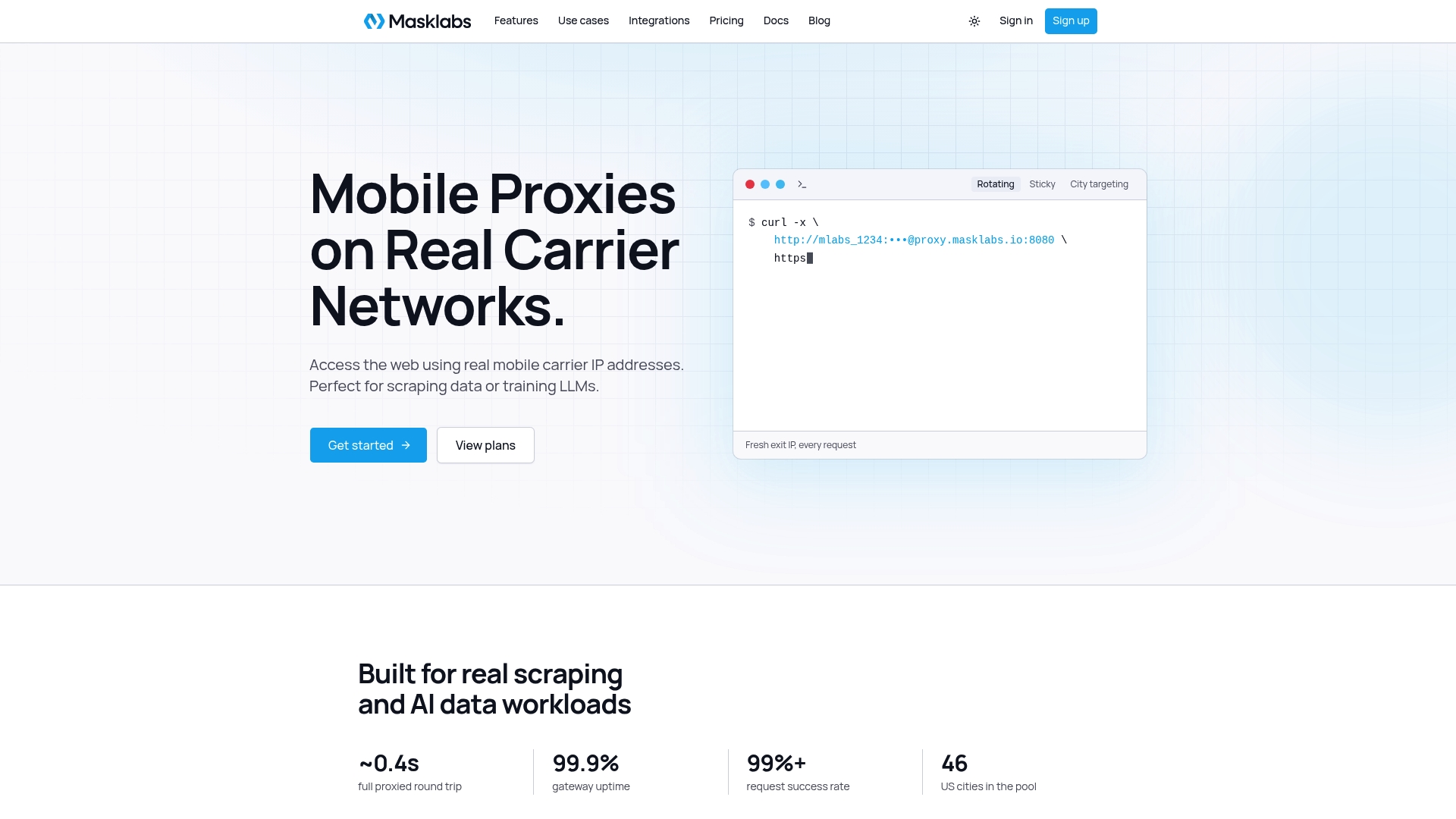
We offer a Starter plan suitable for testing small pipelines, with additional plans that scale as your data needs grow. For current pricing details, please visit the pricing page. Check our pricing page to find the plan that fits your current project, and set up your proxy endpoint in minutes without a sales call.
FAQ
Is AI scraping illegal?
Scraping with AI tools is not inherently illegal in most jurisdictions, but the legality depends on how the data is collected and used rather than on the use of AI itself. The FTC has warned that deceptive or unfair data practices, including misleading terms of service changes, can trigger enforcement regardless of the collection method.
Is web scraping illegal in the US?
Web scraping itself is not explicitly illegal in the United States, but it falls under the FTC Act's prohibitions on unfair or deceptive practices. The FTC Act section 5 is the primary regulatory framework that governs how collected data can be used and disclosed.
How do I scrape websites without being blocked?
Match your User-Agent with correctly sequenced Sec-CH-UA client hints, keep your TLS and HTTP fingerprints consistent with the browser you claim to use, and route requests through a proxy that matches your target device type, such as a mobile carrier IP for mobile-site scraping. Behavioral consistency, including realistic navigation timing, also matters since modern bot detection relies on more than static headers.
What's the difference between scraping a mobile website and a native app?
Mobile website scraping renders a responsive site through browser emulation, while native app scraping requires intercepting the app's own API calls or automating its UI directly, since there is no webpage to render. API interception is generally the faster and more scalable method when the app's endpoints are reachable.
Do mobile proxies actually reduce blocking compared to datacenter proxies?
Mobile carrier IPs come from shared NAT pools used by real phones, which makes them statistically harder to distinguish from genuine mobile traffic than datacenter IP ranges. This is a meaningful operational advantage for mobile-site and app scraping where IP reputation is a primary detection signal.
Sources
- DataForest – Scraping tools and technologies glossary
- Medium – Best user agent for scraping: desktop, mobile, or browser
- FTC – AI, other companies quietly changing your terms of service could be unfair or deceptive
- Cloudflare – Bot detection engines
- MDN – User-Agent reduction