One Week Test: VPN vs Proxy for Scraping When Geo or Anti Bot Matter

For scalable web scraping, proxies, especially residential or mobile proxies, are usually the better choice. VPNs work fine for a single device running a small, one-off job or for troubleshooting a blocked connection, but they run out of road fast once you need concurrency, IP diversity, or geo-targeting. Two things should change your decision immediately: a hard geo-location requirement or a target site with aggressive anti-bot defenses.
TL;DR:
- Residential and mobile proxies offer superior IP diversity and scalability for high-volume, geo-targeted scraping jobs, unlike VPNs which are limited to one IP per session.
- Proxies generally provide faster data transfer and support concurrent requests across multiple IPs, reducing the risk of detection compared to VPNs' encrypted tunnels and single IP use.
- Anti-bot systems increasingly analyze client-side signals beyond IP addresses, making IP rotation alone insufficient; combining it with realistic timing, header variation, and session management improves success.
- Small-scale or one-off scraping can often start with a VPN or single proxy, while large, ongoing projects require rotating proxy networks or mobile carrier proxies to avoid rate limits and regional content mismatches.
- Legal and ethical scraping best practices include respecting site policies, avoiding sensitive data, and using APIs when possible; testing proxies with success rate, CAPTCHA incidence, and page rendering helps validate setup before scaling.
Table of Contents
- VPN vs Proxy: How Each One Actually Works
- Speed, Sessions, and Fingerprint Exposure
- How Anti-Bot Systems Catch Scrapers and How to Avoid Detection
- Matching the Right Tool to Each Scraping Job
- Building a Scraper That Stays Online
- What the Rules Say About Scraping Responsibly
- Where Mobile Carrier IPs Change the Calculus
- Picking an Approach and Validating It Fast
- What Most Teams Get Wrong About Proxies
- Try Mobile Proxies Before You Scale Your Scraper
- Sources
- FAQ
VPN vs Proxy: How Each One Actually Works
A VPN builds an encrypted tunnel at the operating system level. Once it's active, every application on that device, your browser, your scraper, your email client, routes through the same encrypted connection and exits through the same IP address. That's useful for privacy, but it gives you almost no control over individual requests.

A proxy works differently. It operates at the request level, typically over HTTP, HTTPS, or SOCKS5, and only reroutes the traffic you point at it. You can assign different proxies to different requests, rotate IPs mid-session, and run hundreds of parallel connections without touching the rest of your system's traffic.
That distinction matters for a few practical reasons:
- A VPN changes your IP for everything at once, so you can't run 50 concurrent sessions from 50 different addresses.
- A proxy lets you control IP, and often region, on a per-request or per-session basis, which is what rotation and scaling depend on.
- Cookies, headers, and TLS fingerprints are handled independently of the VPN or proxy layer, so switching tools alone doesn't fix a scraper that looks like a bot at the browser level.
- Multi-process scrapers benefit from proxies because each worker process can hold its own IP, something a single VPN connection can't offer.
Speed, Sessions, and Fingerprint Exposure
Encryption has a cost. A VPN adds overhead to every packet, which tends to push latency higher, especially over long-distance tunnels. Proxies, particularly ones built for HTTP(S) traffic, usually move data faster because they aren't wrapping every request in an extra encryption layer.
Concurrency is where the gap widens further. A VPN gives you one exit IP per connection. If a target site limits requests per IP, and most do, you're capped at whatever that one connection can sustain. A proxy network lets you spread requests across dozens or thousands of exit IPs, which is the only practical way to scale past a site's per-IP rate limit.
- VPNs typically add latency from encryption overhead and offer one exit IP per session.
- Proxies generally have lower per-request overhead and support many concurrent exit IPs.
- Session stickiness (holding one IP for a set window) is native to proxy pools but awkward to replicate with a VPN.
- Deep packet inspection bypass and private network access are real VPN advantages, just not ones that matter for scraping public web pages.
Detection systems increasingly combine network and client-side signals to flag proxy traffic, according to Cloudflare's research on bot defenses. That means the choice of tool affects only part of what a target site can observe. IP reputation is one signal. TLS and JA3 fingerprints, cookie behavior, and JavaScript execution patterns are separate signals that neither a VPN nor a proxy fixes automatically.
Where a VPN does earn its keep is when you need to route an entire device through a private network or work around deep packet inspection on a restrictive network. For public-web scraping, that scenario is rare enough that it shouldn't drive your main tooling decision.
How Anti-Bot Systems Catch Scrapers and How to Avoid Detection
Modern anti-bot systems don't rely on IP address alone. They combine IP reputation, behavioral analysis (request timing, mouse movement, scroll patterns), client fingerprinting (TLS handshake details, canvas and WebGL signatures), and adaptive challenges like CAPTCHAs that escalate when something looks automated. Cloudflare's 2025 research on bot defenses describes detectors that combine network data with client-side signals specifically to identify traffic coming from residential or commercial proxy networks, which means even a well-run proxy setup isn't invisible.
VPNs tend to fail fast at scale for a simple reason: many VPN providers route large numbers of users through the same block of datacenter IP addresses, and a sudden burst of automated-looking requests from that IP is an easy flag. Residential and mobile proxies look more like ordinary consumer traffic, which reduces some of those signals, but they aren't a guaranteed pass. Detection systems are explicitly built to catch proxy-routed traffic too.
A few adjustments reduce your exposure meaningfully:
- Rotate IPs on a schedule tied to request volume, not just wall-clock time.
- Keep sessions sticky long enough to mimic normal browsing behavior rather than a new identity per click.
- Vary user agents and request headers so every worker doesn't look identical.
- Respect realistic request intervals instead of firing requests as fast as the connection allows.
- Monitor CAPTCHA and block rates continuously so you catch a detection shift before it tanks your whole run.
Our own breakdown of bot detection signals scrapers must handle goes deeper into which signals matter most by site type.
Pro Tip: Treat IP quality as one layer of a stack, not the whole solution: pair it with header rotation and realistic timing, or detection systems will still catch you.
Matching the Right Tool to Each Scraping Job
Not every scraping job needs the same setup. A one-off script that pulls product data from a handful of pages doesn't need the same infrastructure as a pipeline hitting thousands of targets daily.
- Small, one-off scraping or debugging: a VPN or a single proxy is usually enough, especially for testing whether a script works before scaling.
- High-concurrency, multi-target scraping: a rotating residential or mobile proxy network is close to a requirement, since you need many exit IPs to stay under per-IP rate limits.
- Geo-targeted or mobile-only content: mobile carrier proxies or geo-targeted residential proxies matter most here, since content served to a mobile carrier IP in a specific city can differ from what a datacenter IP sees.
- Ongoing structured data needs: an official API or a data-sharing agreement is often faster and more reliable than scraping, when one exists.
A practical decision order looks like this:
- Check whether an API or partner feed already provides the data, since that avoids the anti-bot problem entirely.
- If scraping is necessary and volume is low, start with a VPN or a single proxy to validate the approach.
- If volume or geo-targeting requirements grow, move to a rotating proxy network sized to the number of concurrent requests you need.
- If the target serves different content by carrier or region, test with mobile carrier proxies before committing to a residential pool.
Our residential proxy use cases for market research teams walks through how this plays out for geo-testing specifically.
Building a Scraper That Stays Online
A reliable scraper is built around a handful of decisions made before the first request goes out, not patched in after the blocks start.
- Set a rotation cadence, for example rotating IPs every 10 to 20 requests or every few minutes, whichever threshold the target site tolerates better.
- Use sticky sessions when a workflow requires staying logged in or maintaining cart state, and rotate only between sessions.
- Randomize request intervals instead of firing at fixed intervals, and apply exponential backoff with a capped retry limit when a request fails.
- Manage cookies per session rather than sharing them across IPs, since mismatched cookies and IPs are an easy flag.
- Decide upfront whether you need full JavaScript rendering (headless browser) or whether a lighter HTTP client is enough, since rendering adds fingerprint surface area but is sometimes unavoidable.
- Track success rate, CAPTCHA incidence, and average latency continuously, with an automatic fallback (pause, rotate, or switch proxy pool) when any metric crosses a threshold.
Our post on how rate limiting affects large-scale web automation covers backoff strategy in more detail, and our proxy checker tools roundup is a good starting point for validating rotation and speed before a run goes live.
Pro Tip: Log every block and CAPTCHA with a timestamp and the IP that triggered it. That log is what tells you whether your rotation cadence is actually working or just adding overhead.
What the Rules Say About Scraping Responsibly
Scraping infrastructure choices don't exist in a legal vacuum — secure deployment and data ethics are key, as explained by the webAI Partnership — The Sovereign AI Platform Behind Forge Deployments. The EDPB's 2026 guidelines on web scraping recommend data minimization, filtering out sensitive categories of personal data before collection, and limiting how broadly automated crawlers discover new URLs, since wider discovery raises the chance of picking up data you never intended to collect.
Separately, Eurostat's ESS web content retrieval guidelines recommend identifying your scraper through its user agent, providing a contact channel, and optimizing retrieval to reduce server load, particularly for high-frequency jobs.
- Respect
robots.txtand published site policies as a practical way to reduce both legal and operational risk. - Where scraping would have a significant impact on a site's servers, reach out to the site owner or look for an API first.
- Exclude sensitive personal data categories at the collection stage rather than filtering afterward.
This is general guidance, not legal advice. Check the rules that apply to your jurisdiction and target sites before running anything at scale.
Where Mobile Carrier IPs Change the Calculus
Some scraping jobs depend entirely on what a specific city or carrier sees, and that's where mobile proxies earn their place. MaskLabs provides real US mobile carrier IPs, not datacenter addresses, with city-level targeting across numerous US cities, sticky or rotating sessions, and API access for integration into existing scraping pipelines.
That combination fits a specific set of jobs well:
- Geo-sensitive content that renders differently by city or carrier, where a datacenter IP simply won't see the same page.
- Mobile-only experiences, including apps and mobile-formatted sites that behave differently from their desktop counterparts.
- Ad verification work, where confirming what a real mobile user in a specific market actually sees is the entire point.
Before committing to any mobile proxy setup, test three things: success rate over a realistic request volume, whether rendered pages match what a genuine mobile session sees, and how often CAPTCHAs appear compared to your current setup. Our guide to US mobile proxies for local search testing shows what that testing looks like in practice.
Picking an Approach and Validating It Fast
A solo developer testing a small script should start with a VPN or a single proxy and only move up once blocks appear. A team running ongoing, multi-target scraping should start with a rotating residential or mobile proxy pool from day one, since retrofitting rotation after a project is live costs more engineering time than building it in. A researcher doing geo-specific work should test mobile carrier proxies early, before assuming a residential pool is close enough.
Run a one-week pilot before committing to any infrastructure: scope it to your highest-priority target, track success rate and blocks per hour, and compare a VPN or single proxy against a small rotating pool. If blocks climb past a tolerable level or a geo-mismatch shows up in the data, that's your signal to scale into a paid mobile or residential proxy provider.
What Most Teams Get Wrong About Proxies
The most common mistake is treating an IP swap as the whole fix. Changing your IP address does nothing about a TLS fingerprint that screams "automation," a request pattern with suspiciously even timing, or a JavaScript environment missing the signals a real browser produces. Anti-bot systems built to catch proxy traffic, as Cloudflare's research makes clear, are looking at all of that together.
The second mistake is spending engineering hours building a custom rotation and session layer when a managed proxy service already solves it. That trade-off is worth making deliberately: build it yourself when your volume is small and your requirements are unusual, buy it when you're scaling fast and need reliability more than control.
— Jon
Try Mobile Proxies Before You Scale Your Scraper
If your scraping job depends on what a real mobile user in a specific city actually sees, a datacenter proxy pool won't get you there. MaskLabs runs on real US mobile carrier IPs across numerous US cities, with sticky or rotating sessions and API access built for integration into an existing pipeline, not a separate workflow you have to manage by hand.
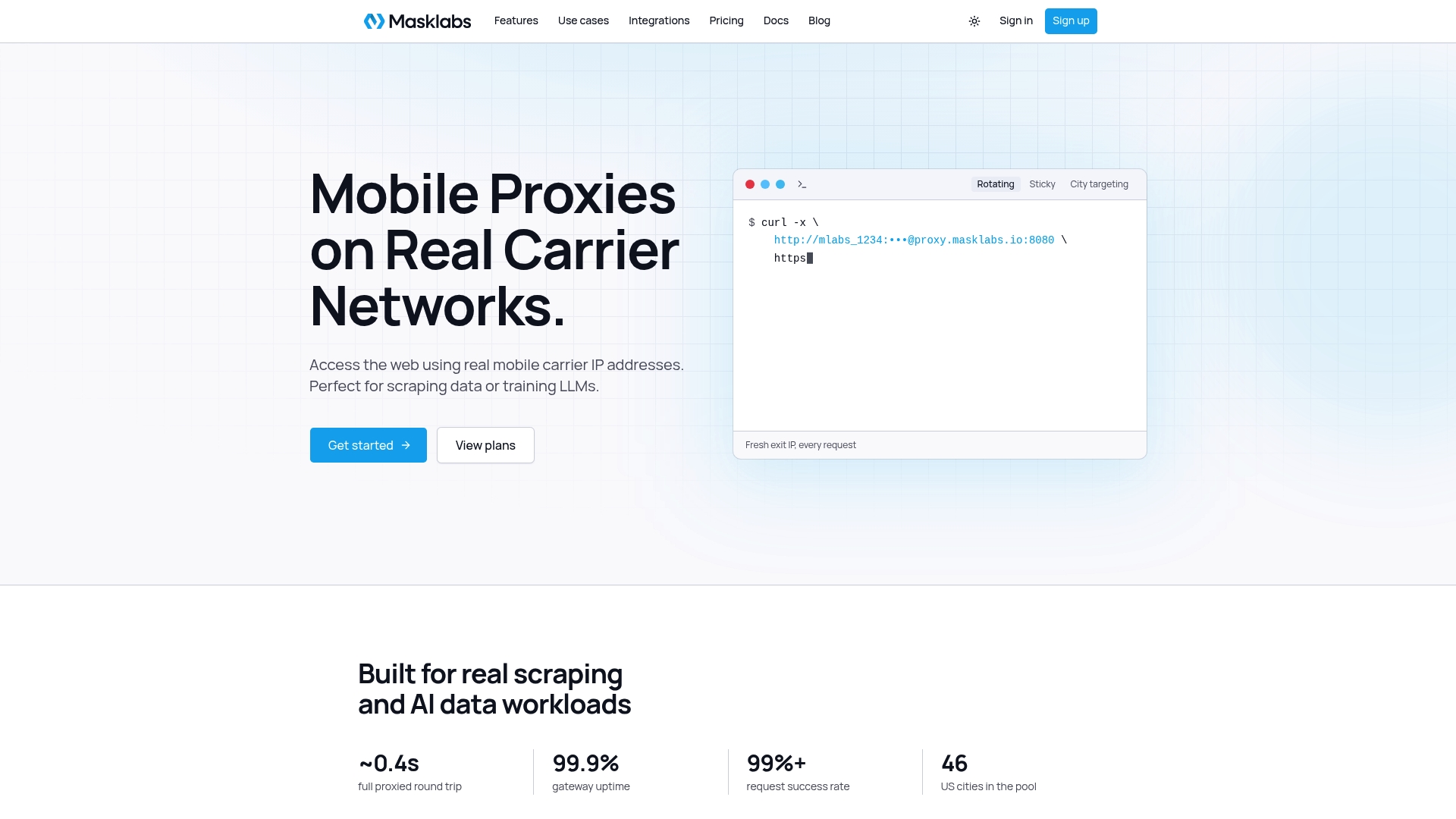
Start by testing three things on a small run: success rate, whether rendered pages match a genuine mobile session, and how often CAPTCHAs show up compared to your current setup. Plans start at Starter for $30 per month, scaling up through Basic, Advanced, and Scale as your data needs grow. Check current plan details on the MaskLabs pricing page or see the full feature set on the MaskLabs homepage.
Sources
- Guidelines 03/2026 on web scraping in the context of generative AI | European Data Protection Board
- ESS web content retrieval guidelines | Eurostat CROS
- Building unique, per-customer defenses against advanced bot threats in the AI era | Cloudflare Blog
FAQ
Can the FBI See Through VPNs?
A VPN encrypts traffic between your device and the VPN server, but that encryption doesn't make traffic invisible to every party by default. Law enforcement typically pursues data through legal requests to VPN providers, internet service providers, or the destination service rather than "seeing through" the tunnel directly, and what's available depends heavily on the provider's logging practices and jurisdiction.
Is It Better to Use a Proxy or a VPN for Scraping?
For scalable scraping, a proxy is generally the better fit because it gives you per-request control over IP rotation and concurrency, something a VPN's single-tunnel design can't match. A VPN remains a reasonable choice for small, one-off jobs or basic troubleshooting.
Is a Proxy Server Illegal?
Using a proxy server is legal in most places; proxies are widely used for privacy, testing, and legitimate business data collection. What matters legally is how the proxy is used, including whether the scraping respects site terms, robots.txt, and data protection rules like those described in EDPB's web scraping guidelines.
Which Proxies Are Best for Large-Scale Web Scraping?
Residential and mobile proxies generally outperform datacenter proxies for large-scale scraping because they carry IP reputation closer to ordinary consumer traffic, which reduces some detection signals. Mobile carrier proxies add value specifically when a job depends on geo-accuracy or mobile-rendered content, since MaskLabs provides real carrier IPs with city-level targeting for exactly that case.