Fix 403 Forbidden Scraping with 8 Quick Checks for Developers

A 403 Forbidden during scraping means the server received your request but refused it, most often because of edge bot defenses, rate limits, or IP reputation, according to MDN's HTTP status documentation. The first move is triage: reproduce the request in a real browser, compare headers side by side, and test whether the block follows your IP or your request pattern.
TL;DR:
- Read the response body and headers, then test browser matching, valid cookies, request timing, and a different IP one variable at a time.
- Check CDN or WAF logs before application logs; edge blocks may never reach the backend, and low bot scores can trigger blocks despite modest volume.
- For recurring jobs, use exponential backoff with jitter, per host quotas, and circuit breakers that pause targets when 403 rates rise.
- Use sticky IPs for login flows and rotating IPs for per IP limits; compare carrier and datacenter proxies by success rate and latency.
- For projects involving personal or copyrighted data, prefer public APIs, licensed datasets, or permission, and seek legal review before scraping at scale.
Table of Contents
- Quick checklist: 8 immediate checks to triage a 403 now
- Deep troubleshooting: request, session, network, and edge defenses
- Scaling safely: rate limits, backoff strategies, and proxy architecture
- Legal and ethical checklist for scraping when you see a 403
- When proxies help: why mobile and carrier IPs reduce 403s
- Author perspective: build vs buy and practical signposts
- MaskLabs: a practical next step for validation
- FAQ
- Sources
Quick checklist: 8 immediate checks to triage a 403 now
Before changing any code, run through a short diagnostic pass. Most 403s resolve once you know which layer is rejecting the request.
- Read the raw response body and headers for WAF or CDN challenge text, not just the status code.
- Reproduce the same request in a browser and capture the User-Agent, Referer, and Accept headers it sends.
- Confirm authentication tokens and cookies are still valid, then re-authenticate if the session expired.
- Add randomized pauses between requests to rule out rate limiting.
- Switch to a different IP, including a local ISP or mobile connection, to check for IP-based blocking.
- Look for CAPTCHA pages or JavaScript challenges that only render correctly in a real browser.
- If you control the target site, check CDN or WAF logs directly rather than guessing from the client side.
- Write down each change you tested and its result, so you don't repeat a failed fix blind.
Pro Tip: Run one test at a time. Changing headers, IP, and timing together makes it impossible to know which fix actually worked.
Deep troubleshooting: request, session, network, and edge defenses
A 403 can originate at four different layers, and each one needs a different fix.
Request-level issues are the easiest to rule out. Many scrapers get blocked simply because their default User-Agent string identifies them as a script. Set a realistic User-Agent, match the Accept and Accept-Language headers a browser would send, and include a plausible Referer when the target expects one. None of this defeats a serious bot-management system, but it clears out a surprising share of false positives.
Session-level issues show up when a site requires login or CSRF tokens. If you authenticate once and then reuse a stale cookie jar, you'll get a 403 on protected routes even though the credentials are fine. Replay the full login flow, store cookies properly between requests, and respect any rate limits during authentication, since repeated failed logins often trigger their own block.
Network-level issues are about IP reputation. If headers and sessions check out but the block persists, test the same request from a different IP, ideally a residential or mobile one, to see whether the server is scoring your IP rather than your request. Sticky sessions matter here: if the target tracks login state by IP, rotating too fast will break the session and look like the attack it's trying to prevent. Use sticky IPs for stateful flows and rotating IPs when the limit is per-IP request volume.
Edge defenses sit in front of the application entirely. Cloudflare's bot management assigns a bot score to incoming traffic, and a low score, typical of automated clients, can trigger a block even at modest request volume. Microsoft's own WAF troubleshooting guidance recommends checking CDN and WAF logs before the application logs, since many of these blocks never reach your target's backend at all. Header tweaks won't fix a bot-score block. That requires a network-level or behavioral change.
- Isolate one variable per test: headers, IP, or timing, never all three at once.
- Reproduce failures with a minimal curl command or short Python script before touching production code.
- Log the response status, headers, and timestamp for every test run.
Pro Tip: Keep a small curl script on hand that mirrors your scraper's exact headers. It's the fastest way to confirm whether a block is server-side or specific to your scraping client.
Scaling safely: rate limits, backoff strategies, and proxy architecture
Once a single request works, scaling it without tripping defenses again is the real engineering problem.
- Add exponential backoff with jitter on every retry, plus per-host quotas so one misbehaving job doesn't trip a block for your whole fleet.
- Use circuit-breakers that pause a target automatically once 403 rates spike, rather than letting a loop hammer a blocked endpoint.
- Choose proxy architecture deliberately: datacenter IPs are cheaper but carry a lower trust score with bot-management systems like Cloudflare's, while carrier IPs tend to look more like ordinary traffic.
- Reserve sticky sessions for login-dependent flows, and use rotation when the limit is strictly per-IP volume.
Cost trade-offs matter as much as technical ones. Proxy pricing is typically billed per gigabyte, so connection reuse and smart session design directly affect your bill, not just your success rate. Track three numbers continuously: success rate, 403 ratio, and latency. A rising 403 ratio is the earliest warning sign, and it should trigger an automated slowdown before the whole job fails. For more on throttling design, see our guide on rate limiting and large-scale automation.
Legal and ethical checklist for scraping when you see a 403
A 403 is a technical signal, not a legal ruling. Treat a site's terms of service and robots.txt as context for your decision, not as definitive legal permission or prohibition. The FTC's 2024 enforcement announcement makes clear there's no AI-specific exemption from existing consumer-protection law, and deceptive uses of scraped data or AI training sets fall squarely within its enforcement focus. When a target holds personal data, copyrighted content, or anything feeding an AI product, prefer a public API, a licensed dataset, or explicit permission, and loop in legal counsel for higher-risk projects before scraping at volume.

When proxies help: why mobile and carrier IPs reduce 403s
Mobile and carrier IPs generally carry a higher trust reputation than datacenter ranges, since they're shared by real phone traffic and harder for bot-management systems to flag outright. That doesn't eliminate 403s, but it removes one common trigger.
- Use sticky sessions for logins or multi-step flows that depend on consistent state.
- Use rotating sessions when the target enforces a hard per-IP request limit.
- Validate any proxy switch with real numbers: success rate, median latency, and session stability before and after.
We provide mobile carrier IPs with city-level targeting, sticky and rotating sessions, API access, and reported high uptime and success rates, figures worth testing directly against your current setup rather than taking at face value. For a deeper look at the signals triggering these blocks in the first place, see our breakdown of bot-detection signals.
Pro Tip: Run the same validation job on your current proxy pool and on a mobile-IP trial side by side. The 403 ratio difference tells you more than any vendor claim.
Author perspective: build vs buy and practical signposts
For a short, one-off scrape, build it yourself: respect rate limits, use a public API where one exists, and skip the infrastructure investment entirely. The calculation changes once blocks become routine, volume climbs, or the job needs consistent geotargeting and session persistence across thousands of requests. Recurring edge blocks and rising maintenance hours are the clearest signal that in-house scraping infrastructure has stopped paying for itself, and that's the point to evaluate a managed proxy service instead of patching headers again.
— Jon
MaskLabs: a practical next step for validation
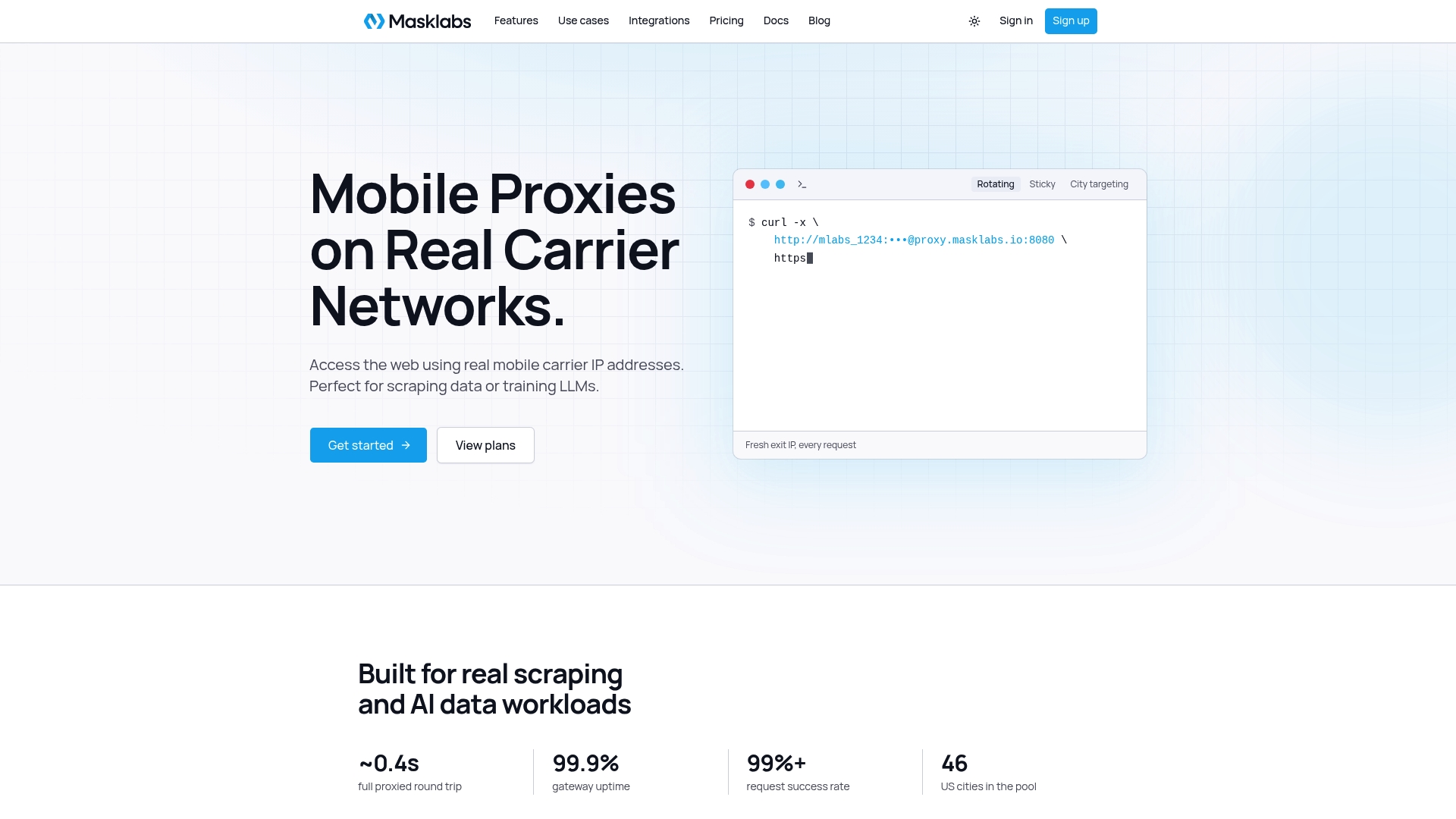
We built MaskLabs around real US mobile carrier IPs rather than datacenter ranges, with city-level targeting, sticky and rotating sessions, and full API access for teams that need to test before committing.
- Sign up for a trial and run it against an endpoint you know currently returns 403s.
- Compare your success rate, latency, and session stability against your existing proxy setup.
- Review plan sizing on our pricing page, where multiple tiers cover a range of monthly data volumes.
For browser-driven workflows, our Selenium proxy integration guide walks through setup for automated testing teams. Start the trial from our product overview and measure the difference against a known blocked target before scaling anything up.
FAQ
How do I fix a 403 Forbidden error?
Start by comparing your scraper's request headers against a real browser's, then check whether the block follows your IP or persists across IPs. If the response body contains challenge text or a CAPTCHA, the block is happening at the edge, which generally requires a network-level fix rather than a header change.
Is AI scraping illegal?
Scraping for AI training isn't illegal on its own, but the FTC has stated there's no AI-specific exemption from existing consumer-protection law, and deceptive or unfair data practices remain enforceable regardless of the technology involved. Risk rises sharply when the scraped data includes personal information or content used in ways the source site didn't authorize.
Is web scraping illegal in the US?
Web scraping itself isn't categorically illegal in the US, but legality depends on what's scraped, a site's terms of service, and applicable laws like copyright or data-privacy statutes. Treat robots.txt and terms of service as important context, and get legal review for any project touching sensitive or copyrighted data.
How do I avoid getting blocked while scraping?
Match realistic request headers, respect rate limits with randomized delays, and use IPs with good reputation, since bot-management systems like Cloudflare's can flag automated traffic even at low volume. Mobile and carrier IPs tend to trigger fewer blocks than datacenter ranges, which is worth testing directly against your current setup.
Sources
- 403 Forbidden - HTTP | MDN
- Cloudflare bot score documentation
- Troubleshoot WAF blocking legitimate requests (403) - Microsoft
- FTC Announces Crackdown on Deceptive AI Claims and Schemes | Federal Trade Commission