Dev: Stop TLS Fingerprint Drift With JA3/JA4 and Mobile Proxies

Yes, you can impersonate a browser's TLS fingerprint, but it is not a one-time fix. It requires matching the ClientHello, the HTTP/2 or HTTP/3 behavior that follows it, and ongoing testing as detection rules shift. The practical starting point is a browser-accurate TLS client such as curl-impersonate or curl_cffi, paired with proxies and a fingerprint test endpoint to confirm the match.
TL;DR:
- Matching a browser's TLS fingerprint requires precisely replicating the ClientHello, HTTP/2 or HTTP/3 behavior, and ongoing testing due to shifting detection rules.
- Nearly 90% of observed traffic uses just the top 31 cipher-suite combinations, making cipher list choice critical for successful impersonation.
- Using patched clients like curl-impersonate or curl_cffi simplifies achieving byte-identical handshakes, but regular updates are necessary to keep up with browser changes.
- Combining TLS fingerprint mimicking with real carrier IP addresses from mobile proxies enhances evasion, as IP reputation and TLS are separate detection factors.
- Maintaining effective impersonation involves continuous validation, focusing on high-value targets, and adapting to evolving anti-bot detection methods.
Table of Contents
- Quick primer: what TLS fingerprinting is and why anti-bot systems use it
- How TLS fingerprints are constructed: JA3/JA4 and GREASE
- Practical evasion: tools, libraries, and implementation approaches
- Testing and validation: confirming your client matches the target fingerprint
- Ethics, risk, and operational considerations
- MaskLabs perspective: where mobile carrier proxies fit a TLS-evasion workflow
- Practitioner view: maintaining impersonation over time
- MaskLabs: a complementary option for scraping success
- FAQ
- Sources
Quick primer: what TLS fingerprinting is and why anti-bot systems use it
Every TLS connection opens with a ClientHello message, and that message carries a surprising amount of identifying detail: the TLS version offered, the ordered list of cipher suites, the extensions presented, and the supported elliptic curve groups. A real browser's networking stack produces a highly consistent ClientHello across requests, while most scripting libraries produce a different, more generic one.
Anti-bot systems exploit that gap. Formats like JA3 and JA4 condense the ClientHello fields into a short hash or string, making it cheap to compare a request against known browser signatures at scale.
TLS fingerprinting rarely works alone. It sits inside a layered detection stack alongside:
- HTTP/2 frame ordering and SETTINGS values sent right after the handshake
- JavaScript environment checks that run once a page loads.
- Header order and casing, which can betray a non-browser client
Our earlier look at browser fingerprint surfaces covers how these signals combine in practice, which matters because fixing TLS alone rarely clears a well-tuned anti-bot system.
How TLS fingerprints are constructed: JA3/JA4 and GREASE
JA3 builds its hash from five fields in the ClientHello: TLS version, cipher suites, extensions, elliptic curves, and elliptic curve point formats, concatenated in the order they appear and then hashed with MD5. JA4 was designed to address JA3's weaknesses by using more durable, human-readable components and by handling ordering more consistently across TLS libraries.
Order matters because most TLS stacks have a fixed, implementation-specific way of listing ciphers and extensions. A Python script using default requests or urllib3 settings will almost never match the order Chrome or Firefox produces, even if the underlying cipher list overlaps.

Nearly 90% of observed traffic falls within the top 31 cipher-suite combinations, according to academic fingerprinting research, which shows just how decisive cipher-list selection is for distinguishing clients.
A few structural factors complicate impersonation further:
- GREASE values, defined in RFC 8701, reserve certain extension and cipher values so clients can advertise placeholder options without breaking older servers; the RFC specifically recommends random selection of these values, and warns that deterministic or non-random GREASE usage can itself become a fingerprinting signal
- JA3's reliance on MD5 is a legacy choice that offers no cryptographic strength and only works as a comparison key, not a security measure
- TLS 1.3 and HTTP/3 narrow some of the surface area that older fingerprinting methods relied on, since fewer fields are sent in the clear and handshake behavior differs from TLS 1.2
Practical evasion: tools, libraries, and implementation approaches
Matching a browser's TLS fingerprint by hand means recompiling a TLS library with the exact cipher order, extension list, and curve preferences a target browser uses, then verifying the output byte by byte. Most teams skip that work by using patched clients instead.
- curl-impersonate. This patched build of curl compiles against the same TLS libraries real browsers use (BoringSSL for Chrome-based impersonation, NSS for Firefox) and adjusts ciphers, extensions, and ALPN settings so the handshake is close to byte-identical to the target browser. Projects like zikzak-ai/curl-impersonate and the original lwthiker/curl-impersonate document exactly which options they change per browser version.
- curl_cffi for Python. curl_cffi wraps curl-impersonate's capabilities in a Python binding, exposing an
impersonateparameter, HTTP/3 support, proxy integration, and a command-line interface for debugging. It also ships updates that refresh the built-in fingerprint database as browsers change. - Low-level manual control. When no prebuilt client fits, compiling directly against BoringSSL or NSS and setting cipher suites, curves, extensions, ALPN, and HTTP/2 SETTINGS by hand gives full control, at the cost of significant setup and maintenance time.
Each approach trades convenience for control. Patched clients get you most of the way with little code, while manual compilation suits teams targeting a narrow set of high-value domains where every byte needs to match.
Pro Tip: Capture the full handshake, not just the ClientHello. Many detection systems also check the HTTP/2 SETTINGS frame and frame ordering that immediately follows, so a correct TLS fingerprint paired with a mismatched HTTP/2 signature still gets flagged.
Operationally, expect ongoing maintenance. Browser vendors update cipher lists and extension sets with new releases, so an impersonation profile that worked last quarter can drift out of date without warning.
Testing and validation: confirming your client matches the target fingerprint
Validation should happen before you point any impersonation setup at a real target. Start with a dedicated fingerprint test endpoint, send a request from your impersonation client, and compare the resulting JA3 or JA4 string against the one a real browser produces from the same network.
- Use a site like tls.browserleaks to capture your client's JA3/JA4 hash and its raw ClientHello fields
- Run the same request through a real browser on the same connection to get a baseline hash to compare against
- Capture packets with tcpdump or Wireshark when a hash mismatch needs deeper inspection than a JSON endpoint provides
- Change one TLS setting at a time (cipher order, then extensions, then curves) and record whether the hash moves closer to the target
| Check type | Tool | What it confirms |
|---|---|---|
| Fingerprint hash | tls.browserleaks | JA3/JA4 string matches target browser |
| Packet capture | Wireshark or tcpdump | Exact ClientHello byte layout |
| HTTP/2 behavior | Server response headers | Frame order and SETTINGS consistency |
Once the TLS layer checks out, repeat the same tests through your proxy setup, since some proxy configurations alter handshake behavior in ways that only show up under combined testing.
Ethics, risk, and operational considerations
TLS impersonation exists in an arms race, and pushing it against production systems you do not control carries real operational risk.
- Aggressive or mismatched impersonation attempts can trigger account bans or IP blacklisting faster than no impersonation at all
- Detection teams escalate quickly once they spot a pattern, so repeated probing from the same source tends to shorten, not extend, how long a method works
- Treat this work as defensive research: test against lab environments or systems you own, and avoid hammering production infrastructure you do not control
- Jurisdictional legal questions around scraping and impersonation vary widely and sit outside what this guide can answer, so consult legal counsel for anything beyond controlled testing
MaskLabs perspective: where mobile carrier proxies fit a TLS-evasion workflow
TLS impersonation and IP reputation solve different problems. A perfectly matched ClientHello still gets flagged if the request comes from a known datacenter IP range. Mobile proxy services like ours give requests a real carrier IP address, sticky or rotating sessions, and API access that slots directly into an impersonation client.
The two layers are independent: fixing one does not fix the other. We recommend validating your TLS fingerprint locally first, then layering in rotating or sticky sessions to confirm the combination holds up under sustained testing.

Practitioner view: maintaining impersonation over time
Fingerprint impersonation is not a settled problem you solve once. Server-side detection rules change as fast as browser TLS libraries do, so any fingerprint database you rely on needs the same update discipline you'd give a dependency with known security patches, not a one-time download.
Most teams can't justify matching every browser version for every target. The pragmatic approach is to invest heavily in impersonation accuracy for the handful of high-value sites that matter most, and accept a looser, lower-maintenance setup everywhere else.
— Jon
MaskLabs: a complementary option for scraping success
Once your TLS fingerprint matches, the remaining weak point is usually the IP itself. We provide real US mobile carrier IPs across 46 cities, not datacenter ranges, which means the requests your impersonation client sends look like they come from an actual phone on an actual carrier network.
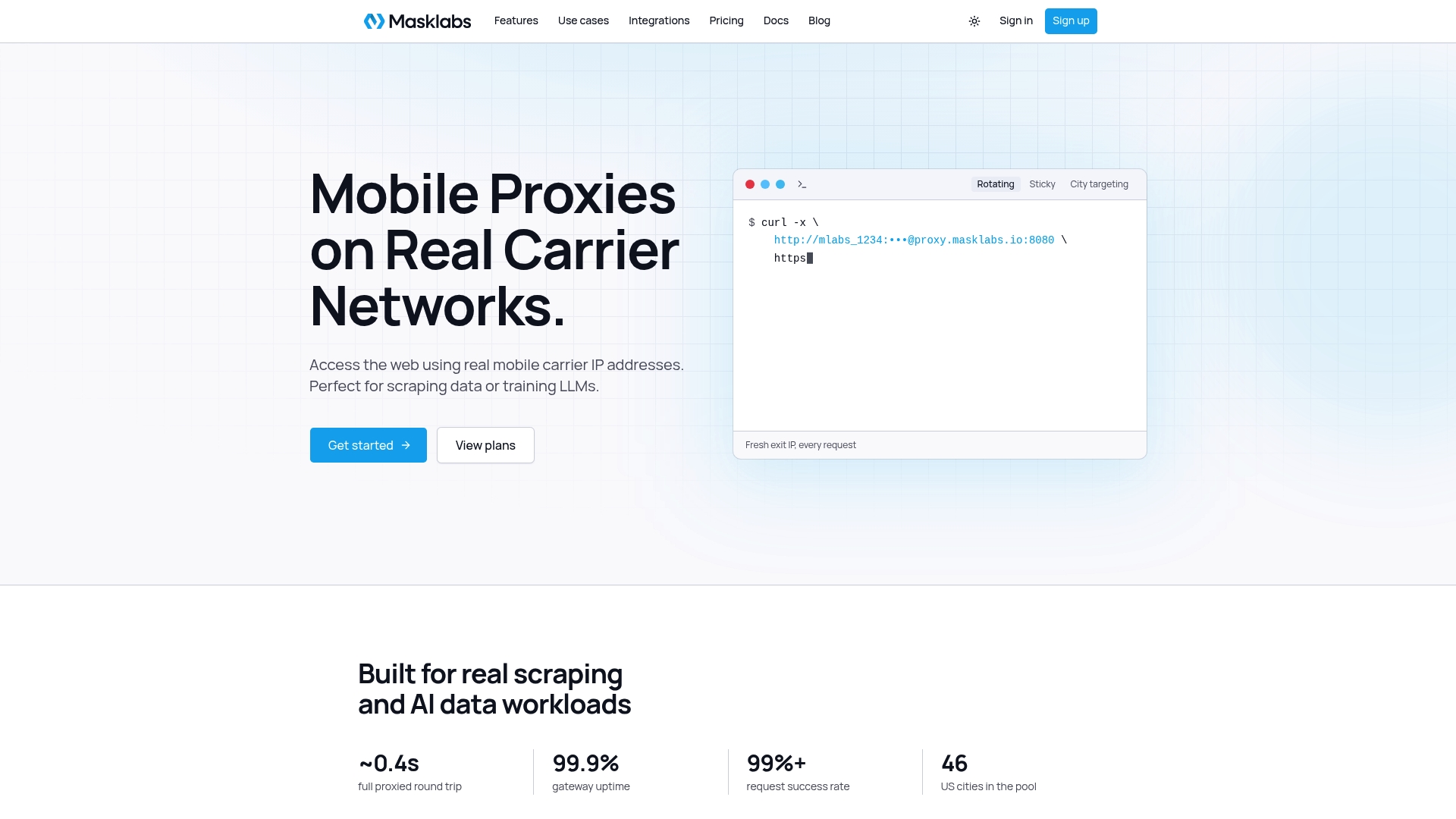
Sticky sessions hold one IP for tasks that need continuity, while rotating sessions cycle through fresh carrier IPs for high-volume jobs, and both are reachable over HTTP, HTTPS, or SOCKS5 through a single API. Plans range from entry-level to premium tiers, all listed on our pricing page. Start with a short trial to confirm your impersonation setup holds up once real carrier IPs are in the loop.
FAQ
Can you fully bypass TLS fingerprinting detection?
You can closely match a browser's TLS fingerprint using tools like curl-impersonate or curl_cffi, but detection systems also check HTTP/2 behavior, JavaScript signals, and IP reputation. Matching TLS alone rarely clears every layer of a well-built anti-bot system.
What is the difference between JA3 and JA4 fingerprints?
JA3 hashes five ClientHello fields, including TLS version, cipher suites, and extensions, using MD5. JA4 was built to address JA3's ordering inconsistencies and uses more durable components, making it somewhat more resistant to simple evasion tricks.
Does GREASE make TLS fingerprinting easier or harder?
GREASE, defined in RFC 8701, is meant to preserve protocol extensibility by having clients advertise random reserved values. It can actually ease detection when implemented with non-random or deterministic values, since that pattern becomes its own fingerprintable signal.
Do I need proxies if I already impersonate TLS fingerprints?
Yes, because TLS fingerprinting and IP reputation are separate detection layers that anti-bot systems check independently. A correctly matched fingerprint from a flagged datacenter IP can still get blocked, which is why we pair impersonation with real carrier IPs for more consistent results.
How often do browser TLS fingerprints change?
Browser vendors update cipher suites, extensions, and curve preferences with new releases, so impersonation profiles can go stale without warning. Keeping fingerprint libraries like curl_cffi updated in your build pipeline helps catch drift before it affects live scraping jobs.
Sources
For readers who want to verify the technical claims here or dig into implementation details, the GREASE specification in RFC 8701 and the TLS 1.3 specification in RFC 8446 are the primary protocol documents. The curl-impersonate and curl_cffi repositories document exactly which TLS and HTTP/2 settings they modify per browser version, and the original curl-impersonate project remains a useful reference for browser-specific patches. For broader context on fingerprinting research, see the academic survey on cipher-suite diversity and the arms-race dynamics paper covering how fingerprinting and evasion evolve together.
For adjacent detection surfaces worth combining with TLS work, see our notes on bot detection signals scrapers must handle, session management for stable proxy workflows, and proxy checker tools for testing rotation and speed.