Scraper Success Rate: Developer Checks That Catch Silent Failures

Use reliable mobile proxies, controlled concurrency, and robust retry and validation logic together to increase your scraper success rate. Each tactic solves a different failure mode: proxies prevent blocks, concurrency limits prevent rate limiting, and validation catches silent failures that status codes miss. Combined, these three layers typically turn an unreliable scraper into one that completes jobs with far fewer manual fixes. Services like MaskLabs give you one piece of that stack: real mobile IPs that reduce the first point of failure.
TL;DR:
- For fewer than 50 URLs, scrape sequentially; use 10 to 20 concurrent requests for 50 to 500, and batch jobs exceeding a few thousand.
- Rotate IPs per request for stateless pages, but keep an IP and its cookies together during login or multi step workflows.
- Follow server supplied wait times on 429 and 503 responses; otherwise use capped exponential waits with jitter, and do not retry permanent 404 errors.
- Before saving responses, require a CSS selector, XPath element, or JSON field, because a 200 status can still contain empty or misleading content.
- Use mobile proxies for strict anti bot sites; residential addresses suit less protected targets, while JavaScript heavy pages may require a headless browser.
Table of Contents
- How to pick and operate proxy pools
- Controlled concurrency: semaphores, per-site caps, and ramping safely
- Headers, TLS, cookies, and when to use headless browsers
- Implementing retries: parse 429s, exponential backoff, and jitter
- Detecting and handling silent failures with content markers
- KPIs and dashboards to track scraper health
- Publisher proof and author attribution
- IP reputation management and avoidance techniques
- Handling CAPTCHAs and anti-bot protections
- Geo-targeting strategies with mobile proxies
- Using residential vs mobile proxies for success
- Integration best practices with proxy services like MaskLabs
- Author checklist: what I'd verify before a production run
- Start scraping reliably with MaskLabs
- FAQ
- Sources
How to pick and operate proxy pools
Your proxy choice determines how often you get blocked before any other tactic matters. Datacenter IPs are cheap and fast, but they're easy for anti-bot systems to flag because they don't belong to real consumer networks. Mobile and residential IPs come from carrier or ISP address space shared by real devices, so requests look like ordinary user traffic rather than automated infrastructure.
Rotation strategy matters as much as IP type. Rotating on every request spreads load thin and works well for stateless scraping of public pages. Sticky sessions, where you pin one IP for a set window such as a few minutes, suit workflows that require login state or multi-step navigation. A hybrid approach, rotating stickily per task but switching IPs between tasks, covers most production scraping needs.
Pool health needs ongoing attention, not a one-time setup:
- Track latency per proxy and drop any IP that consistently responds slowly.
- Monitor error rate per proxy and retire IPs that return blocks or CAPTCHAs repeatedly.
- Align cookie and session rotation with IP rotation so a session never jumps between two different IPs mid-flow.
- Use city-level targeting when a site serves different content or pricing by region, which mobile IPs across 46 US cities can address directly.
Pro Tip: Log every proxy's success and failure counts in a simple table from day one. It's the fastest way to spot a bad IP before it drags down your whole run.
For Scrapy-based projects, configuring proxy rotation at the middleware level keeps this logic out of your parsing code entirely.
Controlled concurrency: semaphores, per-site caps, and ramping safely
Concurrency is the fastest way to speed up a scraper, and the fastest way to get it blocked if you don't cap it. A useful decision guide: fewer than 50 URLs, run sequentially and skip the complexity. Between 50 and 500, moderate concurrency with a semaphore of 10 to 20 concurrent requests usually balances speed and safety. Beyond a few thousand URLs, chunk the job into batches and persist results after each chunk so a failure late in the run doesn't cost you everything before it.
The effect of concurrency on runtime is substantial. A 9,000-URL job running at one request per second takes roughly 2.5 hours, while the same job at 20 concurrent requests finishes in about 7.5 minutes, according to a concurrency guide for scraper builders. That guide also recommends per-site semaphores so a slowdown or block on one domain never starves requests to another.
A practical ramp-up sequence:
- Start with a conservative concurrency limit, around 10 in-flight requests per target site.
- Monitor for 429 and 503 responses during the first few hundred requests.
- Increase concurrency gradually only after error rates stay near zero for a sustained window.
- Use
asyncio.as_completedor an equivalent worker pool instead of firing every task at once, so you keep control over backpressure and progress tracking.
MaskLabs reports a success rate above 99% when mobile IPs are paired with this kind of controlled request pacing instead of unthrottled bursts.
Headers, TLS, cookies, and when to use headless browsers
Request fingerprints give anti-bot systems as many signals as your IP does. A request missing common browser headers, or reusing the exact same header set across thousands of requests, stands out even from a clean mobile IP.
Adjustments worth making on every scraper:
- Set a realistic
User-Agentand rotate among a small set of current browser strings rather than reusing one indefinitely. - Include
Accept-Languageand a plausibleRefererso requests look like they arrived from normal navigation. - Match TLS handshake behavior to a real browser; a mismatched TLS fingerprint causes blocks that look identical to IP bans, which our guide to fixing TLS issues walks through in detail.
- Keep cookies tied to the same sticky IP session for any site that checks session continuity, especially after login.
Lightweight HTTP requests are faster and cheaper, and they're the right default for static or server-rendered pages. Headless browsers cost more in compute and time, but they're worth the overhead for JavaScript-heavy sites where content never appears in the raw HTML response. Our Puppeteer proxy rotation guide covers pairing headless sessions with mobile IPs when that trade-off makes sense.
Implementing retries: parse 429s, exponential backoff, and jitter
A 429 response means the server is rate limiting you, and many implementations base that limit on client IP, which is exactly why IP rotation and retry logic work together, according to MDN's documentation on 429 responses. Servers often include a Retry-After header on 429 and 503 responses telling you how long to wait, and MDN notes that support for this header is inconsistent across clients but honored by many well-behaved crawlers.
A resilient retry pattern:
- Parse the response for a
Retry-Afterheader and wait that exact duration when present. - When no header exists, apply exponential backoff starting around one second, doubling on each attempt up to a capped maximum.
- Add randomized jitter to every wait time so parallel workers don't retry in sync and recreate the same spike that caused the block.
- Distinguish transient errors like 429 and 503 from permanent ones like 404, and requeue only the transient ones; move permanent failures to a dead-letter list for manual review.
Pro Tip: Cap your maximum backoff at something reasonable, like 60 seconds. An uncapped exponential curve can leave a worker sleeping for hours on a single stubborn URL.
Our post on how rate limiting affects large-scale automation walks through tuning these caps for high-volume jobs.
Detecting and handling silent failures with content markers

A 200 OK status code tells you the server responded, not that it sent you useful data. Production scraping failures often come from silent data corruption, where a response returns successfully but the body is empty, truncated, or an error page disguised as a normal response, according to practitioner research on silent data corruption. Status codes alone can't catch this.
The fix is content-marker validation before you ever save a response:
- Define a required CSS selector, XPath element, or JSON field that must exist in every valid response.
- Reject and flag any response missing that marker, treating it as a candidate for retry rather than accepted data.
- Add schema checks for structured responses, confirming field types and expected array lengths before persisting.
- Log validation pass and fail rates per batch so a sudden drop surfaces immediately instead of silently corrupting your dataset.
When that happens, route failures to targeted retries on a different proxy or to a manual review queue rather than letting bad data flow downstream.
KPIs and dashboards to track scraper health
You can't fix what you don't measure, and scraper health needs more than a pass or fail count at the end of a run. The metrics worth tracking on every job:
- Request success rate: the percentage of requests returning a usable response, not just a 200 status.
- Content-marker pass rate: the percentage of saved responses that pass your schema or marker check.
- Per-proxy error rate: which IPs in your pool are generating blocks, timeouts, or CAPTCHAs.
- Latency: average and p95 response time, which flags throttling before it becomes outright blocking.
- Retries per success: how many attempts it takes on average to land one good response, a direct measure of pool health.
A simple per-proxy table makes triage fast during a live run:
Provider dashboards paired with your own structured logging give you both sides: the proxy layer's view and your application's view of what actually got parsed and saved.
Publisher proof and author attribution
The recommendations in this guide reflect how MaskLabs is built for developers running production scraping jobs. Our infrastructure runs on real carrier mobile IPs rather than datacenter ranges, with sticky and rotating session options and city-level targeting across 46 US locations.
For integration patterns beyond this guide, our developer-focused posts cover Python scraping with proxy rotation and Java proxy configuration in more depth. This article is written by Jon, drawing on the proxy management and scraping reliability practices covered throughout.
IP reputation management and avoidance techniques
An IP's reputation is built from its history, not just its type. A mobile IP that has been flagged for abusive behavior by a previous user can still get blocked even though mobile ranges generally carry a cleaner reputation than datacenter blocks. Reputation damage compounds: one blocked request on an IP often triggers heightened scrutiny on the next request from that same address, even on an unrelated site.
Avoidance starts with request behavior, not just IP selection. Spacing requests to mimic human browsing patterns, avoiding identical request sequences across sessions, and never hammering the same endpoint from a single IP all reduce the chance of a reputation flag in the first place. Respecting robots.txt crawl-delay guidance is also a practical signal of polite crawling that some sites use to decide whether to escalate blocking, as a web scraping best practices guide from the University of Pittsburgh recommends.
Practical steps that protect pool reputation over time:
- Retire any IP that triggers a CAPTCHA or hard block rather than continuing to use it on the same target.
- Spread requests across a large enough pool that no single IP carries disproportionate load.
- Avoid reusing an IP immediately after it gets flagged, even on a different domain, since some anti-bot vendors share reputation data across sites.
A pool with transparent per-IP error tracking, the same table discussed in the monitoring section above, makes this kind of proactive retirement realistic rather than something you only notice after a run fails.
Handling CAPTCHAs and anti-bot protections
A CAPTCHA appearing mid-scrape is usually a symptom, not the root problem. It typically means your IP, header fingerprint, or request pattern already looked suspicious before the CAPTCHA ever rendered. The most effective fix is prevention: a clean mobile IP, realistic headers, and human-like pacing reduce how often a CAPTCHA challenge triggers at all.
When a CAPTCHA does appear, the response matters more than the solving method. Treat it the same way you'd treat a content-marker failure: don't save the page, don't retry immediately from the same IP, and log it as a reputation signal against that specific proxy. Retrying from a fresh IP with adjusted headers often resolves the issue without any CAPTCHA-solving step at all.
More sophisticated anti-bot systems go beyond CAPTCHAs, using behavioral analysis, TLS fingerprinting, and JavaScript challenges that run before a page ever renders. Headless browser automation, covered earlier in this guide, handles JavaScript challenges that a lightweight HTTP request simply can't execute. For sites layering multiple anti-bot techniques, combining a clean mobile IP with a full browser session and realistic interaction timing addresses most of these signals at once, rather than trying to solve each one separately with a patchwork of tools.
The goal isn't to defeat anti-bot protection outright. It's to look like legitimate traffic by default, so the protection never has a reason to escalate.
Geo-targeting strategies with mobile proxies
Geolocation-specific scraping needs are common: local pricing pages, region-locked content, and location-based search results all render differently depending on where a request appears to originate. A scraper running from a single IP location will miss or misreport this entirely.
City-level mobile IP targeting solves this by letting you route requests through a real carrier IP physically associated with a specific metro area. Pulling local search results, regional e-commerce pricing, or location-based ad verification all require requests that genuinely appear to come from that location, not just a country-level IP range. Mobile IPs spanning 46 US cities make this kind of targeted comparison possible without maintaining separate physical infrastructure in each market.
Practical geo-targeting setup involves mapping your target list to the correct city before a job starts, then validating that returned content actually matches the expected region, since some sites use IP geolocation inconsistently or cache by broader zones. Combine geo-targeted proxies with the content-marker validation covered earlier: if your marker check expects region-specific pricing or local business listings and doesn't find them, that's a sign your geo-targeting didn't land correctly on that request, not just a generic scraping failure.
Using residential vs mobile proxies for success
Residential and mobile proxies both route through real consumer internet connections rather than datacenter infrastructure, but the distinction matters for success rates on heavily protected sites. Residential IPs come from fixed broadband connections, assigned by ISPs to households. Mobile IPs come from cellular carrier networks, often shared across many devices behind carrier-grade NAT.
That shared nature works in your favor. Anti-bot systems are generally more cautious about blocking a mobile carrier IP outright, since blocking it could also block a large number of legitimate mobile users on the same carrier network behind the same address. This makes mobile IPs comparatively more resilient for high-sensitivity targets like social platforms, ticketing sites, and e-commerce checkouts, where aggressive blocking carries a real risk of false positives against real customers.
Residential proxies remain a reasonable choice for less aggressively protected targets where cost efficiency matters more than maximum resilience. For scraping jobs on sites with strong anti-bot defenses, or for any workflow where a block translates directly into lost revenue or missed data, mobile IPs are the stronger default. The choice isn't about one type being universally better, it's about matching the IP type's resilience profile to how aggressively your specific target site defends against automation.
Integration best practices with proxy services like MaskLabs
Integrating a proxy service cleanly into your scraper means treating proxy configuration as infrastructure, not a hardcoded detail buried in your parsing logic. Keep your proxy credentials, rotation mode, and session type in environment variables or a config file, separate from your scraping logic, so switching between sticky and rotating sessions doesn't require touching your core code.
For Scrapy projects, proxy rotation belongs in downloader middleware rather than scattered across spider callbacks, a pattern our Scrapy proxy rotation guide walks through directly. For custom Python scripts, wrapping proxy selection in a small client class that handles authentication and session persistence keeps retry and concurrency logic in your main code focused on business logic instead of connection plumbing, as shown in our Python scraping integration guide.
Protocol support matters for flexibility: HTTP, HTTPS, and SOCKS5 compatibility means the same proxy pool works whether you're running raw socket requests, a standard HTTP client, or routing traffic through a SOCKS5-aware tool. For browser automation specifically, our Puppeteer integration guide covers configuring proxy authentication at the browser launch level rather than per-request, which avoids a common source of 407 authentication errors in headless setups.
Test your integration at a small scale first, confirm proxy authentication and rotation behave as expected, then scale concurrency gradually using the thresholds covered earlier in this guide.
Author checklist: what I'd verify before a production run
Before I let any scraper loose on a real job, I run a smoke test of 50 to 100 requests and check three things: content-marker pass rate, per-proxy error rate, and whether any 429s appeared. If error rate clusters on a handful of proxies, I retire them before the full run instead of hoping they recover.
Only once that small batch looks clean do I ramp concurrency up, watching the same three signals continuously rather than waiting for the job to finish.
— Jon
Start scraping reliably with MaskLabs
Everything in this guide points back to one core problem: your IP and your request behavior decide whether a scraper succeeds or quietly fails. Carrier mobile IPs, city-level targeting, and sticky or rotating sessions give you control over the proxy layer that causes most of these failures in the first place.
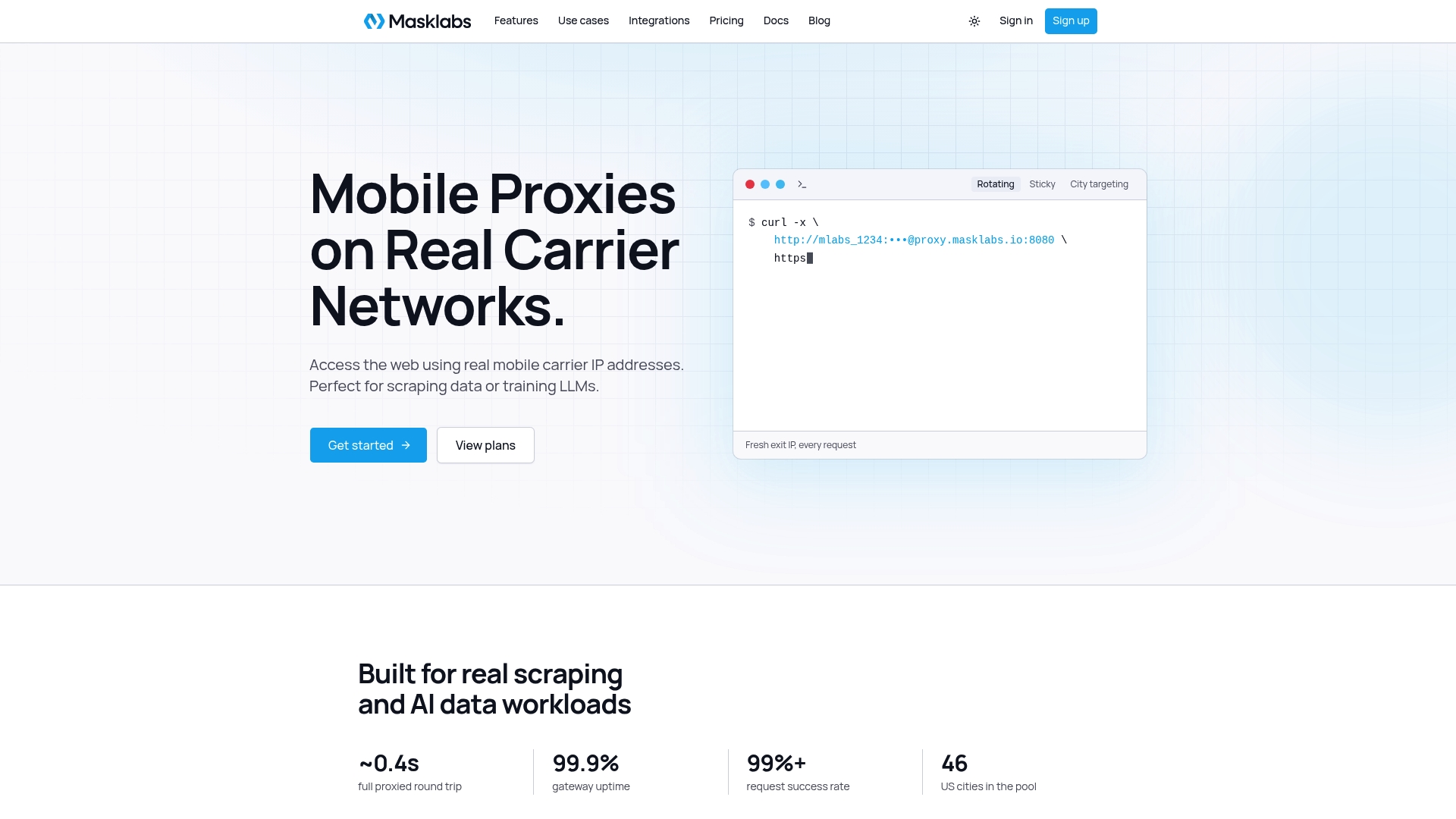
Getting started takes a few concrete steps:
- Pick a plan based on your monthly data needs, from Starter at $30 per month to Scale at $1,000 per month.
- Generate API credentials from your dashboard and drop them into the config pattern covered in the integration section above.
- Start with a small test run on sticky sessions, then scale concurrency using the thresholds covered earlier in this guide.
Check current plans and data options or visit Masklabs to set up an account and start pulling real mobile IPs into your next scraping job.
FAQ
How do data scrapers work?
A data scraper sends HTTP requests to a target site, receives the response, and parses the content to extract specific fields using selectors like CSS or XPath. Production scrapers add layers on top of that basic loop, including proxy rotation, retry handling, and content validation, to keep success rates high at scale.
Can ChatGPT do web scraping?
ChatGPT and similar language models can help write scraping code, suggest selectors, or parse small snippets of text you paste in, but they don't send live HTTP requests or execute a scraping job on their own. Actual scraping still requires a dedicated script or framework like Scrapy connected to proxies and a target site.
How do I avoid getting blocked while scraping?
Avoiding blocks comes down to combining real mobile or residential IPs with realistic headers, controlled concurrency, and request pacing that mimics normal browsing. Honoring Retry-After headers on 429 responses and rotating IPs before a block escalates, as MDN's 429 documentation explains, also reduces the chance of an IP getting flagged further.
Is AI scraping illegal?
Legality depends on the jurisdiction, the site's terms of service, and what data you're collecting, so there's no single universal answer. Checking a site's robots.txt file and terms of service before scraping, as the University of Pittsburgh's scraping guide recommends, is a practical first step, and consulting a legal professional is the right move for any project involving sensitive or copyrighted data.
What's the difference between mobile and residential proxies for scraping?
Mobile proxies route through cellular carrier networks and often share an IP across many devices, which makes anti-bot systems more cautious about blocking them outright. Residential proxies route through fixed ISP connections and work well for less aggressively protected sites, while mobile IPs tend to hold up better against stricter anti-bot defenses.
Sources
- 429 Too Many Requests - HTTP | MDN
- skills/scraper-builder/references/concurrency-guide.md
- Silent data corruption and validation (practitioner paper)