Proxy Success Rate for Developers: Why 95%–99% Can Mislead

Proxy success rate measures the share of requests that reach a target and return a usable response, and it is the single clearest signal of whether your proxy setup is working. Residential proxy benchmark reports commonly fall between 95% and 99%, with premium providers often landing at 97% to 99%. For mission-critical scraping or AI training pipelines, it is generally recommended to aim for a high success rate in production.
TL;DR:
- Count a request as successful only when its response contains the expected content; log eventual retry successes separately from first attempt results.
- Residential pools commonly report 95% to 99% success, while datacenter proxies can match them on low defense sites but falter under fingerprinting.
- Benchmark representative production traffic concurrently across proxy providers for at least an hour at different times, recording content validity, latency, status codes, and proxy IDs.
- Use sticky sessions for logins and checkouts, but rotate addresses for independent, high volume scraping; back off retries and deduplicate requests with side effects.
- Treat 403 and 429 responses as failures, investigate 407 errors as credential problems, and check IP reputation before changing proxy settings.
Table of Contents
- 1. What counts as a successful proxy request
- 2. Benchmarks: what to expect by proxy type and use case
- 3. Common failure causes and a quick diagnostic checklist
- 4. How to measure and benchmark success rate in your environment
- 5. Tactics to improve success rate and operational controls
- 6. How MaskLabs' approach supports higher success rates
- Balancing success rate, cost, and speed
- Try MaskLabs for high success-rate proxy testing
- FAQ
- Sources
1. What counts as a successful proxy request
A clean definition matters more than most teams realize, because "success" can mean different things depending on how you measure it. The simplest formula is successful requests divided by total requests, multiplied by 100. But the harder question is what qualifies as successful.
Some teams count any HTTP 200 response as a win. That is a mistake. A 200 status code with a CAPTCHA page in the body is not a successful request, even though the server technically responded. A content-validated definition checks the response body against an expected pattern, like a product price field or a specific DOM element, before marking the request successful.
- A request that times out after your defined threshold counts as a failure, not a retry-worthy gray area.
- A 403 or 429 response is a clear failure tied to blocking or rate limiting.
- A retried request that eventually succeeds should be logged separately from a first-attempt success, so your rate reflects real efficiency.
Treating retries honestly keeps your success metric from masking an inefficient, retry-heavy setup.
2. Benchmarks: what to expect by proxy type and use case
Proxy type, target defenses, and the task itself all shift what a realistic success rate looks like. Residential proxy services typically report 95% to 99% success, and premium pools often sit at 97% to 99%, since real consumer IPs carry fewer flags than datacenter ranges.
Datacenter proxies can hit comparable or even higher numbers against low-defense targets, like a static informational site with no bot detection, but they drop sharply against sites using fingerprinting or IP reputation filters. Application type matters just as much as proxy type:
- Public, low-defense pages often see success rates near the top of any proxy type's range.
- Search engine results pages and login flows tend to sit lower because of aggressive anti-bot defenses.
- API endpoints with strict rate limits need careful pacing regardless of proxy quality.
Teams tracking cost per usable result, not just cost per request, get a far more honest view of proxy ROI.
3. Common failure causes and a quick diagnostic checklist
Most low success rates trace back to a handful of root causes. Working through them in order usually isolates the problem faster than guessing at a fix.
- Blocked or flagged IPs: a proxy's reputation history can get it filtered before your request even lands, independent of anything you did.
- Rate limiting and anti-bot defenses: too many requests from one IP in a short window triggers CAPTCHAs or temporary bans.
- Authentication and protocol errors: a 407 response usually means bad proxy credentials, while malformed CONNECT handling or SOCKS misconfiguration causes silent tunnel failures. Our proxy authentication troubleshooting guide walks through fixing 407s step by step.
- DNS issues, timeouts, and network instability: a small or poorly rotated IP pool amplifies all of these because the same handful of addresses absorb all the traffic.
- Open proxies or misapplied NAT configurations: these create both reliability and security problems, and AWS security guidance recommends enforcing authentication and access controls to prevent this kind of exposure.
Checking these five areas in sequence, starting with IP reputation and ending with configuration, resolves the majority of success-rate complaints we see from development teams.
4. How to measure and benchmark success rate in your environment
A trustworthy success-rate number depends on a workload that actually resembles production, not a handful of manual test requests. Start by choosing representative URLs, realistic headers, cookie handling, and request pacing that match how your application behaves at scale. Concurrency matters too: testing one request at a time will not surface the failures that show up under real load.

The most reliable comparison method sends the same workload to multiple proxies at the same time rather than testing them sequentially. This approach, sometimes called simultaneous proxy evaluation, removes traffic and timing variability from the comparison. The original LEAP proxy evaluation architecture demonstrated this by running identical workloads across proxies in parallel and comparing response-time distributions directly instead of relying on separate, staggered tests.
For each request, record the following:
- Status code and proxy ID, so failures can be traced back to a specific IP.
- Latency per request, not just an average across the batch.
- A response checksum or content check to catch silent failures like CAPTCHA pages disguised as 200s.
- The Proxy-Status header when your proxy or target supports it, since it carries structured diagnostic detail.
Publish your results as percentiles (p50 and p95 latency), success rate over rolling time windows, and a distribution plot rather than a single blended average, which hides spikes and tail failures.
Pro Tip: Run your benchmark test for at least an hour across different times of day, since bot defenses and rate limits often tighten during peak traffic windows.
5. Tactics to improve success rate and operational controls
Raising success rate usually comes down to a short list of operational levers, applied deliberately rather than all at once.
- Match session type to the task: sticky sessions help with multi-step flows like logins or checkouts, while frequent rotation works better for high-volume scraping where each request is independent.
- Build intelligent retry logic: back off exponentially after failures, and deduplicate requests so a retry never double-submits an action with side effects.
- Align geolocation with your target: a city-level IP that matches the expected audience for a site reduces the chance of geographic mismatch triggering a block. Our geolocation verification guide covers how to confirm this before you scale a campaign.
- Monitor pool health continuously: prefilter IPs with poor reputation scores before they ever reach production traffic.
- Tune client-side timeouts and concurrency: a timeout set too aggressively creates false failures, while too many concurrent connections from one pool can create a local bottleneck that looks like a proxy problem.
Pro Tip: Review our proxy failover strategies if retries are consuming more bandwidth than the original requests themselves.
6. How MaskLabs' approach supports higher success rates
We built our mobile proxy service around real carrier IP addresses rather than datacenter ranges, since carrier IPs carry far less reputation baggage with most targets. Our platform supports:
- City-level targeting across 46 US cities, for geolocation-specific data collection.
- Sticky and rotating session options, so you can match session behavior to the task at hand.
- Full HTTP, HTTPS, and SOCKS5 protocol support across common development environments.
For protocol-level diagnostics, our HTTP vs HTTPS decision guide and proxy checker tools roundup cover the practical testing steps.
Balancing success rate, cost, and speed
Success rate matters most when a failed request costs you downstream, like a missing data point in a training set or a gap in a price-monitoring feed. When the task tolerates gaps, optimizing for speed or cost instead often makes more sense. Our practical triage order: reproduce the failure, isolate whether it is the proxy or the target, measure before and after any change, then apply one fix at a time. Keep a simple success-rate SLO visible to your team so drift gets caught early, not after a client notices.
— Jon
Try MaskLabs for high success-rate proxy testing
If blocked requests and inconsistent success rates are slowing down your scraping or AI training pipeline, real mobile carrier IPs tend to perform better against modern bot defenses than datacenter alternatives.
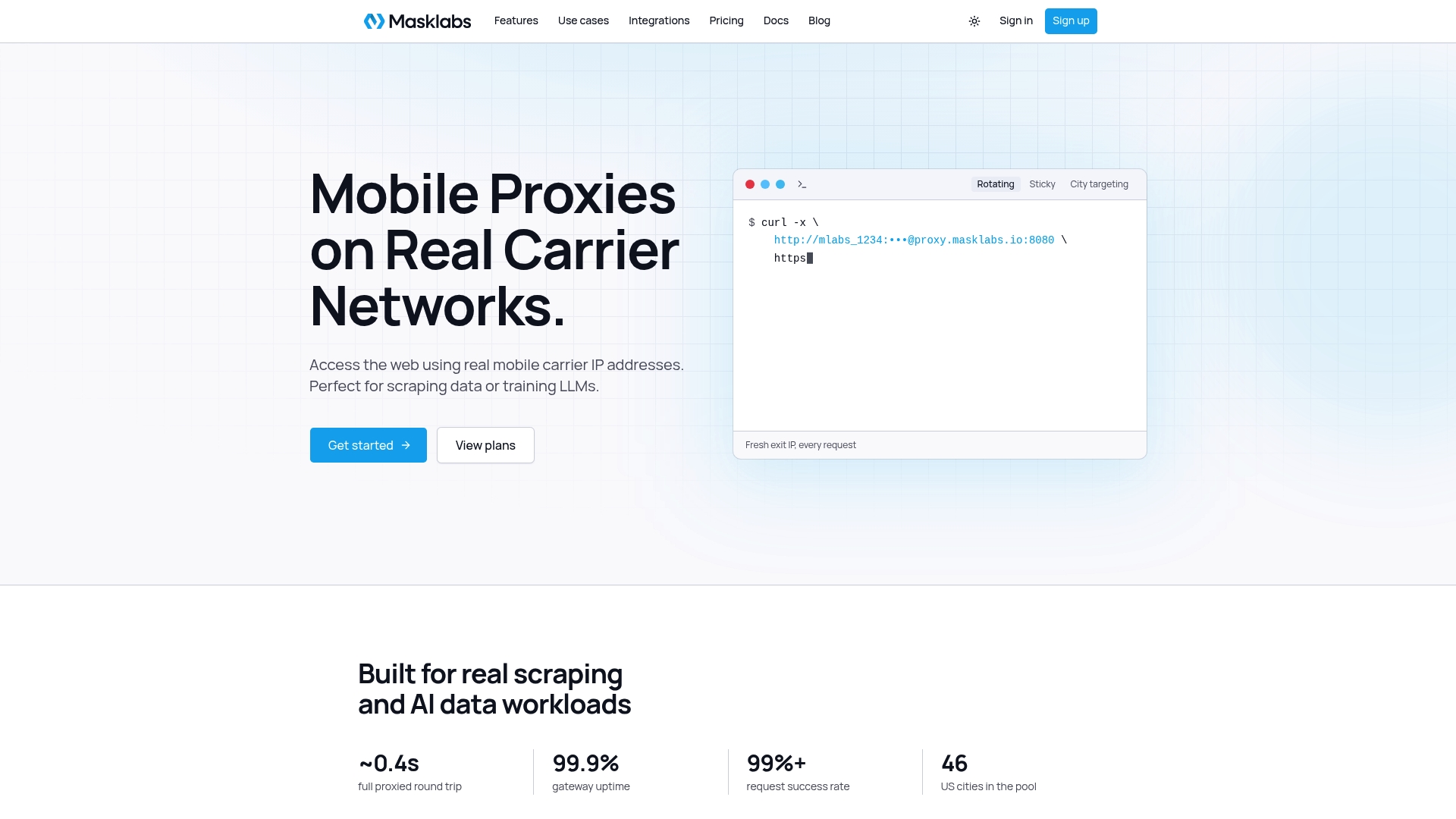
Check our pricing plans on the MaskLabs site, or visit the product page to start a trial and benchmark your own workload before committing.
FAQ
What are the risks of using a proxy?
Residential proxy networks can include devices added to the pool without the owner's consent, and the FBI advisory on residential proxy networks recommends checking a provider's consent model before relying on its IP pool. Open or misconfigured proxies also carry operational and security exposure, which is why providers should enforce authentication and access monitoring.
How long does a proxy last?
Proxy lifespan depends entirely on the session type you choose rather than a fixed duration. Sticky sessions typically hold one IP for a set window, often a few minutes, to support multi-step flows, while rotating sessions assign a new IP on every request or at shorter intervals.
What are the top 3 proxy servers?
Proxy quality depends on IP type, target defenses, and use case rather than a single universal ranking, so there is no one definitive top three. Residential and mobile carrier IP providers generally outperform datacenter options against sites with strong anti-bot defenses, while datacenter proxies can work well against low-defense targets.
How much does a good proxy cost?
Pricing varies by provider, data volume, and plan tier. Our own plans start at $30.00 per month for the Starter tier, scaling up through Basic, Advanced, and Scale tiers based on monthly data pool size.
Sources
For teams validating their own testing setup or security posture, these resources go deeper than any single blog post can:
- Implementing a web proxy evaluation architecture (LEAP/SPE paper)
- Securing open proxies in your AWS environment | AWS Security Blog
- Evading residential proxy networks: Protecting your devices from becoming a tool for criminals — FBI