Reduce CAPTCHAs While Scraping: 6 Developer Fixes to Test in an Hour

Prevention is the highest-leverage way to reduce CAPTCHAs in scraping, and solving should stay a fallback. Start with a few moves: switch to carrier or residential IPs, align your browser and TLS signals, and pace requests with jitter. OWASP and Google's reCAPTCHA docs explain what defenders watch. Our mobile proxies are one provider option for the IP layer.
TL;DR:
- Use residential or mobile IPs, then keep each address tied to one cookie jar, authentication token, and browser identity throughout stateful tasks.
- Match browser claims with the TLS handshake, platform details, viewport, and language; inconsistent signals can trigger challenges before suspicious behavior begins.
- Use jittered delays, limit concurrency per IP and session, and back off after a 429 or challenge; rotating addresses cannot evade account or path limits.
- Track endpoint challenge rates per 1,000 requests and measure each adjustment; reserve solving for persistent failures, with sensitive data excluded from solver services.
Table of Contents
- What can you fix in the next hour to reduce CAPTCHAs?
- How does your IP strategy change CAPTCHA rates?
- Why do fingerprints and TLS trigger CAPTCHAs?
- How should you pace requests to avoid behavioral triggers?
- How does session management lower CAPTCHA frequency?
- When should you use a solver, and how do you do it safely?
- How should you configure Playwright, Puppeteer and browser clients?
- How do you monitor CAPTCHA frequency and retry intelligently?
- Which human-like behaviors help beyond request pacing?
- How should you manage user agents alongside proxies?
- How do advanced headers and HTTP/2 make traffic look like a browser?
- How do you tune mobile proxy IPs for fewer CAPTCHAs?
- How do you prevent CAPTCHAs in AI model training pipelines?
- Why prevention beats solving, from an engineering view
- MaskLabs mobile proxies: a practical way to cut CAPTCHA interruptions
- FAQ
- Sources
What can you fix in the next hour to reduce CAPTCHAs?
Most CAPTCHA problems come from a handful of mismatches, so start with the changes that cost the least and move the most. Work through this list in order and stop when your challenge rate drops:
- Swap datacenter proxies for mobile or residential IPs on the endpoints that challenge you most.
- Turn on sticky sessions for any stateful flow such as login, cart or pagination.
- Add jittered delays between requests instead of a fixed sleep.
- Persist cookies and localStorage between runs so you look like a returning visitor.
- Make your User-Agent, TLS handshake and platform details tell the same story.
- Run a headful browser for pages that still challenge a headless one.
Two quick config checks. In Playwright, reuse a persistent profile and keep the browser visible:
context = playwright.chromium.launch_persistent_context(
    user_data_dir="./profile",
    headless=False,

    locale="en-US",
)
In a plain HTTP client, reuse one session so cookies carry over, and randomize the delay:
import random, time, requests
s = requests.Session()
for url in urls:
    s.get(url)
    time.sleep(delay)
Pro Tip: Change one variable at a time and log CAPTCHA responses before and after each change. A small, repeatable experiment tells you which fix actually worked.
How does your IP strategy change CAPTCHA rates?
IP reputation is the first signal most defenses read, before any header or behavior. Datacenter ranges are cheap and fast, but they are widely known and often scored as risky. Residential IPs come from home connections and look more like ordinary users. Mobile carrier IPs sit behind carrier-grade NAT, so many real people share the same address, which makes sites reluctant to challenge or block them aggressively. That is why we build on real carrier IPs rather than datacenter ranges.
Choose session behavior based on the flow you are automating:
- Sticky IPs suit logins, carts, multi-page forms and anything tied to a session token. A starting point is holding one IP for several minutes, long enough to finish the task, then rotating.
- Rotating IPs suit independent, stateless fetches such as public listing pages, where no single address should accumulate many hits.
- Per-endpoint or per-account rotation spreads load so one IP never produces a burst against a single path.
Binding matters as much as rotation. If your cookies say "returning user" but the IP changes on every request, you look stateless and inconsistent. Tie each IP to one cookie jar and one auth token, and retire them together.
Geotargeting is the quiet lever. A site that mostly serves customers in one metro area expects traffic from that region. A request for a Chicago storefront arriving from an IP in a distant state invites scrutiny. Match the exit city or region to what the target expects.

For more on how limits interact with large jobs, see our piece on how rate limiting affects large-scale web automation.
Pro Tip: Start with sticky sessions of a few minutes, then lengthen or shorten them based on where your challenge rate rises. The right lifetime depends on the target, so measure it.
Why do fingerprints and TLS trigger CAPTCHAs?
A User-Agent string is one self-reported line. Anti-bot systems cross-check it against signals you cannot easily fake with a header edit, including the TLS handshake, which produces fingerprints such as JA3 and JA4. Some HTTP clients, including Python's requests library, produce a handshake that does not resemble any browser. Claiming to be Chrome in the header while handshaking like a script is a classic mismatch, and it often triggers a challenge before you send a single suspicious request.
Practical steps that hold up:
- Use real browser automation with a preserved profile for pages that fingerprint aggressively.
- Avoid naive header rotation. Swapping in a random User-Agent per request breaks consistency with everything else the server has seen from you.
- Keep the TLS handshake stable across a session, and prefer libraries that reproduce a real browser's handshake when you must use an HTTP client.
- Keep platform details consistent: a Windows User-Agent should not arrive with macOS fonts, a mobile screen size or a Linux graphics stack.
Drift usually creeps in quietly. Library upgrades change defaults, containers ship without the fonts a real desktop has, and a headless build reports different graphics capabilities than a headful one. Catch it by running your scraper against a fingerprint inspection page and diffing the output between releases. When the report changes and you did not intend it to, investigate before your challenge rate tells you the hard way.
We go deeper on this in browser fingerprint facts teams should know and fixing TLS first to avoid IP blocks. The wider picture is in our list of bot detection signals scrapers must handle.
How should you pace requests to avoid behavioral triggers?
Defenders count behavior, and they rarely count it by IP alone. OWASP's bot guidance recommends applying rate limits to multiple keys, such as per-username and per-IP buckets, because a single-IP limit is trivial to dodge by rotating addresses. It also recommends token-bucket or sliding-window algorithms over fixed-window counters, which are vulnerable to bursts at window boundaries. Read that from the other side: if the server limits by account, session or path, spreading across more IPs will not save you. Your own pacing has to be conservative at every key.
Build your client the same way:
- Use a token bucket per target host so you control both average rate and burst size.
- Add randomized jitter to every wait so requests never land on a metronome.
- Back off on any sign of friction, such as a 429 or a sudden challenge, and reduce your rate before retrying.
- Cap concurrency per IP and per session, not just globally.
- Probe thresholds gradually: raise the rate in small steps while logging status codes, challenge pages and latency, and stop at the first sustained change.
Expect the server to be vague. OWASP advises against returning diagnostic details when a limit triggers, so a generic 429 is typical and you will not be told how much headroom remains. That makes your own telemetry the only reliable guide. Record the request rate at the moment each challenge appeared so you can reconstruct the threshold afterward.
Pro Tip: Test pacing on a low-value endpoint of the same site first. You learn the threshold without risking the IP or session you need for the pages that matter.
How does session management lower CAPTCHA frequency?
A session that persists looks like a person who came back. A session that resets on every request looks like a script. Reusing cookies and localStorage, and keeping server-issued tokens attached to the session that received them, removes a large class of "new visitor" suspicion.
Design the lifecycle on purpose:
- Create a session object that owns one IP, one cookie jar and one set of tokens.
- Rotate the whole bundle together, never the IP alone.
- Detect expiry early. A redirect to login, a sudden 401 or an unexpected challenge page means the session is dead, so rebuild it rather than hammering on.
- Define a fallback: when a session breaks, start a fresh one on a new IP instead of retrying on the old identity.
Validate continuity with a short checklist before you scale up:
- The cookie set after request one is sent on request two.
- The IP is unchanged for the whole life of the session.
- Anti-CSRF and similar tokens are read from each response and replayed on the next request.
- The same headers and TLS fingerprint appear on every call.
- Session lifetime matches what a plausible user would spend on the site.
If continuity fails in your logs, fix it before tuning anything else. Almost every other adjustment works better on top of a stable session.
When should you use a solver, and how do you do it safely?
Treat solving as a measured fallback for the small share of requests that still get challenged after prevention. Industry practice favors fixing the cause first, because every solve adds cost, latency and a third party into your pipeline. Instrument it: count solver calls, set a budget, and alert when usage climbs, since a rising solve rate usually means something upstream drifted.
HackTricks documents CAPTCHA bypass testing and lists solver integrations. Its useful warning is to treat external solver services as data processors and avoid sending sensitive production data to them.
Integration checklist:
- Pass the challenge parameters, such as the site key and page URL, rather than whole pages.
- Submit the returned token in the same session that received the challenge, with the same IP and cookies.
- Verify the result server-side or by confirming the next page loads, instead of trusting the solve response alone.
- Never send production screenshots, credentials or session tokens to a solver without approval from whoever owns that data.
- Escalate to a human-in-the-loop queue for flows where automated solving repeatedly fails or the data is too sensitive for a third party.
Solver services are data processors: HackTricks advises avoiding sensitive production data when using them, so scope what you send.
How should you configure Playwright, Puppeteer and browser clients?
Browser automation fixes most fingerprint problems by being a real browser, but defaults can still give you away. Headless modes have historically reported different rendering and graphics details than a visible browser, so headful runs, or modern headless modes that close the gap, reduce mismatches. Run the same build you test on, and compare its fingerprint to a normal desktop session.
Settings worth standardizing in Playwright and Puppeteer:
- Use a persistent user data directory so cookies, localStorage and cache survive between runs.
- Set a realistic viewport, device scale factor, locale and timezone that match your proxy's location.
- Drive input through real events (click, type, wheel) rather than setting values directly in the DOM.
- Add a small slowMo value so actions are not instantaneous.
- Keep browser versions current, since an outdated build is itself a signal.
You do not need a browser everywhere. A plain HTTP client is fine for simple, static or API-style endpoints that do not run client-side checks, and it is far cheaper per page. Move to full automation when a page depends on JavaScript execution, sets tokens through scripts or fingerprints the client. Match the tool to the complexity of the endpoint and you keep both CAPTCHA rates and compute costs down. Pair either choice with stable Python tooling and pinned dependencies so behavior does not drift between deployments.
How do you monitor CAPTCHA frequency and retry intelligently?
You cannot tune what you do not measure. Capture these on every run, broken down by endpoint:
- CAPTCHA rate: challenged responses divided by total requests.
- Successful requests per 1,000 attempts.
- Solver usage as a percentage of total requests.
- Added latency from challenges, retries and solves.
Retries should be disciplined. Use exponential backoff with jitter, enforce a global deadline so a bad target cannot stall the whole job, and treat a challenge as a signal to slow down, not just to retry. If one endpoint's challenge rate climbs while others stay flat, reduce its request rate or move it to a fresh session before reaching for a solver. We cover the patterns in scraper retry logic.
Use the numbers to iterate. A spike after an IP pool change points at proxy quality. A rise after a library upgrade points at fingerprint drift. A rise at a particular time of day points at pacing against peak traffic.
Which human-like behaviors help beyond request pacing?
Pacing controls when you act. Behavior controls how you act, and behavioral scoring watches pointer, scroll and keyboard patterns on pages that load interaction scripts. Google's reCAPTCHA v3 is built around this idea: it returns a risk score from 0.0 (bot) to 1.0 (human) based on how a visitor interacts, and its documentation notes a typical starting threshold of 0.5 that site owners tune.
Make interaction plausible rather than perfect:
- Mouse movement: move along curved paths with variable speed and small overshoots instead of teleporting to the target and clicking.
- Scrolling: scroll in several uneven steps, pause on content and occasionally scroll back up, rather than jumping to the bottom.
- Keyboard input: type with variable gaps between keystrokes and the occasional correction instead of filling a field instantly.
- Dwell time: spend time on a page that roughly matches how much content it holds.
Apply this only where it pays. Simulating a full human session on every static page wastes time. Reserve it for pages that visibly load behavioral scripts or that challenge you even with clean IPs and consistent fingerprints. Keep the patterns varied, too, since a replayed identical mouse path is easier to spot than an imperfect one.
How should you manage user agents alongside proxies?
A User-Agent should be chosen once per identity and kept, not shuffled per request. The identity is a bundle: IP, User-Agent, TLS fingerprint, viewport, language and cookies. Diversify across identities, not within one.
A workable approach:
- Maintain a small pool of current, common browser versions and operating systems rather than a huge list of exotic strings.
- Assign one User-Agent to each proxy session and hold it for the session's life.
- Match it to everything else: a mobile User-Agent belongs with a mobile viewport and a mobile-network IP, a desktop one with desktop dimensions.
- Retire stale strings. An old browser version stands out because few real users still run it.
- Weight the pool toward what real traffic looks like, so the popular browser appears more often than a rare one.
Do not trust a fingerprint check you have not run. After assigning an identity, verify that the headers, the JavaScript-visible properties and the handshake all agree. Mismatches between a User-Agent and the layer beneath it are a common trigger, so a smaller, consistent pool beats a large, contradictory one every time.
How do advanced headers and HTTP/2 make traffic look like a browser?
Real browsers send a specific set of headers in a specific order, and they negotiate HTTP/2 or newer rather than speaking HTTP/1.1 by default. Many scraping clients differ on both counts, and defenders can see it.
Tighten the details:
- Send the full header set a browser sends, including Accept, Accept-Language, Accept-Encoding, and the fetch metadata headers, not just a User-Agent.
- Preserve header order and casing conventions that match the browser you claim to be, since some clients reorder them.
- Use HTTP/2 where the browser would, and keep its settings, such as stream and window parameters, consistent with that browser's behavior.
- Keep client hints and the User-Agent aligned: if the string says one browser version, the hints must agree.
- Send a plausible Referer for in-site navigation and omit it where a direct visit would.
The cleanest way to get all of this right is to capture the headers a real browser sends to your target, then reproduce them exactly. Starting from a real capture is more reliable than building a header set from memory, and it makes drift easy to catch the next time you compare.
How do you tune mobile proxy IPs for fewer CAPTCHAs?
Mobile IPs start with an advantage, since carrier networks put many real users behind shared addresses and sites tend to challenge them less. You can keep that advantage or waste it with configuration.
Tips that fit mobile IPs specifically:
- Pair the IP with a mobile-consistent identity: a mobile User-Agent, a phone-sized viewport and touch-style input where the page expects it.
- Prefer sticky sessions for stateful work, and rotate after the task finishes instead of mid-flow.
- Pick the exit city to match the content you are collecting, so local results and local expectations line up.
- Keep per-IP concurrency low. A shared carrier address is trusted partly because individual users are slow.
- Rotate on a schedule or on friction signals, not on every request, which would erase the continuity that helps you.
With us, you choose sticky or rotating IPs and target specific US cities, and you can set this up through the dashboard and credentials without a sales call. Our pricing page lists plans from Starter to Scale, so you can match a data pool to your job and then tune these settings against your own CAPTCHA metrics.
How do you prevent CAPTCHAs in AI model training pipelines?
Training collection runs long and wide, which is exactly the profile that attracts challenges. The fix is to build prevention into the pipeline instead of bolting it on when a crawl stalls.
Practical integration points:
- Treat the crawler as a service with its own identity pool, so each worker owns a session bundle (IP, headers, cookies) instead of sharing one.
- Spread collection across time and across hosts. A steady, modest rate on many sources beats a fast burst on one.
- Checkpoint progress so a blocked worker retires its session and resumes elsewhere without re-fetching everything.
- Track CAPTCHA rate as a data-quality metric. Challenge pages that slip into your corpus are noise, so detect them and drop them before they reach training data.
- Budget solver usage explicitly and review it per source, treating a rising solve share as a signal to adjust pacing or identity, not as a normal cost.
Geography matters for training data too. If you need region-specific text, prices or listings, collecting from matching city-level IPs improves both the relevance of the data and your success rate. Keep logs of which identity fetched which page, so a quality problem can be traced to its source later.
Why prevention beats solving, from an engineering view
I have watched teams reach for a solver on day one because it feels like the fastest unblock, and then spend months paying for it. Solving treats the symptom. Every challenge you solve is a request that a better IP, a consistent fingerprint or a slower pace might never have triggered, and each solve adds latency and a third party to your pipeline.
The approach that holds up is dull and measurable. Change one variable, record the challenge rate per 1,000 requests, keep what helps and revert what does not. Teams repeat the same mistakes: rotating User-Agents per request, swapping IPs mid-session, scaling concurrency before measuring a threshold, and never checking their own fingerprint after an upgrade. Instrument first, tune second, solve last.
— Jon
MaskLabs mobile proxies: a practical way to cut CAPTCHA interruptions
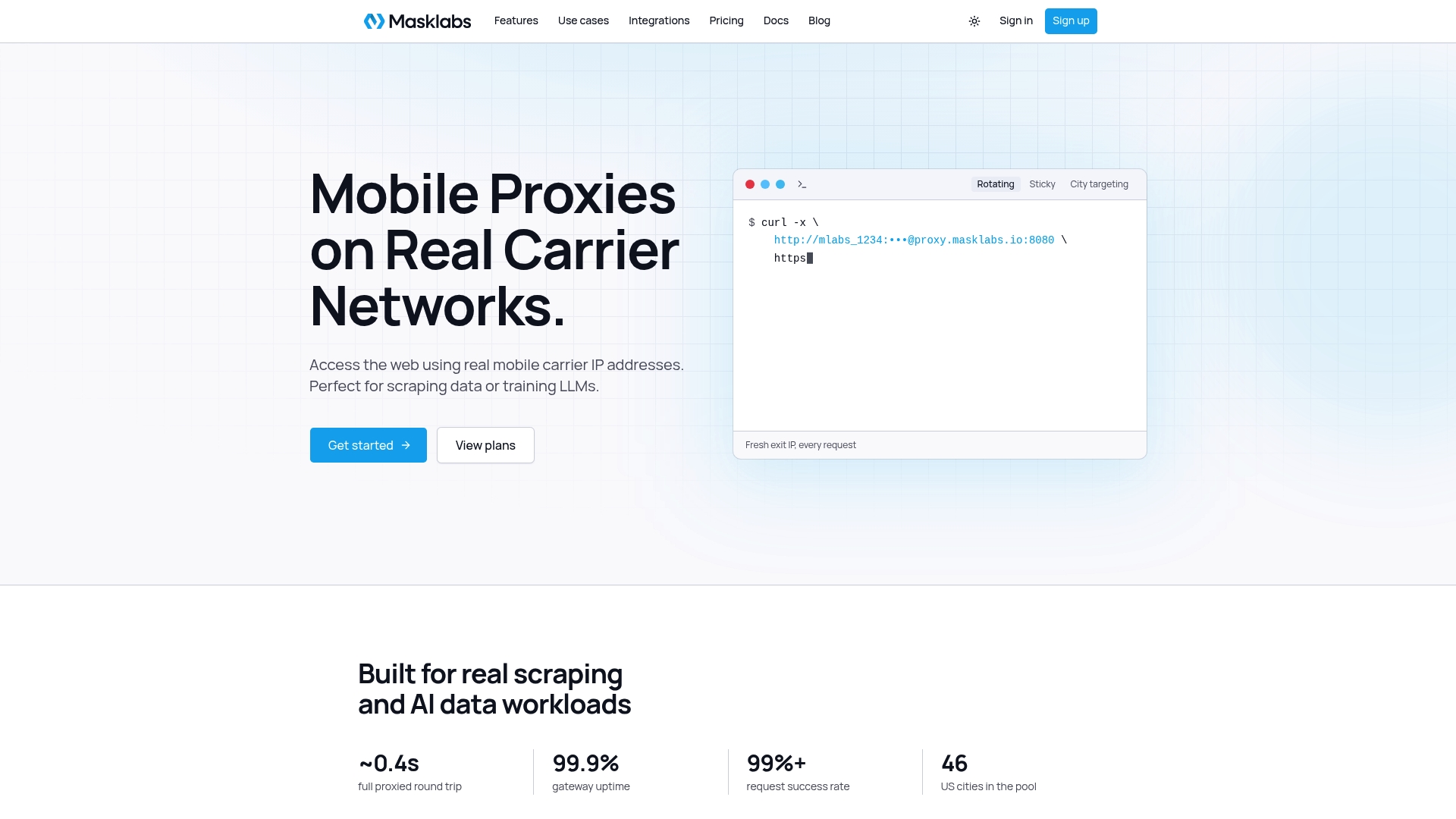
We built our service around the prevention tactics in this guide. You get real US mobile carrier IPs rather than datacenter ranges, sticky or rotating sessions, city-level geotargeting across US cities, API access, and tiered plans from Starter to Scale. It suits teams that need steady success rates on geo-targeted scraping or large-scale automation, and individual developers who want to start quickly. Compare plans on our pricing page, or see how our US mobile proxies on real carrier IPs fit your stack and start with the free trial.
FAQ
Is bypassing CAPTCHA illegal?
It depends on your jurisdiction, the site's terms and what you collect, so there is no single answer. Review the target's terms of service and applicable law, and get legal advice before running anything at scale. Reducing how often challenges appear through pacing and clean infrastructure is a different matter from defeating a protection built to keep you out.
How do CAPTCHAs stop robots?
They add a task or a risk assessment that is easy for people and awkward for scripts. Modern versions such as reCAPTCHA v3 score visitors from 0.0 (bot) to 1.0 (human) based on behavior and let site owners decide what to do with the score. Older versions show visible puzzles, as summarized in this reCAPTCHA overview.
How do I reduce CAPTCHAs on a website I scrape?
Fix the signals that cause them. Use carrier or residential IPs, keep your browser and TLS fingerprints consistent, persist cookies, and pace requests with jitter. Measure the challenge rate per 1,000 requests before and after each change so you know what worked.
Are CAPTCHAs becoming obsolete?
Not yet, but they are moving out of sight. Score-based systems judge visitors in the background and show a challenge only when risk looks high. That makes consistent, human-like traffic more valuable than ever.
Sources
- Bot Management and Anti-Automation - OWASP Cheat Sheet Series
- Developers
- Captcha Bypass - HackTricks
- En